
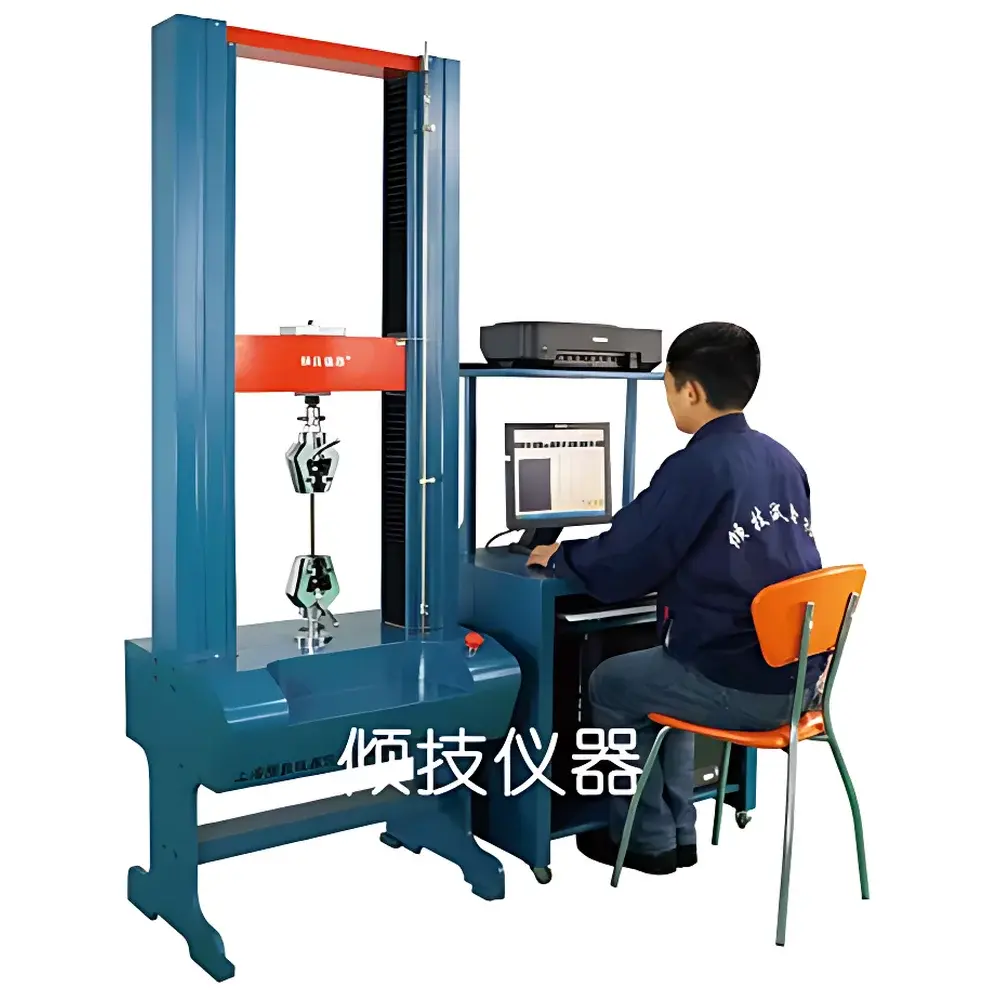
Vertical Elevator Cable Bending and Torsion Testing Machine – QJ211 Series
| Origin | Shanghai, China |
|---|---|
| Manufacturer Type | Authorized Distributor |
| Origin Category | Domestic (PRC) |
| Model | QJ211 |
| Max Torque | 0–20 kN·m |
| Torque Measurement Range | 0–20 kN·m |
| Torque Resolution | Customizable |
| Torsional Angle Measurement Range | 0–1080° (full-scale, ±0.1° repeatability) |
| Motor Power | 750 W |
| Load Capacity | 30 kN (axial) |
| Force Accuracy | ±0.5% of reading |
| Displacement Accuracy | ±0.5% of reading |
| Speed Range | 0.001–500 mm/min (closed-loop controlled) |
| Effective Test Width | 420 mm |
| Vertical Test Space (without fixtures) | 800 mm |
| Dimensions (W×D×H) | 700 × 420 × 1600 mm |
| Weight | 145 kg |
Overview
The Vertical Elevator Cable Bending and Torsion Testing Machine (Model QJ211) is a specialized electromechanical test system engineered for the dynamic mechanical evaluation of elevator traction cables, hoist ropes, and related wire rope assemblies under combined bending fatigue, torsional loading, and axial tension conditions. Designed in strict accordance with ISO 4344:2016 (Crane wires — Requirements), EN 14492-2 (Cranes — Winches — Part 2: Wire ropes, sheaves and drums), and GB/T 8903–2018 (Elevator Steel Wire Ropes), this machine replicates real-world service stresses experienced during repeated winding/unwinding over pulleys and guide sheaves. Its vertical architecture enables gravity-aligned cable routing—critical for simulating actual elevator drum and counterweight configurations—while integrating high-fidelity torque sensing, angular displacement feedback, and synchronized axial force control to capture hysteresis, residual twist, and progressive strand degradation over thousands of bending cycles.
Key Features
- Vertically oriented frame (1600 mm height) optimized for true-to-installation cable path geometry, minimizing parasitic bending moments during testing
- Dual-mode actuation: precision servo-motor (750 W, closed-loop speed control) coupled with electro-hydraulic or electromechanical axial load application (up to 30 kN)
- High-stability torque transducer with 0–20 kN·m range and ≤±0.5% full-scale linearity; resolution configurable per ASTM E251 calibration requirements
- Optical encoder-based torsional angle measurement (0–1080°, ±0.1° repeatability) synchronized with axial displacement tracking (800 mm stroke, ±0.5% accuracy)
- Modular fixture interface supporting standardized elevator cable clamps (ISO 4344-compliant jaw profiles), bend radius adapters (R = 200–1200 mm), and multi-sheave test rigs
- Integrated safety architecture: electronic travel limits, overload cutoff (>110% max torque), emergency stop circuitry compliant with IEC 60204-1
- Windows-based control software with real-time dual-axis plotting (torque vs. angle, force vs. extension), programmable cycle sequencing, and audit-trail-enabled data logging
Sample Compatibility & Compliance
The QJ211 accommodates elevator cables ranging from 6 mm to 24 mm nominal diameter—including 6×19, 6×36, 8×19, and compacted-strand constructions—as defined in ISO 2408 and GB/T 8903. Fixture sets support both single-cable and multi-cable (twin/triple) configurations used in machine-room-less (MRL) and gearless traction systems. All test protocols align with mandatory regulatory frameworks: EN 81-20/50 (Safety rules for lifts), ASME A17.1/CSA B44 (Safety Code for Elevators and Escalators), and CNCA-C11-01:2023 (China Compulsory Certification for elevator components). Data acquisition meets GLP traceability standards, with timestamped metadata, operator ID tagging, and export-ready CSV/PDF reporting compliant with ISO/IEC 17025 documentation requirements.
Software & Data Management
Control and analysis are executed via proprietary Windows-native software compliant with FDA 21 CFR Part 11 for electronic records and signatures. The platform supports user-defined test methods (e.g., ISO 17892-3 cyclic bending fatigue), automatic pass/fail evaluation against pre-set thresholds (e.g., torque decay >5% after 10⁴ cycles), and batch-level statistical summaries (mean cycles to failure, Weibull modulus estimation). Raw data streams (force, torque, angle, time) are stored in HDF5 format with embedded calibration certificates and sensor serial numbers. Export options include ASTM E122-22-compliant summary reports, trend charts for preventive maintenance scheduling, and direct integration with LIMS via OPC UA protocol.
Applications
- Validation of cable fatigue life under repeated bending over traction sheaves (per ISO 4344 Annex B)
- Quantification of torsional relaxation and residual twist accumulation in preformed vs. non-preformed ropes
- Comparative evaluation of lubricant retention performance across bending cycles
- Verification of splice integrity and termination strength under combined torsion-tension loading
- Supporting root-cause analysis of field failures through lab-replicated stress histories
- Qualification testing for new cable materials (e.g., polymer-coated, stainless steel hybrid strands)
FAQ
What standards does the QJ211 comply with for elevator cable certification?
It supports test execution per ISO 4344, EN 14492-2, GB/T 8903–2018, and EN 81-20 Annex H for bending fatigue validation.
Can the machine perform simultaneous tension-torsion-bending tests?
Yes—the vertical configuration enables fully coupled loading where axial force, rotational torque, and fixed-radius bending are applied and monitored in real time.
Is calibration documentation included with delivery?
Each unit ships with NIST-traceable calibration certificates for load cell, torque sensor, and encoder subsystems, valid for 12 months.
What maintenance intervals are recommended for long-term reliability?
Lubrication of lead screws and bearing housings every 500 operational hours; annual recalibration of all transducers is advised per ISO/IEC 17025.
Does the system support third-party software integration?
Yes—OPC UA server implementation allows bidirectional data exchange with MES, SCADA, and enterprise quality management systems.



