
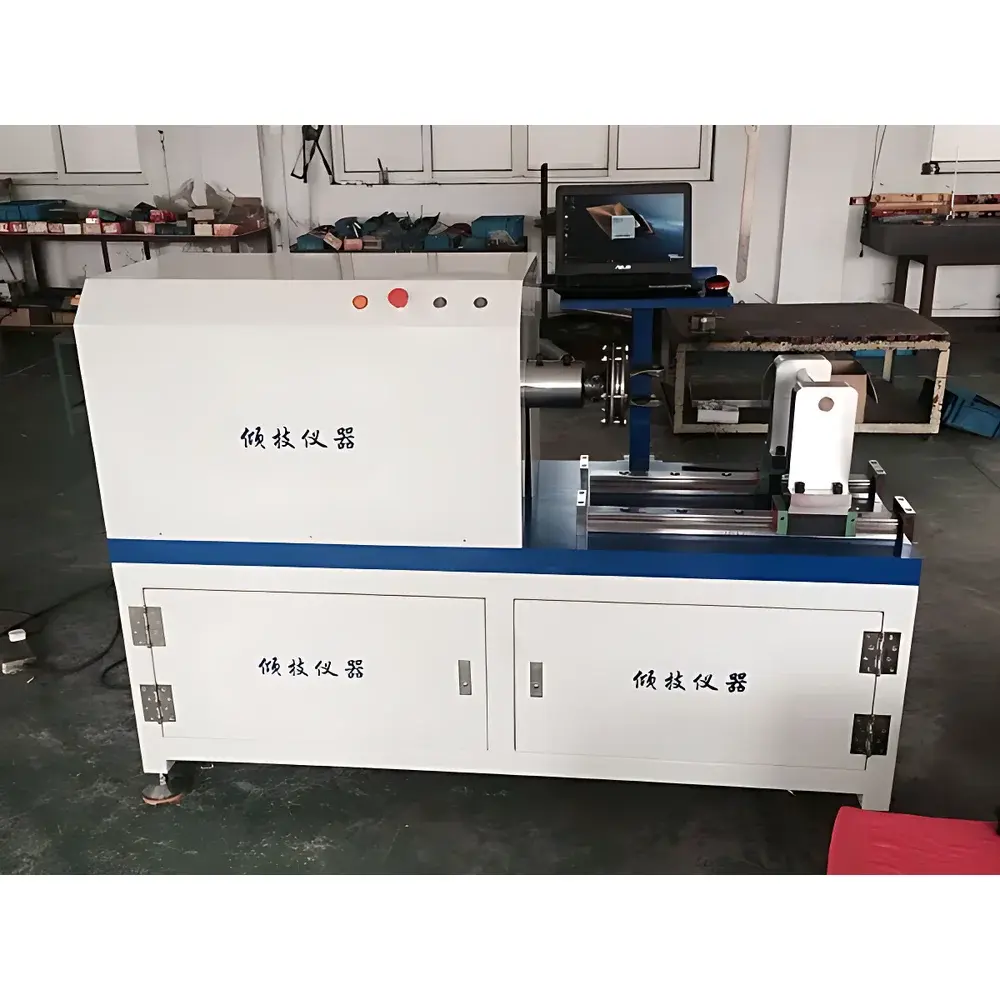
QJNZ Automotive Driveshaft Torsion Testing Machine
| Origin | Shanghai, China |
|---|---|
| Manufacturer Type | Authorized Distributor |
| Model | QJNZ |
| Price | USD 7,700 (FOB Shanghai) |
| Max Torque | 10,000 N·m |
| Torque Measurement Range | 50–5,000 N·m |
| Torque Resolution | ±0.001° (angular) |
| Torsion Angle Range | 0 to ±100,000° (4-digit digital display) |
| Motor Power | 1.5 kW |
Overview
The QJNZ Automotive Driveshaft Torsion Testing Machine is a high-capacity, precision-engineered electromechanical system designed for static and quasi-static torsional characterization of automotive driveline components—primarily propeller shafts, CV joint assemblies, universal joints, and torque tubes. It operates on the principle of controlled angular displacement under applied torque, enabling direct measurement of torsional stiffness, yield torque, ultimate torsional strength, plastic deformation behavior, and hysteresis during cyclic loading. The machine complies with core mechanical testing standards including GB/T 9370–1999 (Methods for Torsional Testing of Metallic Materials), GB/T 239–1999 (Torsion Testing of Metallic Wires), and JJG 269–1981 (Verification Regulation for Torque Measuring Instruments). Its architecture integrates a high-torque servo motor, precision planetary gearbox, dual-axis load cell with integrated angular encoder, and rigid C-frame structure engineered for minimal parasitic bending and axial deflection during high-moment testing.
Key Features
- Maximum rated torque capacity of 10,000 N·m with full-scale resolution of 1/350,000—ensuring stable, noise-immune torque measurement across the entire 50–5,000 N·m operational range without range switching or hardware reconfiguration.
- High-fidelity angular measurement system delivering ±0.001° resolution and ±0.5% relative error in torsion angle over a dynamic range of 0 to ±100,000°, supported by four-digit digital angular readout synchronized with torque acquisition.
- Variable-speed torsion actuation from 0.01°/min to 1,000°/min (infinitely adjustable), with speed accuracy maintained within ±0.2% of setpoint across the full range—critical for creep, stress-relaxation, and rate-dependent material evaluation.
- Modular gripping system accommodating specimens with diameters from Φ8 mm to Φ40 mm (extendable via custom jaw sets), with standard gauge length of 1,500 mm between chucks to meet OEM driveline dimensional requirements.
- Integrated 1.5 kW servo drive system offering high dynamic response, low thermal drift, and repeatable torque delivery—validated per ISO 2631-1 for vibration-sensitive test environments.
Sample Compatibility & Compliance
The QJNZ torsion tester supports metallic (steel, aluminum alloys, titanium), composite (carbon-fiber-reinforced polymer driveshafts), and hybrid driveline components. Specimen mounting follows standardized practices aligned with SAE J1208 (Automotive Propeller Shaft Fatigue Testing) and ISO 7800 (Torsional Testing of Metallic Materials). All torque and angular measurements are traceable to national metrological standards (CNAS-accredited calibration certificates available). The system meets functional safety requirements per ISO 13857 and incorporates emergency stop circuitry compliant with IEC 60204-1. Data integrity protocols support GLP/GMP-aligned audit trails when paired with validated software modules.
Software & Data Management
Control and analysis are executed via proprietary virtual instrumentation software built on a real-time Windows OS platform. The application provides closed-loop PID control of torque or angular position, synchronized multi-channel data acquisition at up to 1 kHz sampling rate, automated test sequencing (including stepwise torque ramping, hold periods, and reverse-torque cycling), and post-processing tools for calculating shear modulus (G), non-proportional limit torque, torsional yield strength, and energy absorption. Reports are exportable in PDF, CSV, and XML formats—with embedded metadata (operator ID, timestamp, calibration ID, environmental conditions) to satisfy FDA 21 CFR Part 11 electronic record requirements. Optional API integration enables linkage with LIMS or MES platforms.
Applications
- Validation of OEM design specifications for front-wheel, rear-wheel, and all-wheel drive propeller shafts.
- Quality conformance testing per incoming inspection protocols for forged, welded, and composite shaft subassemblies.
- Failure mode analysis—including torsional buckling, spline wear initiation, and CV joint angular misalignment effects.
- Material qualification of new alloy grades or surface treatments (e.g., nitriding, shot peening) under torsional loading.
- Research into torsional damping characteristics of elastomeric couplings and hydraulic torque converters.
FAQ
What standards does this machine comply with for automotive component validation?
It conforms to GB/T 9370–1999, GB/T 239–1999, JJG 269–1981, and supports method development aligned with SAE J1208 and ISO 7800.
Can the system perform cyclic torsion fatigue testing?
Yes—the software supports programmable sinusoidal, triangular, and trapezoidal waveforms with user-defined amplitude, frequency, and mean torque offset; however, dedicated high-cycle fatigue configurations require optional thermal management and extended-duty motor packages.
Is torque calibration traceable to international standards?
All factory calibrations are performed using NIST-traceable reference torque transducers, with CNAS-accredited calibration certificates issued upon request.
What is included in the standard warranty and service support?
The system carries a 12-month parts-and-labor warranty; lifetime technical support and spare parts availability are guaranteed, with on-site commissioning and operator training provided at no additional cost.
Does the machine support third-party software integration?
Yes—via TCP/IP and OPC UA interfaces; SDK documentation and sample code for Python, LabVIEW, and MATLAB are supplied with the system.



