
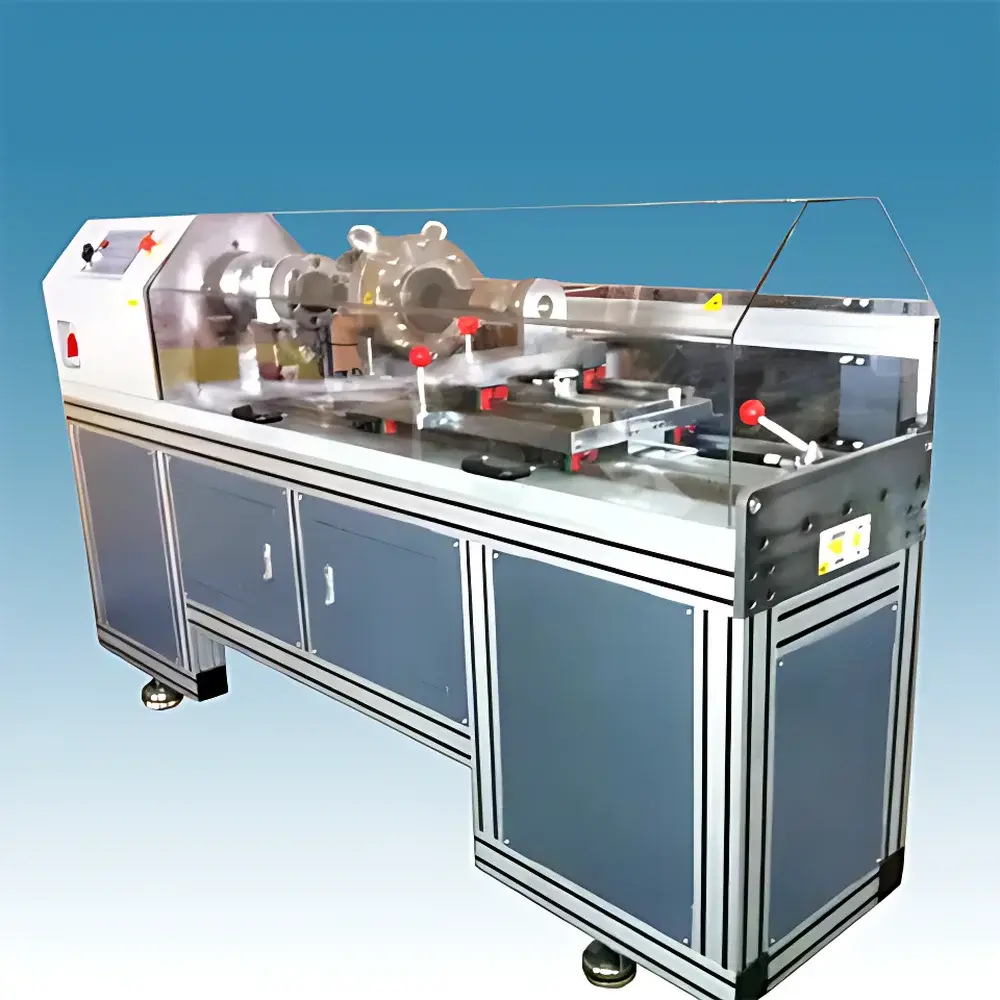
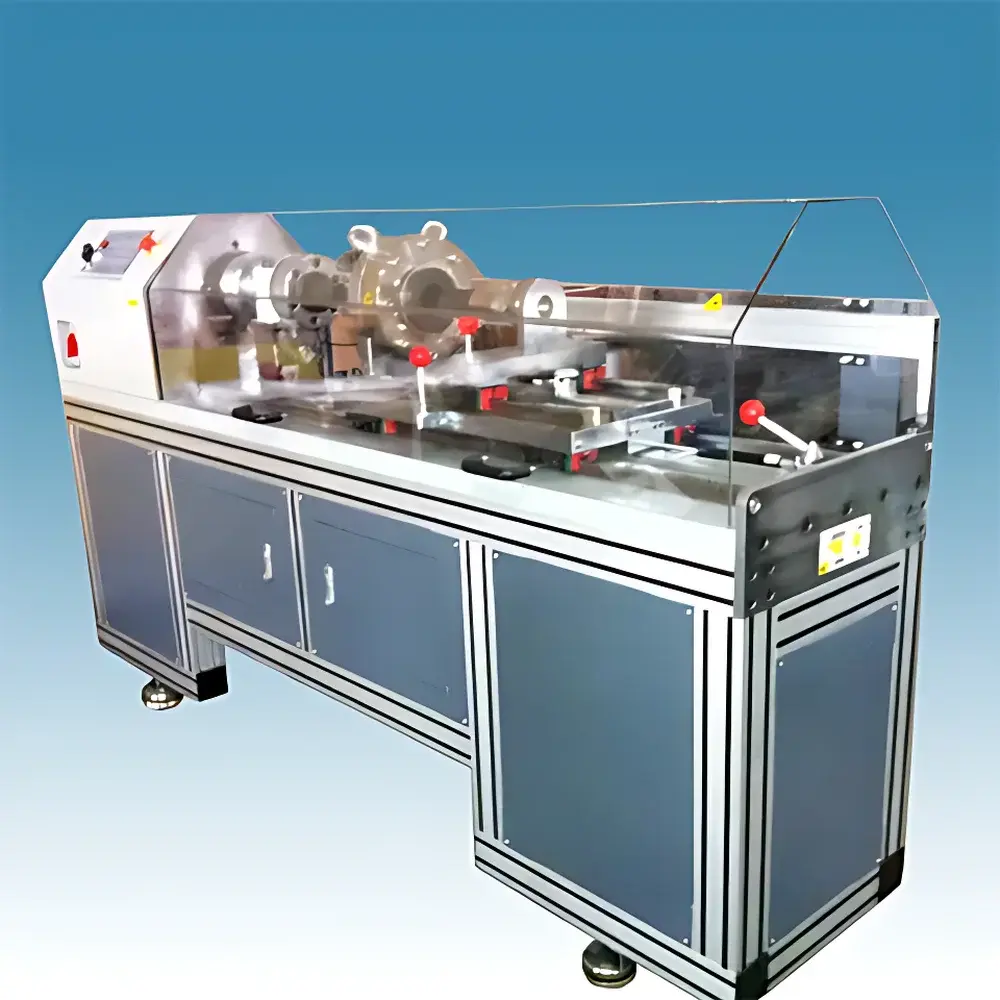
Hengyi HY-1000N·m Stainless Steel Bolt and Nut Friction Coefficient Tester – Torsion Testing Machine for Fastener Mechanical Characterization
| Brand | Hengyi |
|---|---|
| Origin | Shanghai, China |
| Manufacturer Type | Direct Manufacturer |
| Product Origin | Domestic (China) |
| Model | HY-1000N·mU7JKJ |
| Max Torque | 1000 N·m |
| Torque Measurement Range | 1–1000 N·m |
| Torque Resolution | 1/500,000 |
| Twist Angle Measurement Range | 0–100,000° (or continuous) |
| Motor Power | 5 kW |
| Axial Force Range | 3–300 kN |
| Torque Accuracy | ±1% FS (typ. ±0.5%) |
| Angular Position Accuracy | ±1% FS (typ. ±0.5%) |
| Rotational Speed Accuracy | ±0.5% |
| Clampable Thread Sizes | M8–M22 (customizable) |
| Gauge Length | 600 mm |
| Dimensions (L×W×H) | ~1800 × 540 × 1250 mm |
| Weight | 1800 kg |
Overview
The Hengyi HY-1000N·m Stainless Steel Bolt and Nut Friction Coefficient Tester is a high-precision torsion testing system engineered for quantitative mechanical characterization of threaded fasteners under controlled torque-tension conditions. Based on the principle of simultaneous dual-sensor measurement—high-accuracy torque transducers and calibrated axial load cells—the instrument enables independent determination of thread friction torque, bearing surface friction torque, and total applied torque during controlled angular displacement. It operates in accordance with the fundamental mechanics described in ISO 16047:2005 (“Mechanical properties of fasteners — Determination of torque/clamp force characteristics”) and GB/T 3098.9–2002 (“Mechanical properties of fasteners — Fatigue testing”). The system employs a 32-bit ARM-based embedded controller, Japanese AC digital servo drive, precision planetary gearbox, and high-resolution optical encoder to achieve stable rotational control from 0.01°/min to 1000°/min (adjustable), ensuring reproducible kinematic profiles across static, quasi-static, and dynamic loading regimes.
Key Features
- Simultaneous real-time acquisition of axial clamping force (3–300 kN), total torque (1–1000 N·m), and twist angle (0–100,000° or continuous) with synchronized sampling at ≥1 kHz
- Dual-torque decomposition capability: independent measurement of thread torque and bearing surface torque via calibrated split-load path architecture
- Torque resolution of 1/500,000 full scale and verified accuracy of ±0.5% FS (better than ISO 16047 Class 1 requirement)
- High-stiffness mechanical frame (1800 kg mass, rigid cast-iron base) minimizing parasitic deflection during high-torque testing
- Bi-directional torsional actuation (clockwise/counterclockwise) with programmable dwell, ramp, step, and cyclic profiles
- Modular jaw design accommodating standard metric threads M8–M22; optional adapters available for non-standard or custom fastener geometries
- Integrated safety interlocks, emergency stop circuitry, and overload protection compliant with IEC 61800-5-2 for drive systems
Sample Compatibility & Compliance
The tester is validated for use with stainless steel, alloy steel, titanium, and nickel-based superalloy bolts, nuts, and stud assemblies per ISO 898-1, ASTM F568M, and DIN 933/934. Its mechanical architecture supports both single-turn tightening tests (for K-factor and μthread/μbearing derivation) and multi-cycle torsional fatigue protocols (e.g., low-cycle fatigue per ASTM E606). All hardware and firmware comply with electromagnetic compatibility (EMC) standards EN 61326-1 and functional safety requirements per ISO 13849-1 PL e. Data integrity mechanisms—including audit-trail-enabled test logs, timestamped raw channel exports, and user-access-controlled parameter locking—are aligned with GLP and GMP documentation practices. Calibration certificates traceable to CNAS-accredited national metrology institutes are provided with each unit.
Software & Data Management
The proprietary Hengyi TestMaster™ software (v4.2+) runs on Windows 10/11 x64 platforms and provides full control over test sequencing, real-time visualization, and post-processing. It supports automated calculation of critical fastener parameters including: torque coefficient (K), total friction coefficient (μtotal), thread friction coefficient (μthread), bearing surface friction coefficient (μbearing), yield torque, ultimate torque, proof load, and elastic-plastic transition angle. Raw data export is available in CSV, Excel (.xlsx), and universal HDF5 formats. The software includes built-in report templates conforming to ISO 16047 Annex A and GB/T 3098.9 Clause 7, with configurable digital signatures and electronic record retention compatible with FDA 21 CFR Part 11 requirements when deployed with network authentication and role-based access controls.
Applications
This torsion tester serves as a primary qualification tool in R&D labs and QC departments across aerospace (e.g., airframe fastener validation per SAE AS7210), automotive (engine assembly torque verification per VW TL 211), energy (nuclear-grade bolt preload monitoring), and medical device manufacturing (implant-grade titanium fastener certification). It supports failure mode analysis—including galling onset detection, thread stripping thresholds, and relaxation behavior under sustained torque—and enables correlation studies between surface finish (Ra, Rz), lubrication type (molybdenum disulfide, zinc flake, dry film), and resulting frictional response. The system is routinely used to validate tightening process windows for electric powertrain assembly lines and to support PPAP submissions requiring statistical process control (SPC) of torque-tension relationships.
FAQ
Does the system support automated K-factor calculation per ISO 16047?
Yes—TestMaster™ automatically computes K = (T × 1000) / (F × d) using synchronized torque (T, N·m), axial force (F, kN), and nominal diameter (d, mm) inputs, with uncertainty propagation per GUM guidelines.
Can it measure friction coefficients separately for thread and bearing surfaces?
Yes—using dual-load-path calibration and ISO 16047 Annex B methodology, the system decomposes total torque into thread and bearing components to derive μthread and μbearing independently.
Is the software compliant with FDA 21 CFR Part 11 for regulated environments?
When configured with domain authentication, electronic signatures, and audit-trail logging enabled, the software meets core Part 11 requirements for electronic records and signatures.
What is the maximum clamping length for large-diameter fasteners?
The standard gauge length is 600 mm; extended column options up to 1200 mm are available upon request for long studs or flanged connections.
Do you provide calibration and traceability documentation?
All torque and force sensors ship with individual calibration certificates traceable to NIM (National Institute of Metrology, China) or equivalent NMIs, valid for 12 months under normal operating conditions.



