
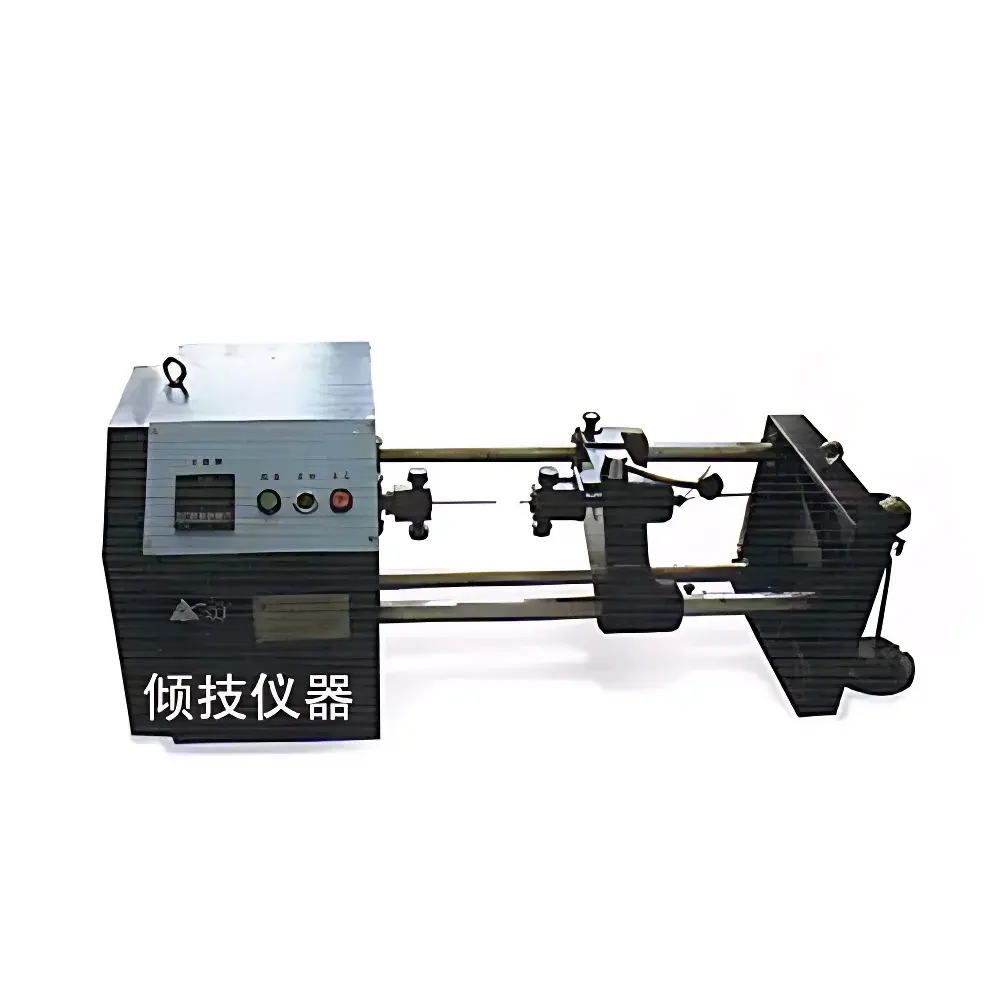
Qinji QJNZ-3/6 Metal Wire Winding and Torsion Testing Machine
| Brand | Qinji |
|---|---|
| Origin | Shanghai, China |
| Model | QJNZ-3/6 |
| Max Torque | 350 N·m |
| Torque Measurement Range | 0.2–350 N·m |
| Torque Resolution | 0.1 N·m (typical for class 1 torsion systems) |
| Twist Angle Range | 0–9999 revolutions (electronic digital counter) |
| Specimen Diameter Range | Ø0.1–Ø3.0 mm |
| Gauge Length Adjustment | 0–300 mm |
| Pre-tension Force Range | 0.2–350 N |
| Rotational Speed Options | 60 / 90 / 120 / 180 / 300 rpm |
| Motor Power | 250 W, 380 V AC |
| Dimensions (L×W×H) | 1150 × 410 × 460 mm |
| Net Weight | ~200 kg |
| Compliance | GB/T 239–1999 |
Overview
The Qinji QJNZ-3/6 Metal Wire Winding and Torsion Testing Machine is a precision-engineered mechanical testing system designed to evaluate the torsional ductility, surface integrity, and structural homogeneity of metallic wire specimens under controlled rotational stress. Based on the Chinese national standard GB/T 239–1999 (equivalent in scope to ISO 7800:2012 and ASTM E1441 for torsion testing of wires), this instrument applies quantifiable torque to linear metallic specimens while measuring angular displacement, failure revolution count, and surface deformation characteristics. The machine operates via a digitally regulated AC servo motor coupled with a high-rigidity frame, enabling bidirectional or unidirectional torsion sequences—including single-cycle reversal—within programmable revolution limits. Its primary output metric is the number of complete rotations prior to fracture, interpreted alongside post-test visual inspection of surface cracking, necking, or delamination to assess material plasticity and microstructural uniformity.
Key Features
- Programmable torsion modes: unidirectional rotation, bidirectional reversal (single-cycle), and multi-cycle alternating twist—each configurable via front-panel digital interface
- Electronic digital revolution counter with 4-digit display (0–9999 rev), auto-reset and hold functions for precise failure-point capture
- Adjustable gauge length (0–300 mm) accommodates diverse specimen geometries without mechanical reconfiguration
- Pre-tension force control (0.2–350 N) ensures consistent axial loading during twisting, minimizing slippage and improving repeatability
- Five discrete rotational speed settings (60, 90, 120, 180, 300 rpm) allow selection based on material response kinetics and standard compliance requirements
- Dedicated wire-unlay (strand separation) functionality for steel rope analysis—enabling evaluation of individual wire integrity within multi-strand assemblies
- Robust cast-iron base and reinforced aluminum alloy housing provide vibration damping and long-term dimensional stability
- Integrated safety interlock system halts operation upon door opening or abnormal torque overload detection
Sample Compatibility & Compliance
The QJNZ-3/6 accepts solid round metallic wires ranging from Ø0.1 mm to Ø3.0 mm in diameter—including copper, aluminum, stainless steel, spring steel, and galvanized carbon steel. It supports both bare and coated wire forms, provided coating adhesion does not compromise torsional fracture behavior. Test execution adheres strictly to GB/T 239–1999, which defines specimen preparation, clamping geometry, speed tolerances, and pass/fail criteria based on visible surface defects after specified revolution counts. While not certified to ISO/IEC 17025, the system’s mechanical design, torque calibration traceability (via external load cell verification), and documented operational procedures support GLP-compliant laboratory workflows. Optional calibration certificates (NIST-traceable torque standards) are available upon request for audit-ready environments.
Software & Data Management
This model operates as a standalone benchtop instrument with embedded firmware—no PC dependency required for basic operation. All test parameters (speed, direction, target revolutions, pre-tension) are set and stored locally via membrane keypad and LED display. For laboratories requiring electronic records, optional RS-232 or USB-to-serial interface enables real-time data streaming to third-party acquisition software (e.g., LabVIEW, MATLAB, or custom Python scripts). Exported logs include timestamp, applied torque (averaged per revolution), cumulative rotation count, and operator ID fields—supporting 21 CFR Part 11-aligned audit trails when paired with validated host software and user access controls. Raw data files are saved in CSV format for downstream statistical analysis (e.g., Weibull distribution fitting for failure probability modeling).
Applications
- Quality assurance of drawn copper wire for electrical cable manufacturing
- Evaluation of cold-drawn stainless steel wire used in medical guidewires and orthodontic archwires
- Process validation of zinc-coated steel wire in galvanizing line optimization
- Comparative ductility assessment between heat-treated and annealed spring wire batches
- Failure mode analysis of aluminum alloy wire subjected to cyclic torsion in aerospace harness applications
- Strand-level integrity testing of 7×7 and 7×19 steel ropes during production certification
- Research into grain boundary effects on torsional fracture initiation in ultrafine-grained metals
FAQ
Does the QJNZ-3/6 comply with international torsion testing standards beyond GB/T 239?
Yes—its mechanical architecture and measurement methodology align with the functional intent of ISO 7800:2012 and ASTM E1441, though formal certification requires third-party verification per local regulatory requirements.
Can the machine perform continuous cyclic torsion (e.g., ±180° for 10,000 cycles)?
No—it supports only single forward/reverse cycles up to 9999 revolutions; it is not designed for high-frequency fatigue testing.
Is torque calibration performed at the factory, and is recalibration supported in-field?
Each unit ships with a factory torque verification report; users may perform routine verification using calibrated dead-weight torque standards—full recalibration requires return to authorized service center.
What maintenance intervals are recommended for long-term accuracy?
Lubrication of lead screws and bearing inspection every 12 months; belt tension check every 6 months; digital counter battery replacement every 3 years.
Is technical documentation available in English for global installation and operation?
Yes—comprehensive English-language user manual, wiring diagrams, and GB/T 239–1999 cross-reference guide are included with shipment.



