
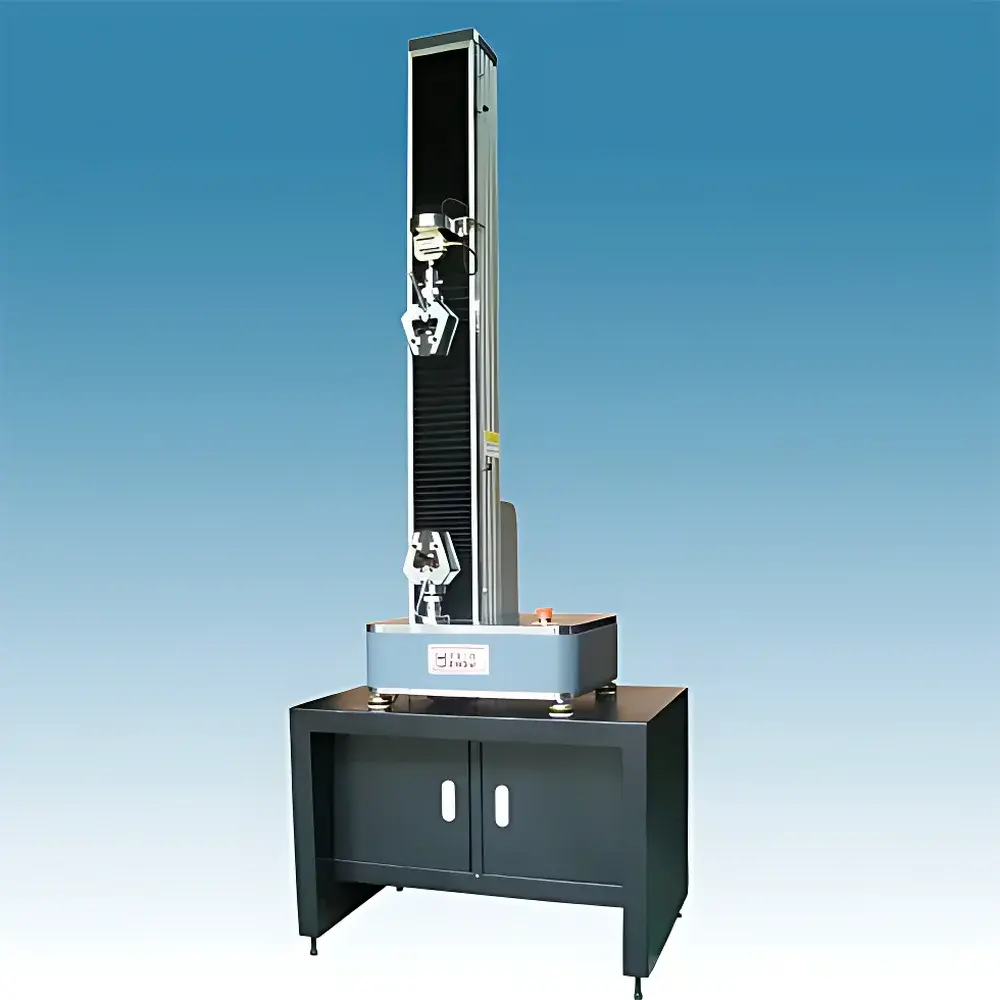
Hengyi HY-0580RTTT Single-Column Tensile Testing Machine for Filamentous Biomaterials (e.g., Lotus Root Fibers)
| Brand | Hengyi / Hengyitest |
|---|---|
| Origin | Shanghai, China |
| Manufacturer Type | Direct Manufacturer |
| Regional Category | Domestic (China) |
| Model | HY-0580RTTT |
| Price Range | USD 2,800 – 7,200 |
| Instrument Type | Electromechanical Tensile Tester |
| Maximum Test Load | 5 kN |
| Force Measurement Range | 0.001–100% of Full Scale |
| Force Accuracy | ±0.5% FS |
| Stroke | 800 mm |
| Displacement Resolution | 0.001 mm |
| Load Cell Accuracy | ±0.01% FS |
| Measuring Accuracy | <±1% |
| Speed Range | 0.001–500 mm/min (adjustable in real time) |
| Speed Accuracy | ±0.5% |
| Displacement Accuracy | ±0.5% |
| Deformation Measurement Accuracy | ±0.5% |
| Effective Width | 150 mm |
| Unit Weight | ~95 kg |
| Power Supply | 220 V AC |
| Dimensions (W×D×H) | 590 × 355 × 1640 mm |
| Safety Features | Electronic stroke limit protection, emergency stop button |
| Control Mode | Full PC-based control with VB+SQL data processing engine |
Overview
The Hengyi HY-0580RTTT is a precision-engineered single-column electromechanical tensile testing machine specifically configured for high-reproducibility mechanical characterization of low-to-medium strength filamentous and fibrous biomaterials—most notably lotus root fibers, but also applicable to plant-derived cellulose filaments, alginate strands, chitosan threads, and other hydrated or semi-rigid natural polymers. It operates on the principle of controlled uniaxial force application via a servo-controlled ball-screw actuator, enabling static and quasi-static mechanical testing under ISO 527, ASTM D638, ASTM D3039, ISO 6892-1, and GB/T 228.1 compliant conditions. The system delivers calibrated load measurement through a high-stability load cell (±0.01% FS accuracy), synchronized with sub-micron displacement tracking (0.001 mm resolution) and real-time strain acquisition. Designed for laboratory environments where space efficiency, operational repeatability, and traceable metrology are critical, the HY-0580RTTT integrates seamlessly into quality assurance workflows across academic research labs, food science institutes, biopolymer development centers, and regulatory-compliant material testing facilities.
Key Features
- Single-column rigid frame architecture optimized for compact benchtop deployment (590 × 355 × 1640 mm), minimizing footprint without compromising structural stiffness.
- Full-range adjustable crosshead speed from 0.001 to 500 mm/min, supporting both slow-rate viscoelastic creep tests and rapid fracture evaluation—each velocity maintained within ±0.5% tolerance.
- Simultaneous acquisition of load, large deformation (via extensometer or encoder), small deformation (optional clip-on extensometer), and absolute crosshead displacement—time-synchronized at 1 kHz sampling rate.
- Real-time stress–strain curve rendering with auto-scaling axes, dynamic zoom, and interactive parameter extraction (e.g., yield point, linear elastic modulus, breaking elongation, toughness area).
- Programmable test protocols including load-hold, displacement-hold, cyclic loading (low-cycle fatigue up to 10⁴ cycles), and conditional termination (e.g., fracture detection via slope threshold, pre-set load/strain limits).
- Comprehensive safety subsystem: dual-channel electronic stroke limit switches, hardware-triggered emergency stop circuitry, and software-enforced operational boundaries.
- PC-based control interface built on VB.NET with embedded SQL database backend—ensuring audit-ready data integrity, user-defined method templates, and export compatibility with CSV, Excel, and PDF formats.
Sample Compatibility & Compliance
The HY-0580RTTT accommodates specimens ranging from 10 mm to 300 mm gauge length, with clamping options tailored for delicate, slippery, or hygroscopic filaments—including pneumatic self-tightening grips, serrated wedge grips, and custom-designed fiber-holding fixtures. Its force range (0.001–5 kN) and displacement capacity (800 mm stroke) make it suitable for tensile, compression, peel, tear, and flexural testing of non-metallic materials per ISO 179, ISO 178, ASTM D882, ASTM D1876, and YY/T 0127 series standards. The instrument meets essential requirements for GLP-compliant testing environments, supporting configurable user access levels, electronic signature capability, and full audit trail generation for FDA 21 CFR Part 11 readiness when deployed with validated software modules. Calibration certificates traceable to NIM (National Institute of Metrology, China) or equivalent national metrology institutes are provided upon request.
Software & Data Management
The proprietary Hengyi TestMaster™ software suite provides a deterministic, deterministic test execution environment with zero reliance on third-party runtime dependencies. All test parameters—including ramp rates, dwell durations, trigger conditions, and pass/fail criteria—are stored as encrypted XML method files, enabling strict version control and method revalidation. Raw data is written directly to a local SQLite database with timestamped metadata (operator ID, environmental conditions, calibration status), ensuring full traceability. Reporting templates comply with ISO/IEC 17025 documentation requirements: automatic inclusion of uncertainty budgets (based on load cell and encoder specifications), statistical summaries (mean, SD, CV%), and graphical overlays for inter-batch comparison. Export functions support direct integration with LIMS platforms via ODBC connectivity or RESTful API extensions.
Applications
- Mechanical phenotyping of edible plant fibers (lotus root, konjac, bamboo shoot) for texture optimization in functional foods and plant-based meat analogs.
- Characterization of hydrogel-based sutures, wound dressings, and tissue engineering scaffolds under physiological hydration states.
- Quality control of biodegradable packaging filaments (PLA, PHA, starch composites) in accordance with QB/T 4872 and ISO 14855 standards.
- Research-grade tensile mapping of regenerated cellulose fibers (e.g., lyocell, viscose) for textile R&D and sustainability benchmarking.
- Validation of adhesive bond strength in medical device assembly (e.g., catheter tubing lamination, sensor encapsulation).
- Educational use in undergraduate materials science laboratories for hands-on instruction in stress–strain theory, Hooke’s law verification, and fracture mechanics fundamentals.
FAQ
What types of biological filaments are most commonly tested on the HY-0580RTTT?
Lotus root fibers, rice straw filaments, seaweed-derived alginates, fungal mycelium ribbons, and electrospun collagen nanofibers—particularly those requiring low-force (<5 kN), high-resolution displacement measurement under ambient or controlled humidity conditions.
Does the system support ASTM D3822 for single-filament tensile testing?
Yes—the machine’s 0.001 mm displacement resolution, sub-gram force sensitivity, and optional micro-grip kits satisfy all dimensional and metrological requirements specified in ASTM D3822-22 for individual filament evaluation.
Can test methods be exported and shared across multiple instruments?
Absolutely. Method files (.hym) are portable, versioned, and digitally signed—enabling identical protocol replication across distributed lab networks without recalibration or manual reconfiguration.
Is remote diagnostics or firmware update capability available?
Firmware updates are performed locally via USB; remote diagnostic support is available through secure TLS-encrypted VNC sessions initiated by authorized service engineers upon customer consent.
What maintenance intervals are recommended for long-term accuracy retention?
Biannual verification of load cell linearity and displacement encoder calibration is advised; routine lubrication of the ball screw (with lithium-based grease mixed with light mineral oil) every 500 operational hours ensures optimal mechanical fidelity.



