
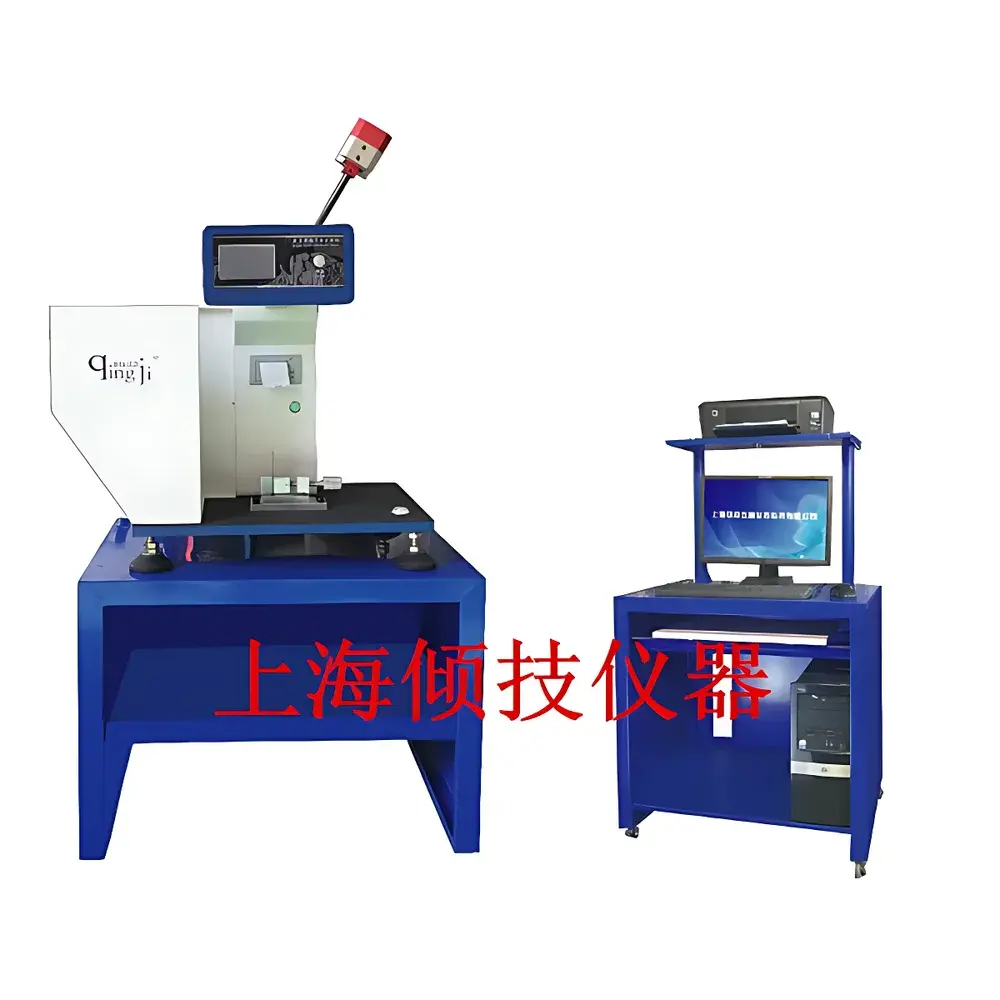
Qinji QJCBJ Pendulum Impact Tester
| Brand | Qinji |
|---|---|
| Origin | Shanghai, China |
| Manufacturer Type | Authorized Distributor |
| Country of Origin | China |
| Model | QJCBJ |
| Price Range | USD 1,400 – 2,800 (FOB Shanghai) |
| Instrument Type | Pendulum Impact Tester |
| Nominal Impact Energy Range | 0–300 J |
| Impact Velocity | 3.8 m/s |
| Standard Impact Energies | 0.5 J, 1 J, 2 J, 4 J, 5 J |
| Pendulum Pre-lift Angle | 150° |
| Distance from Pivot to Strike Center | 395 mm |
| Operating Temperature | 15–35 °C |
| Power Supply | 220 V ±10%, 50 Hz |
| Display | Chinese-language LCD with manual button control, automatic angular and energy readout |
| Compliance | ISO 179-1, GB/T 1043.1, GB/T 2611, JB/T 8762 |
Overview
The Qinji QJCBJ Pendulum Impact Tester is a manually operated, gravity-driven Charpy/Izod-compatible impact testing system engineered for the quantitative determination of notched and unnotched impact toughness in rigid non-metallic materials. Based on classical pendulum impact mechanics—where potential energy is converted into kinetic energy upon release—the instrument measures the energy absorbed by a specimen during fracture under standardized loading conditions. Its robust cast-iron base, precision-machined pendulum arm, and calibrated anvil geometry ensure high reproducibility across repeated tests. Designed explicitly for laboratory and quality control environments, the QJCBJ complies fully with internationally recognized test standards including ISO 179-1 (Plastics — Determination of Charpy impact properties), GB/T 1043.1 (Chinese national standard equivalent to ISO 179-1), GB/T 2611 (General requirements for testing machines), and JB/T 8762 (Mechanical impact testing machines for plastics). The system supports both Charpy and Izod configurations via interchangeable fixtures, enabling direct comparison with legacy datasets and regulatory submissions.
Key Features
- Gravity-driven pendulum mechanism with fixed impact velocity of 3.8 m/s at the point of strike—ensuring consistent kinetic energy delivery per ASTM D6110 and ISO 179-1 specifications.
- Five discrete nominal impact energy settings (0.5 J, 1 J, 2 J, 4 J, 5 J) selectable via pendulum mass and radius configuration; extended range up to 300 J available with optional heavy-duty pendulum assembly.
- Integrated Chinese-language LCD display with real-time angular position feedback and automatic energy calculation—eliminating manual interpolation and reducing operator-induced error.
- Precision-ground anvil and support blocks conforming to ISO 179-1 dimensional tolerances (±0.05 mm), ensuring repeatable notch alignment and support span (40 mm for Charpy, 62 mm for Izod).
- Stable cast-iron frame with vibration-damping feet, minimizing energy loss due to structural resonance during impact event.
- 150° pre-lift angle ensures full gravitational acceleration profile and eliminates spring-assisted or motorized release artifacts common in semi-automatic systems.
Sample Compatibility & Compliance
The QJCBJ accommodates standard rectangular bars (e.g., 80 × 10 × 4 mm for Charpy, 63.5 × 12.7 × 3.2 mm for Izod) as defined in ISO 179-1 and GB/T 1043.1. It is routinely deployed for impact evaluation of thermoplastics (e.g., ABS, PC, PP), fiber-reinforced composites (glass-fiber nylon, carbon-PP), rigid PVC, ceramic tiles, laminated phenolics, and electrical insulating materials. All mechanical dimensions—including strike center distance (395 mm), pendulum radius, and anvil geometry—meet metrological traceability requirements for GLP-compliant laboratories. Test reports generated using this system satisfy documentation prerequisites for ISO/IEC 17025 accreditation when paired with verified calibration certificates (available upon request) and routine verification per GB/T 2611 Annex B.
Software & Data Management
While the base QJCBJ model operates without proprietary software, its analog energy readout and angular encoder output are compatible with third-party DAQ systems (e.g., National Instruments USB-6009, Keysight 34972A) for digital logging and statistical analysis. Optional RS-232 or USB-to-TTL interface modules enable automated data export to Excel or LIMS platforms. For regulated environments, users may integrate the instrument into 21 CFR Part 11–compliant workflows by pairing it with validated electronic lab notebooks (ELNs) that enforce audit trails, user authentication, and electronic signatures during result entry and report generation.
Applications
- Quality assurance of injection-molded plastic components in automotive and consumer electronics supply chains.
- Material qualification for medical device housings requiring documented impact resistance per ISO 10993-1.
- R&D screening of polymer blends and nanocomposites where notch sensitivity correlates with long-term fatigue performance.
- Failure analysis of brittle ceramics and sintered oxides in aerospace thermal barrier applications.
- Educational use in university polymer engineering labs for hands-on instruction in fracture mechanics fundamentals.
FAQ
Does the QJCBJ meet ISO 179-1 and GB/T 1043.1 certification requirements?
Yes—the mechanical design, energy calibration methodology, and fixture geometry are fully aligned with both standards. Calibration certificates traceable to NIM (National Institute of Metrology, China) are available separately.
Can the instrument be configured for both Charpy and Izod tests?
Yes—standard configuration includes interchangeable anvils and clamps supporting both test modes per ISO 179-1 Annex A (Charpy) and Annex B (Izod).
Is technical support available after purchase?
Qinji provides on-site commissioning, operator training, and annual verification services through authorized regional partners. Lifetime spare parts availability is guaranteed for all mechanical components.
What environmental conditions are required for valid test results?
Testing must be conducted within 15–35 °C ambient temperature and ≤70% relative humidity, per ISO 291 conditioning requirements for plastics prior to impact testing.
How often does the pendulum require recalibration?
Annual verification against certified reference specimens (e.g., ISO 179-2 reference bars) is recommended; more frequent checks are advised if used >50 tests/week or following mechanical shock events.



