
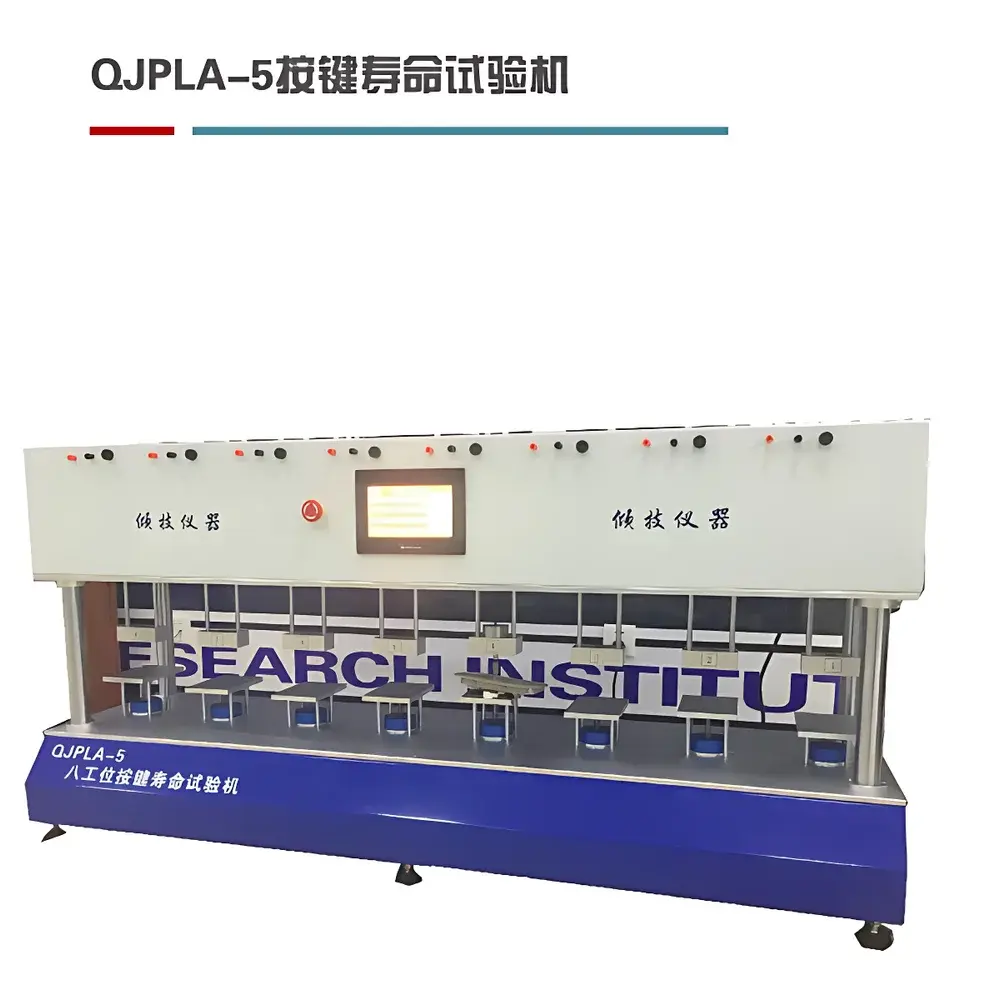
Qinji QJPLA-5 Eight-Station Keypad Fatigue Testing Machine
| Brand | Qinji |
|---|---|
| Origin | Shanghai, China |
| Model | QJPLA-5 |
| Test Stations | 8 |
| Stroke Range | 0–50 mm (adjustable) |
| Vertical Travel | 10 mm |
| Test Speed | 1–360 cycles/min (adjustable) |
| Test Load Options | 50 g, 100 g, 200 g, 300 g calibrated weights |
| Actuation Mechanism | Linear bearing-guided vertical compression |
| Conductivity Detection | Real-time electrical continuity monitoring with automatic halt on open-circuit |
| Counter Range | 0–99,999,999 cycles (8-digit programmable stop) |
| Probe Mounting Height Adjustment | 0–150 mm |
| Test Platform Dimensions | 80 mm × 80 mm |
| Power Supply | 220 V AC, 50 Hz |
| Compliance | Designed for ISO 9001-aligned quality control environments and in-house reliability validation per IEC 60651 / GB/T 15267 standards |
Overview
The Qinji QJPLA-5 Eight-Station Keypad Fatigue Testing Machine is an electromechanical durability evaluation system engineered for high-reproducibility mechanical cycling of tactile input components—primarily membrane switches, rubber dome keypads, mechanical pushbuttons, and capacitive button overlays used in consumer electronics, medical devices, industrial HMI panels, and automotive control interfaces. It operates on a controlled linear compression principle: a vertically actuated probe applies repeatable normal force via calibrated deadweight loads while maintaining precise positional repeatability through linear bearing guidance. The machine executes discrete, programmable press-and-release cycles at user-defined frequency and stroke depth, enabling quantitative assessment of functional lifespan under simulated operational stress. Unlike generalized servo-driven fatigue testers, the QJPLA-5 integrates native conductivity verification—monitoring real-time circuit closure during each actuation—to detect failure modes such as contact oxidation, dome collapse, or adhesive delamination before mechanical end-of-life occurs.
Key Features
- Eight independent test stations: Simultaneous evaluation of up to eight identical or heterogeneous samples under identical environmental and parametric conditions—significantly improving throughput for batch qualification and comparative analysis.
- Precisely adjustable test parameters: Cycle rate (1–360 cpm), stroke depth (0–50 mm), and dwell time (configurable via external timer integration) are digitally set and retained across sessions.
- Calibrated mechanical loading: Four standardized weight options (50 g, 100 g, 200 g, 300 g) ensure traceable, gravity-based force application without dynamic amplification or hysteresis—critical for compliance with tactile feedback specifications in IEC 61000-4-2 and UL 61000-1-2.
- Integrated electrical continuity detection: Built-in low-voltage (<5 V DC), high-impedance continuity sensing circuit halts testing immediately upon loss of conductive path—enabling failure root-cause correlation between mechanical wear and electrical degradation.
- Linear bearing motion architecture: Minimizes lateral deviation (1 million cycles).
- Programmable 8-digit cycle counter: Supports multi-phase test protocols (e.g., 500,000 cycles at 60 cpm → pause → 200,000 cycles at 120 cpm) with non-volatile memory retention and password-protected parameter locking for GLP-compliant audit trails.
Sample Compatibility & Compliance
The QJPLA-5 accommodates planar and low-profile actuators with mounting footprints ≤80 mm × 80 mm and height ≤150 mm (including fixture adapters). Its modular probe holder accepts cylindrical, flat-tip, or custom-shaped indenters (M4 thread interface). The system supports qualification testing per ISO/IEC 17025-accredited laboratories’ internal procedures and aligns with functional reliability benchmarks defined in IPC-9701 (Performance Classes for Printed Board Interconnects) and AEC-Q200-004 (Stress Test Qualification for Passive Components). While not certified to EN 60601-1 or FDA 21 CFR Part 11 out-of-the-box, its deterministic operation, hardware-based stop logic, and unambiguous cycle logging meet foundational requirements for design verification in regulated product development workflows.
Software & Data Management
The QJPLA-5 operates as a standalone benchtop instrument with front-panel membrane keypad and LED display. All configuration—including target cycle count, speed, and station enable/disable—is stored in EEPROM with power-loss protection. Optional RS-232 or USB-to-serial interface enables host PC integration for automated test sequencing, remote status polling, and ASCII-formatted log export (timestamp, cycle count, pass/fail status, continuity flag). Raw data files comply with ASTM E1447-22 formatting conventions for mechanical endurance records and support import into JMP, Minitab, or Python-based Weibull analysis pipelines. Audit-ready reports include operator ID, calibration date of attached weights, ambient temperature/humidity (when paired with optional environmental sensor module), and firmware revision.
Applications
- Endurance validation of smartphone, tablet, and laptop keyboard keycaps and underlying switch assemblies
- Reliability screening of membrane keypads in medical infusion pumps, diagnostic analyzers, and patient monitors
- Design verification of tactile feedback elements in automotive center consoles and infotainment control surfaces
- Supplier qualification testing for rubber dome arrays and metal snap-dome switches per OEM-specific DVP&R requirements
- Failure mode and effects analysis (FMEA) of contact resistance drift versus mechanical cycle count
- Correlation studies between accelerated life testing results and field return data using Arrhenius-based acceleration models
FAQ
Does the QJPLA-5 support variable-force loading beyond the four standard weights?
No—the system relies exclusively on gravity-loaded masses for metrological traceability. Dynamic force modulation (e.g., pneumatic or servo-controlled load) is outside its architectural scope.
Can test data be exported in CSV or Excel-compatible format?
Yes—via serial interface using documented ASCII command protocol; third-party scripts can parse timestamps, cycle counts, and continuity flags into spreadsheet-ready columns.
Is the conductivity detection circuit isolated from mains voltage?
Yes—low-voltage DC sensing (<5 V, <1 mA) is galvanically isolated from AC power circuits per IEC 61000-4-5 surge immunity Class 3 requirements.
What maintenance intervals are recommended for long-term accuracy?
Annual verification of weight calibration (NIST-traceable scale), linear bearing lubrication (per manufacturer’s grease specification), and probe tip wear inspection—documented in included maintenance log template.
Does the machine comply with CE or UKCA marking requirements?
It meets EMC Directive 2014/30/EU and Low Voltage Directive 2014/35/EU when operated within specified environmental class (IEC 60664-1 Pollution Degree 2); CE self-declaration documentation is available upon request.



