
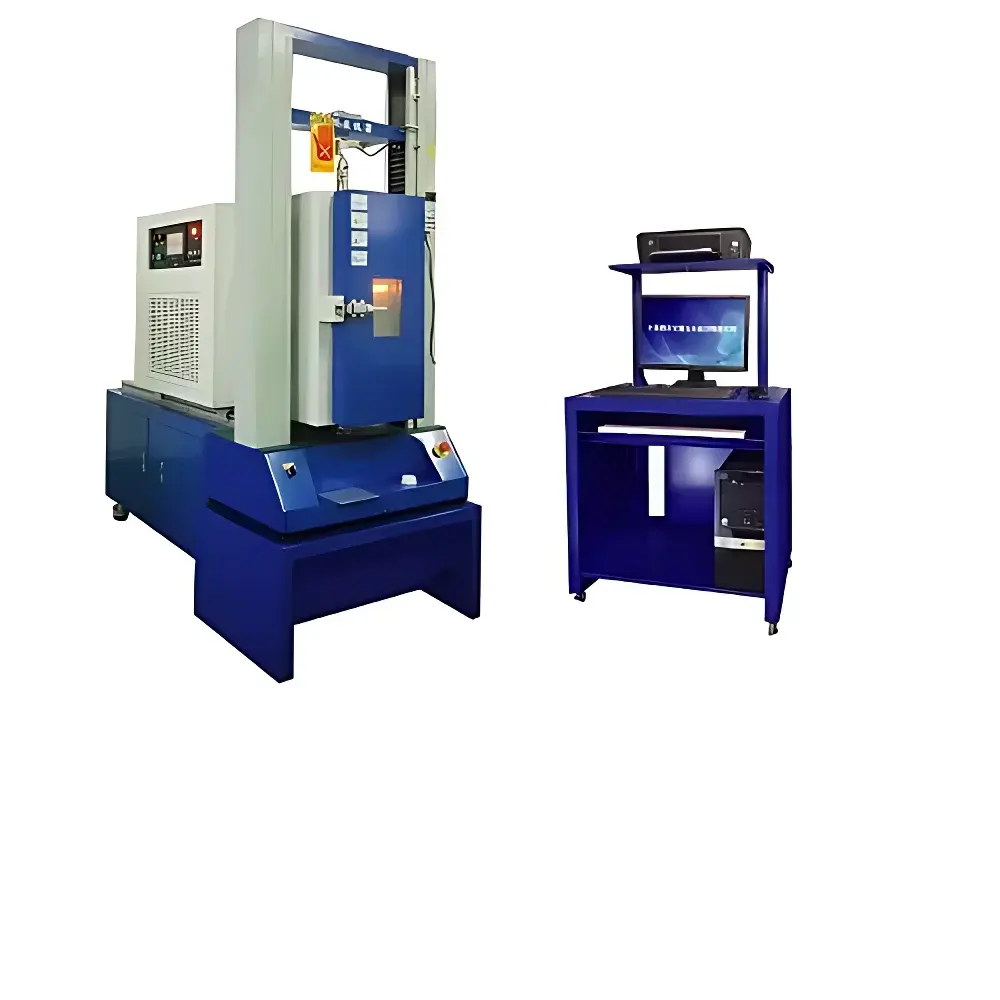
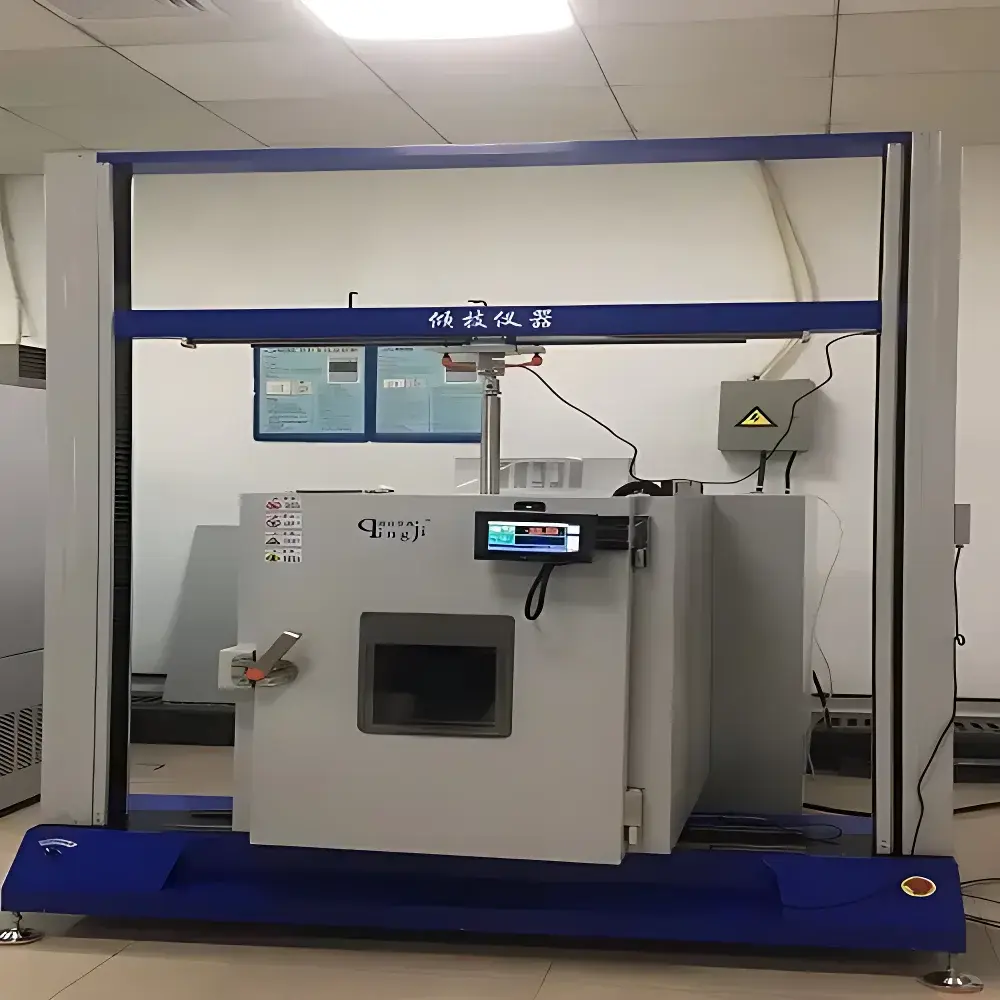
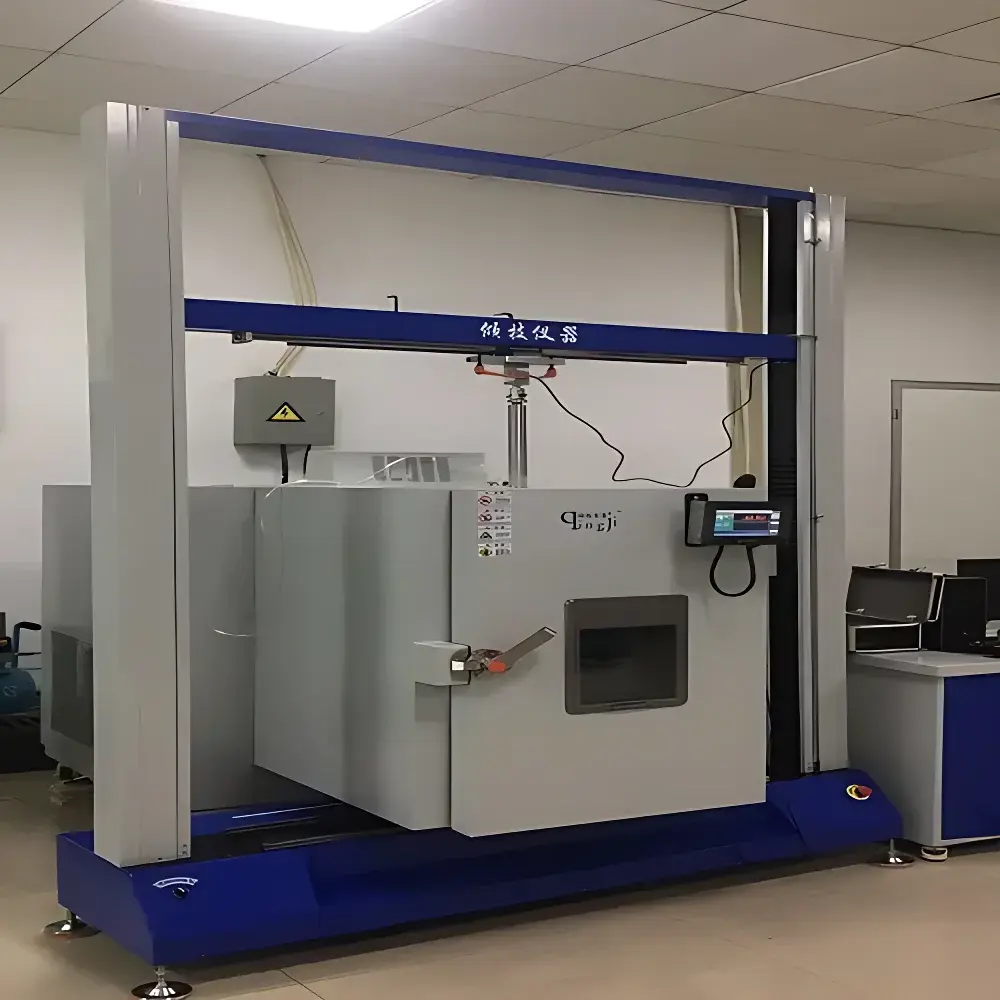
Qinsun QJ211B High-Temperature Universal Testing Machine
| Brand | Qinsun |
|---|---|
| Origin | Shanghai, China |
| Model | QJ211B |
| Load Capacity | 0–40 kN |
| Load Accuracy | ±0.5% FS |
| Temperature Range | −70 °C to +350 °C (customizable) |
| Heating/Cooling Rate | ≥5 °C/min |
| Temperature Resolution | 0.1 °C |
| Test Speed Range | 0.01–500 mm/min (optional up to 1000 mm/min) |
| Speed Accuracy | ±0.5% |
| Displacement Measurement Accuracy | ±0.5% |
| Strain Measurement Accuracy | ±0.5% |
| Effective Test Width | 420 mm |
| Effective Stroke | ~800 mm (extendable) |
| Safety Features | Electronic travel limit protection, emergency stop button |
| Weight | 265 kg |
Overview
The Qinsun QJ211B High-Temperature Universal Testing Machine is an electromechanical materials testing system engineered for precision mechanical property evaluation under controlled thermal conditions. It operates on the principle of servo-controlled axial force application combined with real-time displacement and strain feedback, enabling standardized tensile, compression, flexural, peel, tear, and shear testing per ASTM D638, ISO 527, ASTM D790, ISO 178, ASTM D903, and ISO 6942. Its integrated high-temperature environmental chamber allows uninterrupted mechanical characterization across a broad thermal spectrum—from cryogenic −70 °C to elevated 350 °C—making it suitable for thermally sensitive polymers, elastomers, composites, metallic wires, and coated substrates where temperature-dependent viscoelastic or yield behavior must be quantified.
Key Features
- Robust dual-column frame with reinforced crosshead guidance, ensuring axial alignment stability during high-load thermal cycling
- High-fidelity load cell with 0.01% full-scale resolution and ±0.5% accuracy, traceable to national metrological standards
- Integrated environmental chamber with PID-controlled heating/cooling elements and uniformity-certified airflow design (±1.5 °C across test zone)
- Dual-mode control architecture supporting both PC-based software operation and standalone digital panel interface for redundancy and operational continuity
- Precision ball-screw drive system with backlash-compensated AC servo motor, delivering consistent speed fidelity (±0.5% over full 0.01–500 mm/min range)
- Comprehensive safety suite including programmable electronic travel limits, hardware-triggered emergency stop, and thermal runaway monitoring
- Modular extensometer mounting interface compatible with contact and non-contact strain measurement systems (e.g., video extensometry)
Sample Compatibility & Compliance
The QJ211B accommodates specimens ranging from thin polymer films (≥25 µm thickness) to structural metal rods (up to Ø12 mm), with standard grips optimized for flat, round, and threaded geometries. Its 420 mm test width and 800 mm stroke support ASTM E8/E8M-compliant tensile bars and ISO 37 tear specimens. The system meets essential requirements for GLP-compliant laboratories: audit-trail-enabled software, user-access-level controls, electronic signature support, and data integrity safeguards aligned with FDA 21 CFR Part 11 principles. Temperature calibration procedures follow ISO/IEC 17025 guidelines, and thermal uniformity validation reports are provided upon installation.
Software & Data Management
The proprietary QinsunTest software (v5.2+) delivers ISO 17025-aligned test method templates, automated parameter sequencing, and real-time multi-channel data acquisition at up to 100 Hz sampling rate. All raw data—including force, displacement, temperature, and optional strain—are stored in encrypted binary format with embedded metadata (operator ID, timestamp, calibration status, environmental log). Export options include CSV, XML, and PDF reports compliant with internal QA workflows and external regulatory submissions. Software supports custom pass/fail criteria, statistical batch analysis (mean, SD, Cp/Cpk), and integration with LIMS via OPC UA or REST API.
Applications
- Thermo-mechanical characterization of thermoplastic elastomers (TPEs) and high-performance engineering resins (e.g., PEEK, PEI) across glass transition and melt regions
- Evaluation of solder joint reliability in printed circuit assemblies under thermal cycling stress
- Creep and stress-relaxation testing of silicone rubber seals used in aerospace and automotive applications
- Quality assurance of medical-grade PVC tubing and biodegradable sutures under simulated physiological temperatures
- Interfacial adhesion strength assessment of multilayer packaging films subjected to sterilization-level heat exposure
- Validation of wire bonding integrity in semiconductor packages operating at elevated junction temperatures
FAQ
What temperature uniformity can be expected across the test zone?
Temperature uniformity is validated to ±1.5 °C over a 100 × 100 × 100 mm volume centered within the chamber at steady-state conditions.
Is the system compatible with third-party extensometers?
Yes—the machine features standardized DIN 51221-compliant mounting interfaces and analog/digital signal inputs for integration with OEM and aftermarket contact and video extensometers.
Does the software support automated compliance with ISO 527-2 or ASTM D638 test protocols?
Preconfigured test methods for both standards are included, with automatic calculation of tensile modulus, yield strength, elongation at break, and Poisson’s ratio per specified gauge lengths and strain rates.
What documentation is provided for regulatory audits?
Delivery includes Factory Acceptance Test (FAT) report, temperature calibration certificate (NIST-traceable reference sensors), mechanical verification report, and software validation summary per GAMP5 Annex 11 principles.
Can the system be upgraded to include dynamic mechanical analysis (DMA) capability?
While the QJ211B is designed as a static and quasi-static tester, its modular controller architecture permits future integration of optional oscillatory actuation modules—subject to mechanical reinforcement and thermal isolation upgrades assessed during site survey.



