
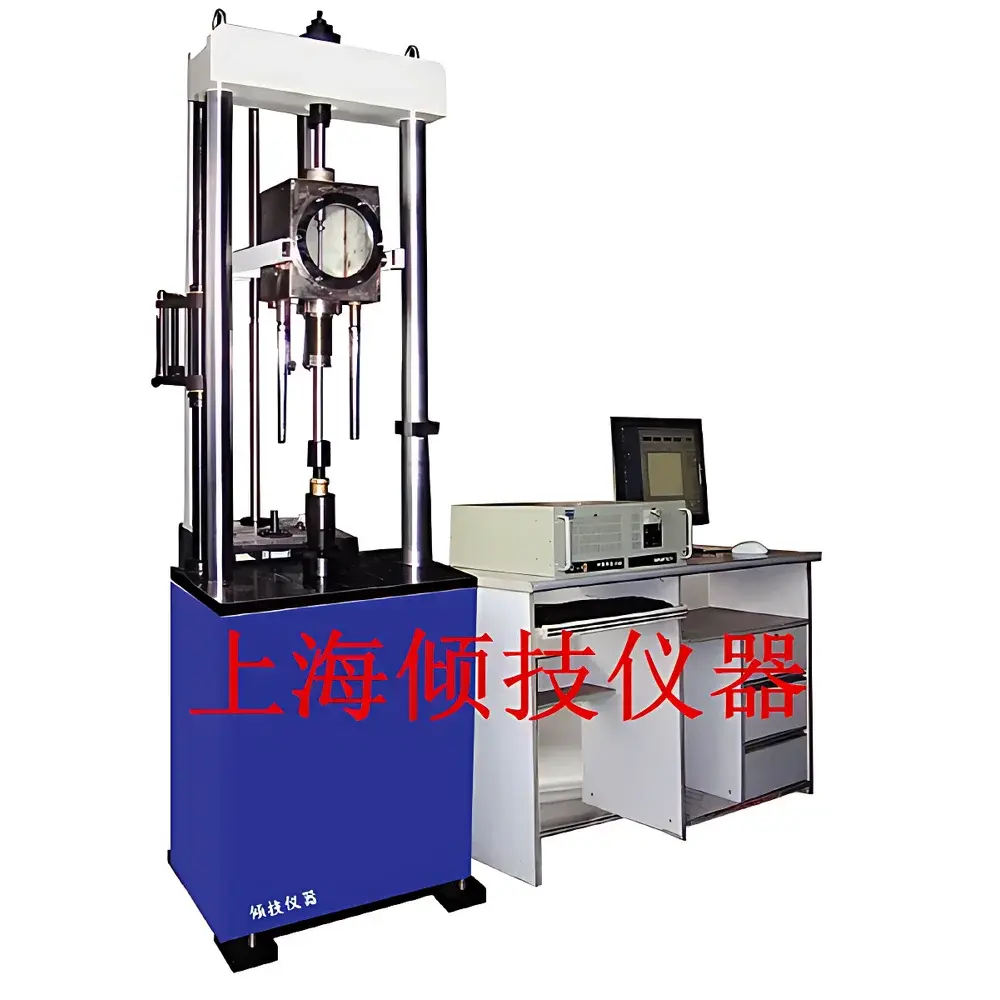
Qinji 212F Electronic Creep and Stress Rupture Testing Machine
| Brand | Qinji |
|---|---|
| Origin | Shanghai, China |
| Model | 212F |
| Instrument Type | Electronic |
| Maximum Test Load | 100 kN |
| Maximum Crosshead Travel | 500 mm |
| Machine Weight | 1450 kg |
| Load Measurement Accuracy | ±0.5% of reading (from 1% FS) |
| Load Control Stability | ±1% of reading |
| Compliant Standards | JJG 276–1988, GB/T 2039–1997, HB 5150–1996, HB 5151–1996 |
Overview
The Qinji 212F Electronic Creep and Stress Rupture Testing Machine is a precision-engineered system designed for long-term mechanical characterization of metallic and alloy materials under sustained uniaxial tensile loading at elevated temperatures. It operates on the fundamental principles of time-dependent viscoelastic deformation analysis—specifically, creep strain accumulation and stress rupture life determination—under controlled thermal and mechanical boundary conditions. The machine integrates a high-rigidity dual-column load frame with a servo-controlled electromechanical actuation system, enabling stable force application over durations ranging from hours to thousands of hours. Its architecture supports standardized test protocols for both constant-load creep testing and stress rupture (time-to-failure) evaluation, making it suitable for qualification of structural alloys used in aerospace propulsion systems, power generation components, and high-temperature industrial equipment.
Key Features
- Electromechanical loading system delivering precise, low-drift force control up to 100 kN, with repeatability validated per ISO 7500-1 Class 1 requirements
- High-stiffness, thermally stabilized load frame (1450 kg mass) minimizing deflection-induced measurement uncertainty during extended-duration tests
- 500 mm crosshead travel range accommodating standard and custom extensometer configurations—including clip-on, laser, and high-temperature LVDT types
- Dual-channel real-time data acquisition synchronized with furnace temperature profiles (compatible with external high-temperature furnaces up to 1200 °C)
- Load cell calibrated traceably to national standards, with accuracy of ±0.5% of reading from 1% of full scale and stability maintained within ±1% of setpoint over 100-hour intervals
- Modular design supporting integration with third-party environmental chambers and digital image correlation (DIC) systems for full-field strain mapping
Sample Compatibility & Compliance
The 212F accommodates cylindrical and flat-sheet specimens conforming to ASTM E139, ISO 204, and GB/T 2039 geometries, including standard gauge lengths of 25 mm, 50 mm, and 100 mm. Specimen mounting utilizes hardened steel grips with pneumatic or manual clamping—configured for both ambient and high-temperature applications when paired with compliant furnace assemblies. The system meets metrological and procedural requirements defined in JJG 276–1988 (Chinese national verification regulation), GB/T 2039–1997 (metallic tensile creep and stress rupture testing), and aerospace specifications HB 5150–1996 and HB 5151–1996. All hardware and firmware architectures support audit-ready operation under GLP and GMP frameworks, with optional configuration for FDA 21 CFR Part 11-compliant electronic records and signature functionality.
Software & Data Management
The embedded control software provides closed-loop load regulation, real-time creep curve visualization (strain vs. time, log-log scaling), and automated event logging—including load step changes, temperature ramping, and failure detection. Raw data export is supported in CSV, Excel (.xlsx), and universal HDF5 formats. Time-stamped datasets include metadata such as operator ID, calibration certificate numbers, environmental chamber status, and sensor health diagnostics. Optional advanced modules enable statistical lifetime prediction using Larson-Miller Parameter (LMP) and Monkman-Grant relationship modeling, with built-in uncertainty propagation analysis based on ISO/IEC Guide 98-3 (GUM). Audit trails are retained for minimum 10 years and support retrospective validation per ICH Q9 and ISO 17025 requirements.
Applications
- Creep property mapping of nickel-based superalloys (e.g., Inconel 718, Waspaloy) for turbine disk and blade certification
- Stress rupture life assessment of titanium alloys (Ti-6Al-4V, Ti-10V-2Fe-3Al) under simulated service temperatures (400–600 °C)
- Long-term integrity evaluation of stainless steels (316H, 304L) in nuclear reactor core components and piping systems
- Material qualification for ASME Section II, Part D and EN 10216-2 compliance in pressure equipment manufacturing
- Research-scale investigation of dislocation climb kinetics and grain boundary sliding mechanisms via multi-stress-level creep testing
- Validation of constitutive models (e.g., Norton-Bailey law, Garofalo equation) used in finite element thermomechanical simulations
FAQ
What temperature ranges can be achieved with the 212F system?
The 212F itself is a room-temperature-capable load frame; high-temperature capability is achieved through integration with externally supplied furnaces or environmental chambers. Compatible systems support operating ranges from ambient to 1200 °C, depending on furnace design and specimen holder configuration.
Is the system compatible with ASTM E139 test protocols?
Yes—the mechanical architecture, load control fidelity, and data acquisition timing resolution meet all hardware-related requirements of ASTM E139 for creep and stress rupture testing of metals.
Can the 212F perform multi-step creep tests with variable load levels?
Yes, the control software supports programmable load profiles, including ramp-hold sequences, stepwise load increases, and conditional triggers based on elapsed time or accumulated strain.
What calibration documentation is provided with delivery?
Each unit ships with a factory calibration certificate traceable to CNAS-accredited standards, covering load cell, displacement transducer, and timing subsystems. Certificate includes as-found/as-left data and uncertainty budgets per ISO/IEC 17025.
Does the system support remote monitoring and data access?
Standard Ethernet connectivity enables secure remote viewing of live test parameters and historical datasets via browser-based interface; optional VPN-secured access and TLS-encrypted API integration are available for enterprise laboratory information management systems (LIMS).



