
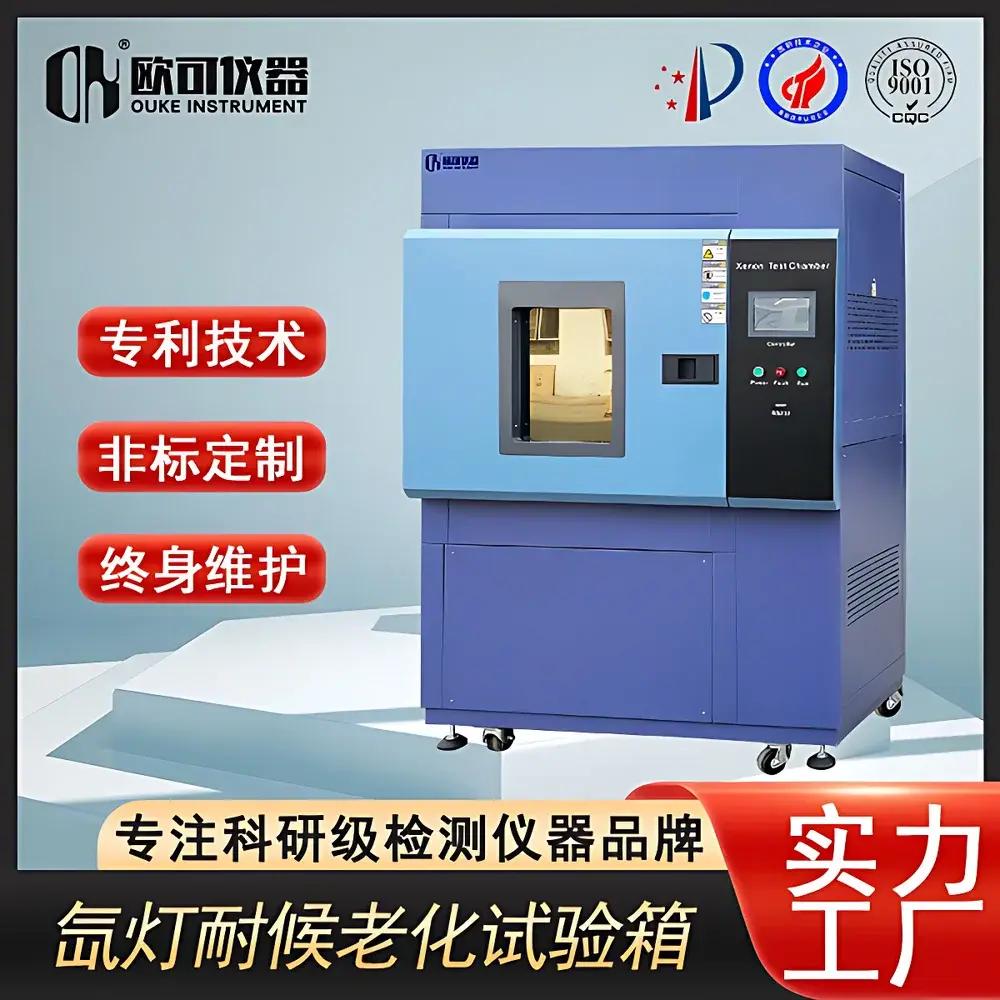
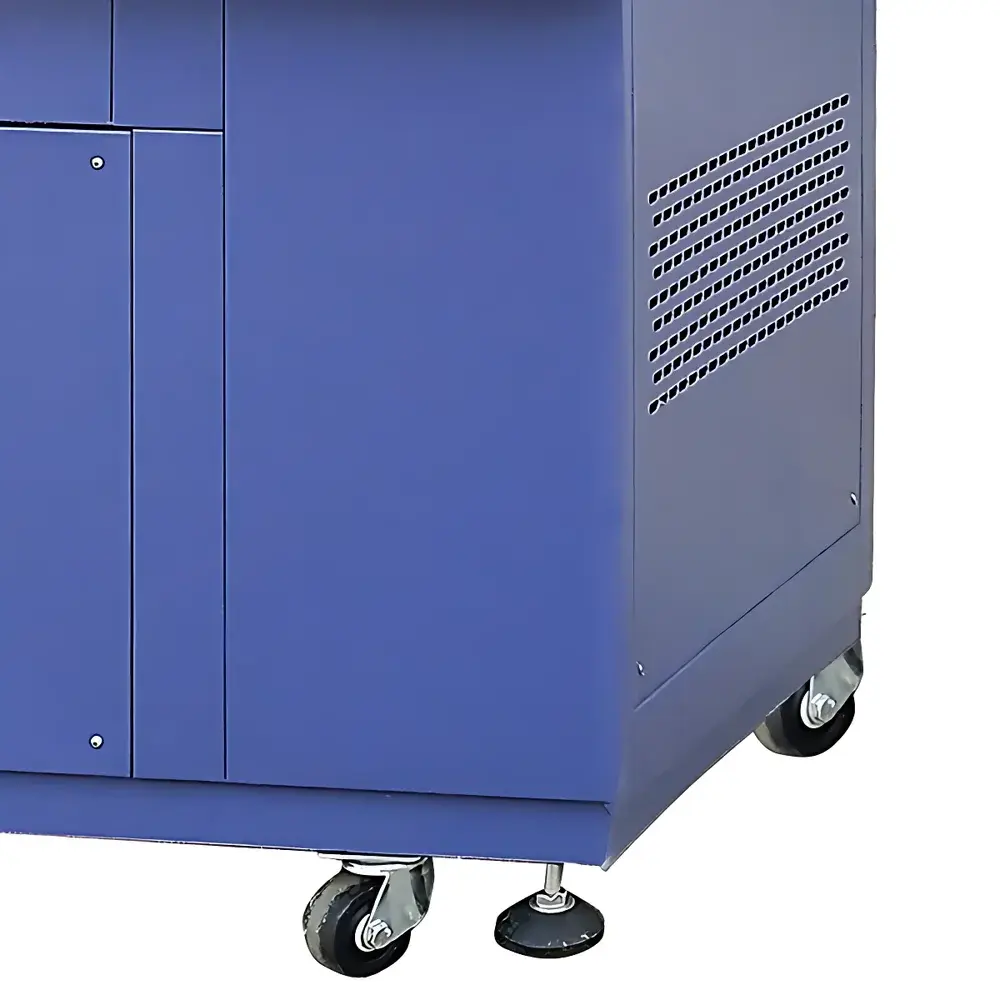
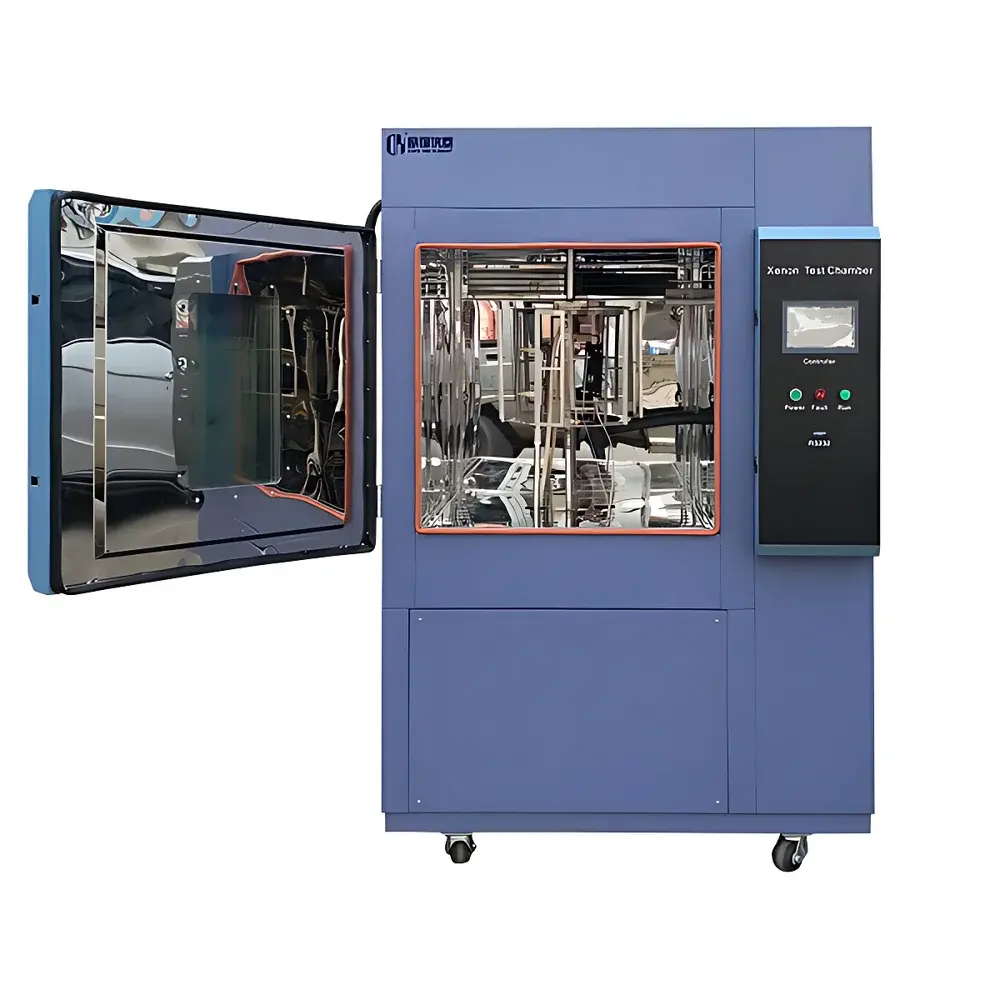

OK-XD-150 Xenon Arc Weathering Test Chamber
| Brand | OK Instruments |
|---|---|
| Origin | Guangdong, China |
| Manufacturer Type | Direct Manufacturer |
| Model | OK-XD-150 |
| Xenon Lamp Power | 3 kW |
| Irradiance Range | ≤1200 W/m² |
| Light Exposure Cycle | 1–999 h/min/sec (continuously adjustable) |
| Humidity Range (Light Cycle) | 20–75% R.H. |
| Compliance | ISO 4892-2, ASTM G155, GB/T 16422.2, SAE J2527/J2412 |
Overview
The OK-XD-150 Xenon Arc Weathering Test Chamber is an engineered environmental simulation system designed to replicate the full-spectrum solar radiation profile—including ultraviolet (UV), visible, and near-infrared (NIR) wavelengths—under tightly controlled temperature, humidity, and wet/dry cycling conditions. Based on the principle of xenon arc irradiation, this chamber employs a 3 kW air-cooled long-arc xenon lamp whose spectral power distribution closely matches natural sunlight (AM 1.5G), especially when paired with precision optical filters (e.g., daylight or window-glass filters). Unlike narrowband UV sources, xenon arc technology enables holistic assessment of photothermal degradation mechanisms, making it the reference method for evaluating color stability, gloss retention, surface morphology changes (e.g., chalking, cracking, blistering), and bulk property loss in polymeric, coated, textile, and composite materials.
Key Features
- 3 kW air-cooled xenon lamp with integrated quartz envelope and calibrated spectral output compliant with ISO 4892-2 Annex A requirements
- Dual-filter configuration support: Daylight filter (Q/B) for outdoor exposure simulation and Window Glass filter (WG) for indoor/automotive interior applications
- Precision irradiance control at 340 nm or 420 nm via real-time feedback from a traceable NIST-calibrated broadband sensor; automatic lamp power modulation ensures ±5% irradiance stability over time
- Black panel thermometer (BPT) and black standard thermometer (BST) monitoring with independent PID control loops for specimen surface temperature regulation (typically 30–100°C range)
- Integrated humidity control system featuring stainless steel steam generator, high-efficiency condensation cooling, and capacitive RH sensors (±2% accuracy) active during light cycles (20–75% R.H.)
- Programmable water spray system with deionized water delivery, adjustable frequency/duration, and non-drip nozzles to simulate dew formation or rainfall events
- 360° rotating sample rack (standard) ensuring uniform irradiance distribution across all specimens; optional flat-bed fixture available for rigid panels or large-format substrates
- Industrial-grade PLC-based controller with intuitive HMI interface, password-protected parameter setting, and data logging capability (temperature, humidity, irradiance, cycle stage)
Sample Compatibility & Compliance
The OK-XD-150 accommodates diverse material forms—including molded plastic parts, painted metal substrates, woven/nonwoven textiles, coated films, elastomeric seals, and architectural composites—within its standardized test chamber volume. Its operational envelope satisfies critical performance criteria defined in major international standards: ISO 4892-2 (plastics), ASTM G155 (non-metallic materials), ASTM D2565 (polymeric coatings), GB/T 16422.2 (Chinese national standard equivalent to ISO 4892-2), SAE J2527 (automotive exterior), and SAE J2412 (automotive interior). The chamber supports full-cycle testing protocols incorporating alternating light/dark phases, humidity ramping, and intermittent water spray—all configurable to match OEM-specific validation sequences. All hardware components—including stainless steel interior walls, corrosion-resistant fasteners, and sealed electrical conduits—are constructed to meet GLP-compliant laboratory infrastructure requirements.
Software & Data Management
While the OK-XD-150 utilizes embedded PLC logic for real-time process execution, optional PC-based software (OK-WeaControl Suite) provides extended functionality for method development, multi-chamber synchronization, and audit-ready reporting. The software supports user-defined test profiles with up to 99 segments per program, including ramp rates, dwell times, and conditional triggers (e.g., initiate spray upon reaching 80% R.H.). Data export complies with ASTM E2042 and ISO/IEC 17025 documentation guidelines, generating timestamped CSV logs with metadata (operator ID, calibration date, lamp hour count). For regulated environments, optional 21 CFR Part 11 compliance modules include electronic signatures, role-based access control, and immutable audit trails for all parameter modifications and test initiations.
Applications
This chamber serves as a primary qualification tool across industries where long-term outdoor durability is mission-critical. In automotive engineering, it validates UV resistance of instrument panel polymers, pigment stability in OEM paint systems, and hydrolytic aging of TPU trim components. Coating manufacturers use it to benchmark chalk resistance of acrylic roof coatings per ASTM D4587 and gloss retention of coil-coated aluminum under cyclic QUV/xenon correlation studies. Textile labs apply it to assess colorfastness of awning fabrics per AATCC TM16 and UV-induced tensile strength decay in geotextiles. Photovoltaic module suppliers rely on it for IEC 61215-compliant backsheet yellowing evaluation, while building product developers employ it for accelerated weathering of EPDM roofing membranes per ASTM D5722. Its ability to reproduce synergistic photochemical–thermal–hydric stress makes it indispensable for failure mode analysis in field-failure root cause investigations.
FAQ
What is the typical service life of the xenon lamp?
Standard 3 kW xenon lamps operate for approximately 1,200–1,500 hours before spectral drift exceeds acceptable limits. Lamp replacement intervals are tracked automatically by the controller and logged in the system history file.
Does the chamber support dark-cycle humidity control?
No—humidity control is only active during illuminated phases per ISO 4892-2 Clause 7.2. Dark-cycle condensation is achieved solely via thermal gradient-induced surface dewing, not active humidification.
Can irradiance be monitored at wavelengths other than 340 nm or 420 nm?
The standard sensor is factory-calibrated for 340 nm (critical for UV-driven degradation) and 420 nm (representative of visible-light contribution). Custom spectral monitoring at 300 nm or 290–800 nm requires third-party spectroradiometer integration and is not part of the base configuration.
Is distilled water sufficient for the spray system, or must it be deionized?
Deionized water (resistivity ≥1 MΩ·cm) is mandatory to prevent mineral deposition on filters, nozzles, and specimen surfaces—especially critical for optical clarity testing and automotive appearance evaluation.
How frequently should the irradiance sensor be recalibrated?
Annual recalibration against a NIST-traceable reference standard is recommended. Field verification using the included calibration tile should be performed prior to each test series to ensure measurement continuity.



