
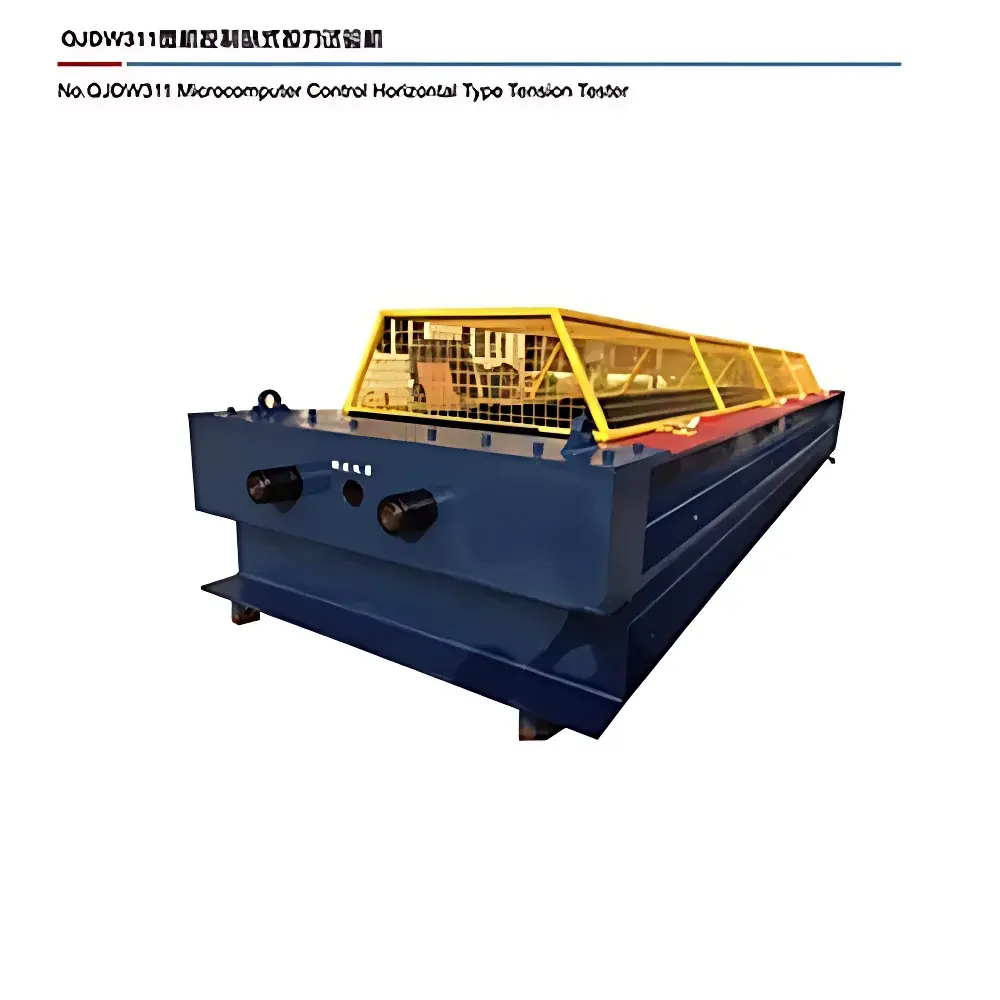
QJTI QJDW311- Horizontal Insulator Tensile Testing Machine
| Brand | QJTI |
|---|---|
| Origin | Shanghai, China |
| Model | QJDW311- |
| Max Test Load | 5000 kN |
| Load Measurement Range | 0.2%–100% FS |
| Load Accuracy Class | Class 1 (per ISO 7500-1 / ASTM E4) |
| Effective Stroke | 200,000 mm |
| Displacement Resolution | 0.001 mm |
| Control System | Full PC-based closed-loop servo control |
| Compliance | GB/T 16491, ISO 7500-1, ASTM E4, IEC 61109, IEEE 1313.1, EN 50383 |
Overview
The QJTI QJDW311- Horizontal Insulator Tensile Testing Machine is a heavy-duty, statically rated mechanical testing system engineered for the high-force, long-stroke evaluation of high-voltage ceramic and composite suspension insulators, strain insulator strings, and associated hardware under controlled axial tensile loading. Unlike vertical tensile frames, this horizontal configuration eliminates gravitational interference during extended-duration creep, load-hold, and step-load tests—critical for verifying mechanical integrity per IEC 61109, IEEE 1313.1, and GB/T 1001.2. The machine employs a dual-column, pre-stressed steel frame with integrated hydraulic actuation and high-stiffness load train to ensure minimal deflection (<0.05 mm/kN) across its full 5000 kN capacity. Force measurement is realized via traceable, temperature-compensated load cells calibrated to ISO 376 Class 1 accuracy (±1.0% of reading), validated annually per ISO/IEC 17025-accredited procedures.
Key Features
- Robust horizontal architecture optimized for insulator string assemblies up to 200 m in effective test length, accommodating multi-unit porcelain or polymer insulator strings under service-representative boundary conditions.
- High-resolution displacement feedback using linear variable differential transformers (LVDTs) and optical encoders, delivering 0.001 mm resolution over 200,000 mm stroke—enabling precise monitoring of elongation, creep deformation, and fracture initiation.
- Full PC-based closed-loop control system compliant with ISO 2041 and ASTM E2382, supporting programmable load profiles including ramp-to-load, load-hold, cyclic tension, and staircase testing.
- Modular load cell interface supporting multiple transducer ranges (e.g., 50 kN, 500 kN, 5000 kN), each independently calibrated and auto-recognized by the controller to maintain accuracy across the entire 0.2–100% FS measurement range.
- Structural frame designed to ISO 7500-1 Annex B requirements for static calibration stability, with thermal drift compensation and real-time stiffness correction algorithms embedded in firmware.
- Integrated safety interlocks including emergency stop circuitry, overload cut-off (110% FS), mechanical end-stop buffers, and load-cell fault detection—all documented in the machine’s Safety Manual (EN ISO 13857 compliant).
Sample Compatibility & Compliance
The QJDW311- accommodates standard and custom insulator configurations—including cap-and-pin, clevis-type, and long-rod composite designs—as defined in IEC 60383-1, GB/T 1001.1, and ANSI C29. This includes full-string assemblies with grading rings, corona shields, and metallic fittings. Test fixtures are supplied with standardized clevis adapters, U-bolts, and adjustable anchoring plates conforming to IEC 61109 Annex D. All test reports include metadata traceable to NIST-traceable force standards, with raw data archived in .csv and .tdms formats for audit readiness. The system supports GLP/GMP-aligned workflows through optional 21 CFR Part 11-compliant electronic signatures and audit trail logging.
Software & Data Management
QJTI TestSuite v5.2 software provides ISO 17025-aligned test sequencing, real-time curve overlay, and automated report generation per ISO 5893 and ASTM D638 templates. Data acquisition operates at ≥1 kHz sampling rate with synchronized force, displacement, and time stamps. Raw datasets include metadata fields for operator ID, calibration certificate ID, environmental conditions (optional sensor integration), and test standard reference. Export options include PDF (with digital signature), Excel, and XML for LIMS integration. Audit trails record all parameter changes, user logins, and report revisions with immutable timestamps—fully compliant with FDA 21 CFR Part 11 Subpart B requirements.
Applications
- Mechanical type testing of suspension and tension insulators per IEC 61109 Clause 8 and GB/T 1001.2 Section 6.2.
- Proof load verification and routine acceptance testing for utility-grade insulator batches prior to field installation.
- Cyclic fatigue assessment of composite insulator cores under alternating tension-compression loads (IEEE 1313.1 Annex C).
- Creep behavior analysis at 50%, 75%, and 100% of specified mechanical failing load (SMFL) over durations up to 96 hours.
- Verification of mechanical performance after artificial aging (UV, salt fog, thermal cycling) per IEC 62217.
- Research-grade characterization of interfacial bond strength in metal-fitting-to-epoxy interfaces using displacement-controlled fracture initiation protocols.
FAQ
What international standards does the QJDW311- support out-of-the-box?
The system ships with preconfigured test methods for IEC 61109, IEEE 1313.1, GB/T 1001.2, ASTM D4762, and EN 50383—including automatic pass/fail logic based on SMFL thresholds and elongation limits.
Is calibration documentation provided with delivery?
Yes—each unit includes an ISO/IEC 17025-accredited calibration certificate for the primary load cell and displacement encoder, valid for 12 months from shipment date.
Can the system be integrated into an existing laboratory network with centralized data management?
Absolutely—the controller features Ethernet/IP and OPC UA connectivity, enabling direct integration with Siemens Desigo, LabVantage, or Thermo Fisher SampleManager LIMS platforms.
What maintenance intervals are recommended for sustained Class 1 accuracy?
Annual recalibration of load cells and displacement sensors is required; hydraulic oil and filter replacement every 24 months; structural bolt torque verification every 6 months per maintenance logbook (provided digitally and in print).



