
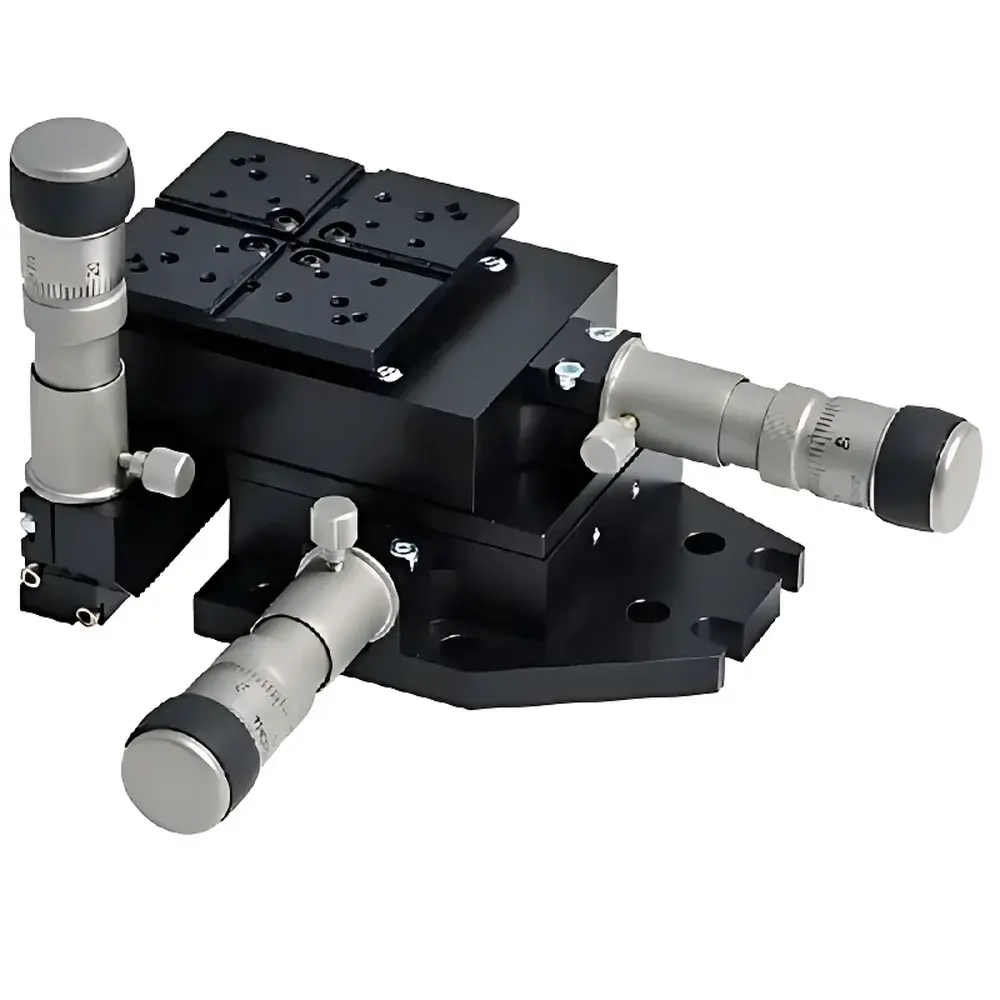
Thorlabs Nanomax Series Multi-Axis Flexure Translation Stage
| Brand | Thorlabs |
|---|---|
| Origin | USA |
| Product Type | Motorized Translation Stage |
| Series | Nanomax |
| Axes | 3–6 |
| Drive Options | Differential Micrometer, Stepper Motor, Piezoelectric Actuator (Open- or Closed-Loop) |
| Stiffness | X/Z = 1 N/µm, Y = 0.5 N/µm |
| Resonant Frequency | >130 Hz (±10%, no load) |
| Repeatability | 30 nm RMS over 30 µm, 0.1% over full travel |
| Angular Resolution | ≤0.03 arcsec (with piezo + sensor), ≤4 arcsec (differential micrometer) |
| Linear Travel Range | ±4 mm (X/Y/Z), ±6° (θx/θy/θz) |
| Top Plate Size | 70.0 mm × 60.0 mm |
| Load Capacity | 1 kg (2.2 lbs) |
| Mounting Height Options | 27.4 mm (XYR1), 62.5 mm (MicroBlock), 112.5 mm (NanoBlock/NBM513/NanoMax 600) |
Overview
The Thorlabs Nanomax Series Multi-Axis Flexure Translation Stage is a high-precision, monolithic-positioning platform engineered for nanoscale optical alignment and stabilization in demanding research and industrial applications. Unlike stacked or gimbaled multi-axis systems, the Nanomax platforms employ a patented parallel flexure architecture—where all degrees of freedom (DOFs) share a common virtual pivot point—enabling true kinematic decoupling, minimal crosstalk (<20 µm/mm), and exceptional mechanical stability. This design eliminates backlash, hysteresis, and wear-induced drift by replacing traditional bearings and screws with monolithic stainless-steel flexure hinges. The system operates on well-established principles of elastic deformation mechanics, delivering sub-arcsecond angular resolution and nanometer-level linear repeatability without lubrication or periodic recalibration. It is widely deployed in ultra-stable interferometry, fiber-to-waveguide coupling, adaptive optics beam steering, and confocal microscopy sample positioning—environments where thermal drift, vibration sensitivity, and long-term positional fidelity are critical performance constraints.
Key Features
- Patented parallel flexure mechanism with shared virtual pivot ensures geometrically consistent alignment across all axes—critical for maintaining collimation during multi-degree-of-freedom adjustments.
- High stiffness architecture: 1 N/µm in X and Z, 0.5 N/µm in Y—enabling rapid settling times and immunity to low-frequency mechanical disturbances.
- Resonant frequency >130 Hz (±10%, unloaded), supporting dynamic positioning tasks in active feedback loops and high-speed scanning protocols.
- Modular drive compatibility: Select from differential micrometers (50 nm/rev, 4 arcsec/div), stepper motor actuators (20 nm resolution), or closed-loop piezoelectric actuators with integrated capacitive position sensors (10 nm resolution, 0.03 arcsec angular resolution).
- Single-piece top plate (70.0 mm × 60.0 mm) with standardized SM1-threaded center bore and arrayed M4/M6 mounting holes—designed for direct integration into cage systems, lens tubes, and OEM optomechanical assemblies.
- Zero-maintenance operation: No grease, no backlash, no particulate generation—compliant with cleanroom Class 100 and vacuum-compatible variants (upon request).
Sample Compatibility & Compliance
The Nanomax platform family supports diverse optical payloads—including single-mode fiber pigtails, micro-optics assemblies, MEMS mirrors, photonic integrated circuits (PICs), and biological samples on glass slides—without compromising positional integrity. Its rigid baseplate and low center-of-gravity geometry ensure stability under static loads up to 1 kg (2.2 lbs) and horizontal loads up to 4.5 kg (10 lbs). All standard models meet ISO 9001 manufacturing controls and are compatible with GLP/GMP-aligned workflows when used with traceable calibration certificates (available upon request). Closed-loop configurations with piezoelectric position sensors comply with FDA 21 CFR Part 11 requirements for electronic record integrity when paired with Thorlabs’ Kinesis® software and audit-trail-enabled controllers. Mechanical specifications conform to ASTM E2585-15 (Standard Practice for Calibration of Positioning Systems) and ISO 230-2:2023 (Test Code for Determining Accuracy of Positioning Systems).
Software & Data Management
Thorlabs’ Kinesis® software suite provides native support for all Nanomax drive types—including USB- and TTL-controlled stepper drivers (BSC20x series), analog piezo amplifiers (EAP series), and digital piezo controllers (KPZ101, BPC303). The API supports .NET, C++, Python, and LabVIEW environments, enabling seamless integration into custom automation frameworks for automated alignment routines, PID-regulated beam stabilization, or synchronized multi-stage scanning. Closed-loop models log real-time position data with timestamped metadata, supporting export to CSV, HDF5, or MATLAB-compatible formats. Firmware updates, parameter tuning (e.g., slew rate, acceleration profiles), and multi-axis trajectory planning (linear, circular, helical) are performed via intuitive GUI or script-driven commands. Audit trails—including user login, command execution, and configuration changes—are retained for regulatory review per ISO/IEC 17025 and CAP-accredited laboratory standards.
Applications
- Fiber-to-chip coupling: Precise 6-DOF alignment of single-mode fibers to silicon photonics waveguides with sub-micron lateral and sub-degree angular control.
- Interferometric metrology: Active compensation of path-length differences in Michelson, Mach-Zehnder, and LIGO-style gravitational wave detection prototypes.
- Confocal and super-resolution microscopy: High-bandwidth Z-axis nanopositioning for axial sectioning, combined with XY translation for tile-based mosaic acquisition.
- Laser cavity alignment: Iterative optimization of mirror tilt and spacing in external-cavity diode lasers (ECDLs) and Ti:sapphire oscillators.
- Quantum optics experiments: Stable mounting and repositioning of nonlinear crystals (e.g., PPKTP, BBO) in SPDC sources and quantum memory interfaces.
- OEM instrumentation integration: Compact footprint and standardized mechanical interfaces facilitate embedding into medical endoscopes, semiconductor wafer inspection tools, and space-qualified optical benches.
FAQ
What distinguishes the Nanomax flexure design from conventional stacked translation stages?
The Nanomax uses a monolithic parallel flexure architecture with a shared virtual pivot, eliminating cumulative errors, mechanical play, and axis misalignment inherent in cascaded stages—resulting in superior orthogonality, lower crosstalk, and higher resonant frequency.
Can the Nanomax platform be operated in vacuum or cleanroom environments?
Standard models are suitable for Class 100 cleanrooms; vacuum-compatible versions (with non-outgassing adhesives and dry-lubricated components) are available as custom orders—contact Thorlabs Technical Support for chamber-rated configurations.
Is closed-loop operation mandatory for achieving nanometer resolution?
No—open-loop piezo or differential micrometer variants deliver repeatable sub-50 nm steps; however, closed-loop sensing is required for absolute position verification, long-term drift compensation, and compliance with ISO 10110-5 surface figure alignment protocols.
How does thermal drift affect positioning accuracy over extended operation?
The all-metal flexure structure exhibits coefficient of thermal expansion (CTE) matching between components, limiting thermally induced offset to <50 nm/°C over the operational range (15–30 °C); active temperature stabilization is recommended for sub-10 nm stability requirements.
Which controller models are certified for use with FDA-regulated instrumentation?
Kinesis® controllers with firmware v1.14.31+ and enabled audit-trail logging meet 21 CFR Part 11 Subpart B requirements for electronic signatures and record retention—documentation packages available under NDA upon request.




