
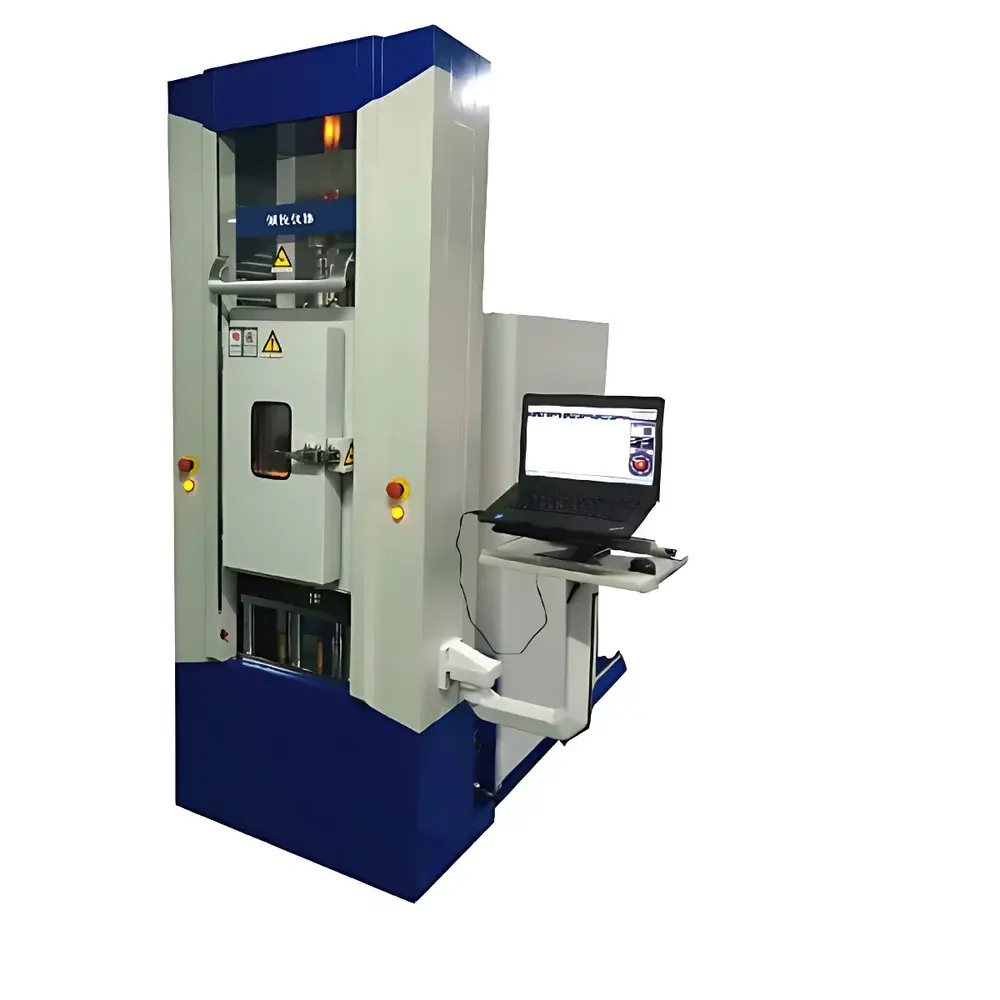
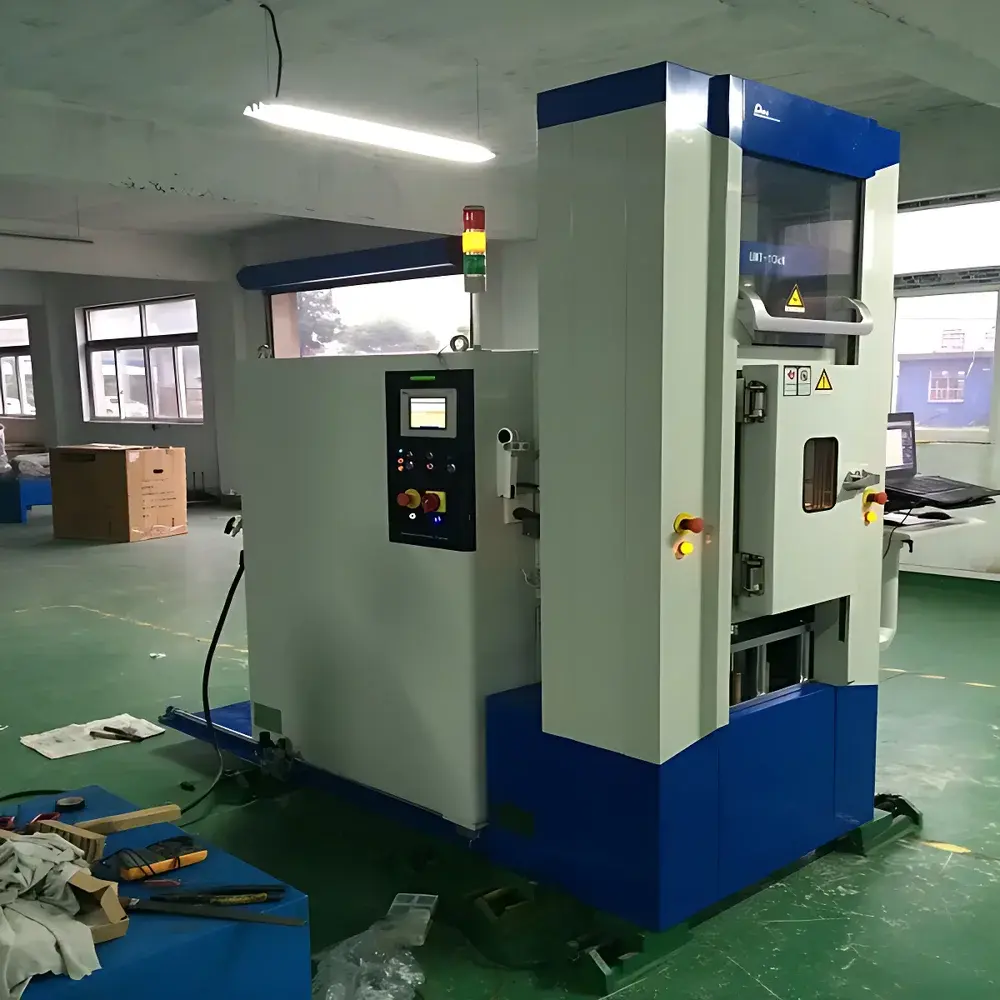
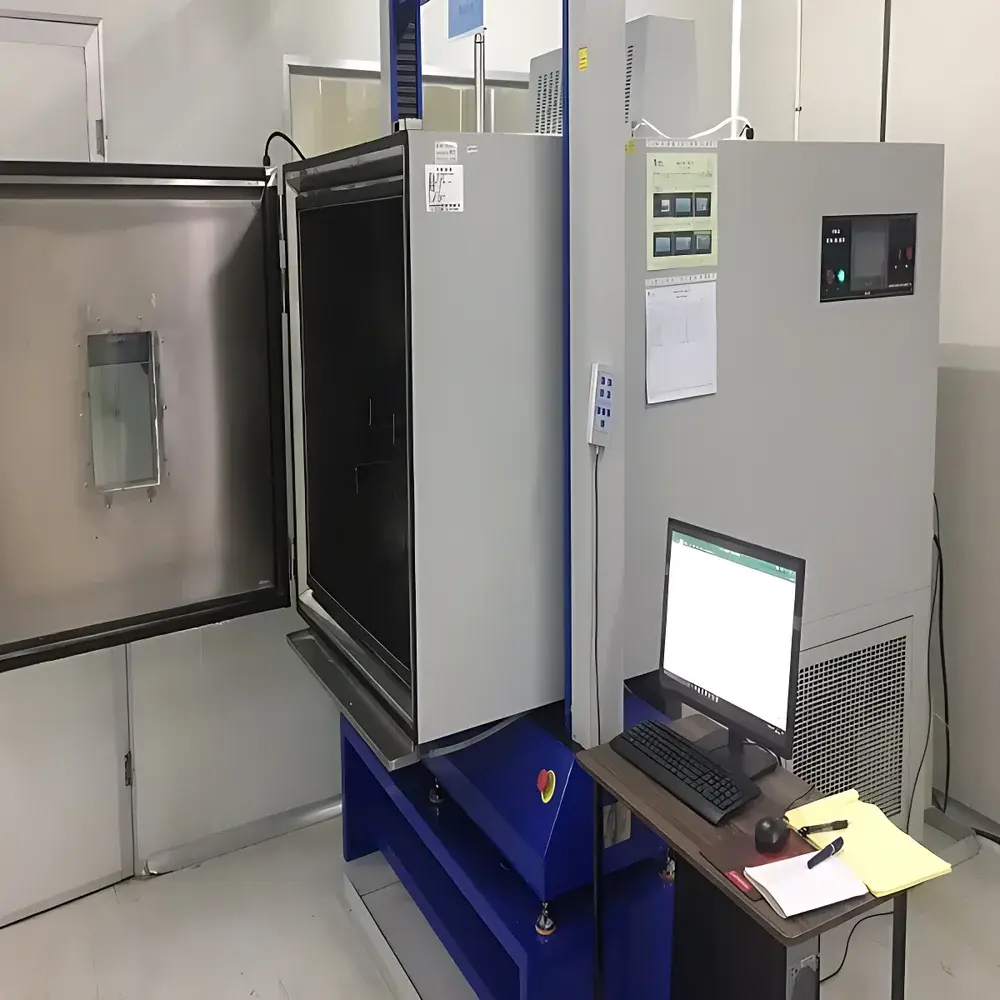
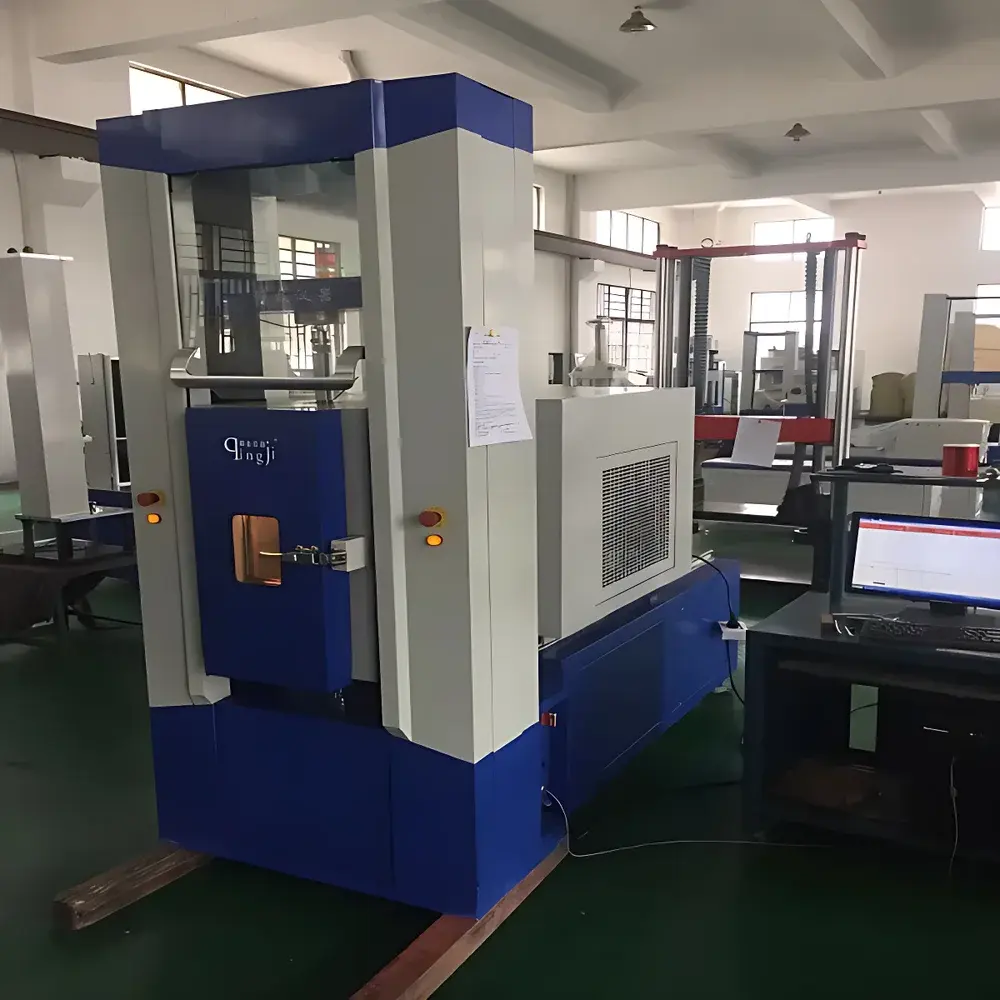
Qinsun QJ212B-50KN High-Temperature Compression Strength Testing Machine
| Brand | Qinsun |
|---|---|
| Origin | Shanghai, China |
| Model | QJ212B-50KN |
| Load Capacity | 50 kN |
| Load Accuracy | ±0.5% FS |
| Effective Test Width | 500 mm |
| Effective Stroke (Tension) | 600–800 mm (configurable) |
| Test Speed Range | 0.001–1000 mm/min |
| Speed Accuracy | ±1% of indicated value |
| Displacement Measurement Accuracy | ±0.2% of indicated value |
| Strain Measurement Accuracy | ±0.2% of indicated value |
| Power Supply | 1.5 kW |
| Dimensions (W×D×H) | 960 × 650 × 2000 mm |
| Weight | 1200 kg |
Overview
The Qinsun QJ212B-50KN High-Temperature Compression Strength Testing Machine is a microprocessor-controlled universal testing system engineered for precise mechanical characterization of materials under elevated temperature conditions. Designed as an integrated platform combining a servo-electric universal testing frame with a high-stability environmental chamber, it supports standardized compression, tensile, flexural, peel, tear, shear, and puncture testing per ISO 6892, ASTM E9, ASTM D695, ASTM D3410, JIS Z2241, DIN 50105, and other internationally recognized protocols. The system operates on a Windows-based control architecture that enables real-time acquisition and dynamic visualization of load–displacement–time curves, with full digital signal processing, multi-channel synchronization, and hardware-triggered data sampling at up to 10 kHz. Its closed-loop PID control ensures consistent strain rate and load ramping across the full 50 kN capacity range, making it suitable for quality control laboratories, R&D centers, and accredited testing facilities requiring traceable, repeatable, and auditable mechanical performance data.
Key Features
- Servo-motor-driven actuation with dual-speed crosshead control (fast jog + fine positioning) for rapid specimen alignment and precise displacement execution
- Integrated high-temperature environmental chamber capable of stable operation from –70 °C to +300 °C (optional extension to +600 °C with ceramic furnace module)
- High-resolution load cell with ±0.5% full-scale accuracy and 1/250,000 internal resolution—maintained uniformly across the entire measurement range without auto-ranging
- Optical encoder-based displacement feedback with ±0.2% linearity and sub-micron repeatability
- Dual-channel extensometer input supporting clip-on, video, or non-contact strain measurement per ASTM E83 Class B requirements
- Electronic limit switches and software-defined safety thresholds—including overload cutoff at 110% of rated capacity and emergency stop interlock compliance with IEC 60204-1
- Modular test table design accommodating custom fixtures, compression platens, and high-temperature grips with water-cooled interfaces
Sample Compatibility & Compliance
The QJ212B-50KN accommodates specimens up to 500 mm wide and 800 mm in active gauge length, supporting metallic alloys, polymer composites, ceramics, concrete cores, and elastomeric seals. Its thermal chamber conforms to ASTM E145 Class II specifications for uniformity and stability, with axial temperature gradients ≤±1.5 °C over the central 100 mm test zone. All firmware and control logic are structured to support GLP/GMP-aligned audit trails, including user login logging, parameter change history, and electronic signature-ready test reports. Data export formats include CSV, XML, and PDF with embedded metadata compliant with FDA 21 CFR Part 11 requirements when paired with validated software configuration.
Software & Data Management
The bundled QinsunTest v5.2 software provides ISO/IEC 17025-compliant test method templates, customizable report generation (with company logo, technician ID, calibration certificate references), and curve manipulation tools—including overlay, differential analysis, modulus calculation (secant/tangent), yield point detection (0.2% offset), and fracture energy integration. Raw data files retain timestamped sensor streams with millisecond-level synchronization. Exported datasets include calibrated load, displacement, temperature, and optional strain channels—each tagged with sensor serial numbers and calibration expiry dates. Remote monitoring via Ethernet/IP is supported, and optional OPC UA integration enables seamless connection to MES or LIMS platforms.
Applications
- High-temperature compressive yield strength and creep behavior of aerospace-grade titanium alloys (per AMS 2300)
- Thermal degradation assessment of fiber-reinforced polymer matrix composites (ASTM D3410/D6641)
- Creep rupture testing of refractory ceramics under sustained compressive loading (ISO 14529)
- Validation of thermal interface material (TIM) compression set and recovery under cyclic thermal stress
- Quality assurance of sintered metal powders and additive-manufactured components per MPIF Standard 35
- Characterization of viscoelastic response in high-performance elastomers used in downhole oilfield applications
FAQ
What is the maximum operating temperature of the integrated environmental chamber?
Standard configuration supports up to +300 °C; extended-range models with vacuum-insulated furnace modules operate up to +600 °C.
Does the system comply with ISO 17025 accreditation requirements for testing laboratories?
Yes—the hardware architecture, calibration traceability (NIST-traceable load cells and encoders), and software audit trail functionality meet foundational requirements for ISO/IEC 17025:2017 Clause 6.4 and 6.5.
Can third-party extensometers be connected and auto-configured?
The system provides analog and digital (LVDT/TTL) input channels compatible with major OEM extensometers; calibration coefficients are programmable via the software interface.
Is remote diagnostics and firmware update capability available?
Yes—via secure SSH-enabled Ethernet connection; updates require authenticated administrator credentials and generate immutable log entries.
What maintenance intervals are recommended for long-term accuracy retention?
Annual recalibration of load cell and displacement transducers is advised; routine verification using certified reference standards should be performed prior to each test series per ISO 7500-1.



