
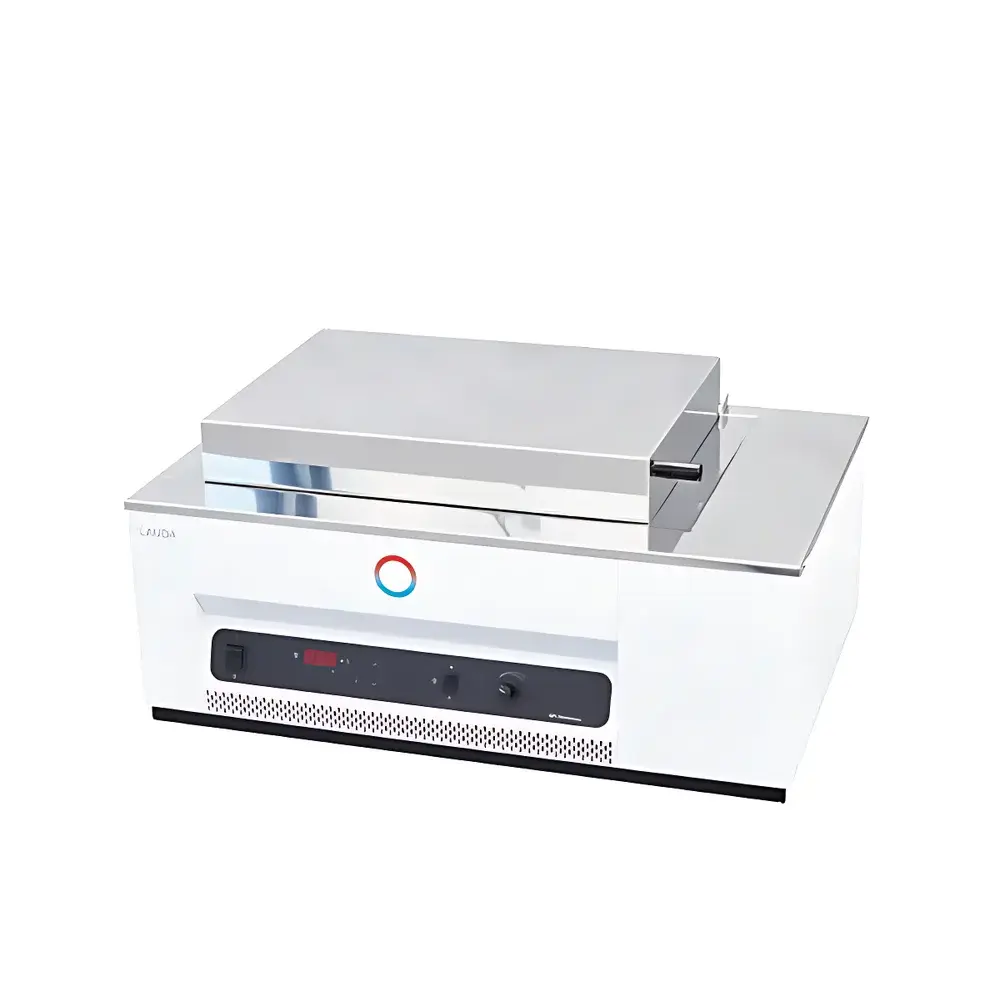
LAUDA Hydro H 20 S Shaking Water Bath
| Brand | LAUDA |
|---|---|
| Origin | Germany |
| Model | H 20 S |
| Temperature Range | 25–99.9 °C |
| Temperature Stability | ±0.1 °C |
| Bath Volume | 9.0–24.4 L |
| Heating Power | 1.5 kW |
| Dimensions (W×D×H) | 715×520×330 mm |
| Weight | 32 kg |
| Oscillation Type | Linear reciprocating |
| Amplitude | 22 mm |
| Speed Range | 10–250 rpm |
| Bath Internal Dimensions | 450×300×160 mm |
| Max Immersion Depth | 190 mm |
Overview
The LAUDA Hydro H 20 S Shaking Water Bath is a precision-engineered laboratory instrument designed for applications requiring simultaneous temperature control and linear reciprocating motion. Built on LAUDA’s decades-long heritage in thermal management systems, this unit integrates a high-stability Peltier-free resistive heating system with a robust, corrosion-resistant oscillation mechanism. Unlike orbital shakers, the H 20 S employs a true linear reciprocating drive—delivering uniform shear distribution across samples placed in flasks, tubes, or microplates. Its operational envelope spans 25 °C to 99.9 °C with ±0.1 °C stability, making it suitable for enzyme kinetics, solubility studies, cell culture suspension, bacterial growth assays, and dissolution testing where thermal homogeneity and mechanical reproducibility are critical. The bath’s stainless-steel construction—including tank, lid, basket, and heating elements—ensures long-term resistance to aqueous corrosion and compatibility with sterilization protocols.
Key Features
- Precision digital temperature control with ±0.1 °C stability across the full operating range (25–99.9 °C), displayed via high-contrast LED interface with intuitive membrane keypad navigation
- Linear reciprocating oscillation with continuously adjustable speed (10–250 rpm) and fixed 22 mm amplitude, engineered for low-vibration, high-reproducibility motion transmission
- Soft-start motor control with electronic overload protection and automatic shutdown upon overtemperature or low-water detection
- Double-walled, stainless-steel insulated lid with integrated condensate channeling to prevent droplet contamination of samples
- Removable stainless-steel shaking basket with quick-release mechanism for routine cleaning and autoclaving compatibility
- Drain valve located at rear panel and level-adjustable feet for precise leveling on benchtop surfaces
- Full stainless-steel wetted components (tank interior, lid, basket, heater sheath) compliant with ISO 8573-1 purity class 4 for cleanroom-adjacent use
Sample Compatibility & Compliance
The H 20 S accommodates a broad spectrum of vessel formats through modular accessory integration—including standard conical flasks (25–1000 mL), test tubes (13–31 mm diameter), microtiter plates, and custom fixtures mounted on optional oscillation trays (e.g., A000023). Its open-bath architecture supports rapid loading/unloading of large-volume containers while maintaining consistent thermal gradients. All electrical components meet IEC 61010-1:2010 safety standards for laboratory equipment. The unit is CE-marked and conforms to EN 60598-1 for luminous safety and EN 60335-1 for household and similar electrical appliances—validated for continuous operation under GLP-compliant environments. Optional water treatment agents (e.g., Algizid Aquastab) support microbiological control per USP and EP 2.6.12 guidelines when used in extended-duration assays.
Software & Data Management
While the H 20 S operates as a standalone analog-digital hybrid controller without native PC connectivity, its front-panel interface logs real-time temperature and speed setpoints with non-volatile memory retention. For audit-trail compliance in regulated laboratories (e.g., pharmaceutical QC), external data loggers (e.g., Testo 176 T4) may be connected via 4–20 mA or 0–10 V analog outputs (available on request with OEM configuration). All firmware adheres to IEC 62304 Class B software lifecycle requirements, and calibration certificates traceable to DKD/DAkkS-accredited standards are available upon installation verification. Temperature sensor drift is compensated automatically during warm-up cycles using dual-point internal reference calibration.
Applications
- Temperature-dependent biochemical reactions requiring agitation, including antigen-antibody binding, PCR pre-incubation, and ligand-receptor equilibration
- Dissolution testing of solid oral dosage forms per USP and Ph. Eur. 2.9.3, particularly when combined with automated sampling manifolds
- Microbial growth monitoring in nutrient broth under controlled thermal-agitation conditions (ASTM D3273)
- Extraction efficiency optimization in environmental sample preparation (EPA Method 3510C)
- Suspension stability assessment of nanosuspensions and colloidal dispersions (ISO/TR 13014)
- Cell detachment and passaging support for adherent mammalian lines prior to centrifugation
FAQ
What is the maximum recommended fill volume for optimal thermal uniformity?
For best performance, maintain liquid levels between 9.0 L (minimum operational volume) and 24.4 L (maximum rated capacity), ensuring immersion depth ≥190 mm for all vessels.
Can the H 20 S be operated without the shaking function enabled?
Yes—the oscillation motor can be deactivated independently while retaining full temperature regulation capability, functioning as a high-precision static water bath.
Is the unit compatible with deionized or distilled water only?
While DI water is preferred to minimize scaling, the stainless-steel construction tolerates buffered saline solutions and low-concentration detergent washes; however, chlorinated or acidic media require post-use rinsing.
Does LAUDA provide IQ/OQ documentation packages?
Yes—factory-verified Installation Qualification (IQ) and Operational Qualification (OQ) protocols are available as part of the LAUDA Validation Support Package (VSP), aligned with FDA 21 CFR Part 11 and EU Annex 11 expectations.
What maintenance intervals are recommended for long-term reliability?
Inspect drain valve seals and lid gasket integrity every 6 months; calibrate temperature sensor annually using a NIST-traceable reference thermometer; clean internal tank with citric acid solution every 3 months if used with hard water.



