
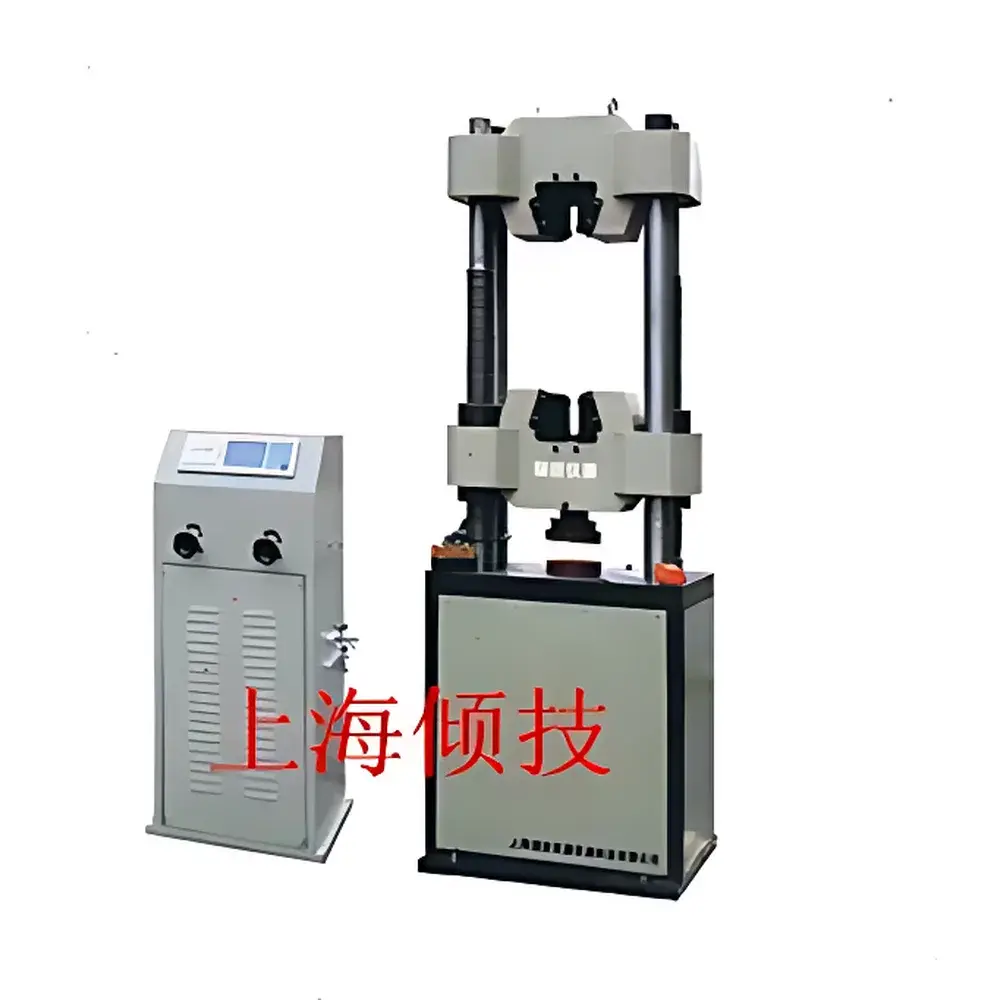
QJYL Series Road Construction Materials Strength Testing Machine
| Origin | Shanghai, China |
|---|---|
| Manufacturer Type | Authorized Distributor |
| Origin Category | Domestic (China) |
| Model | QJYL-2000 / QJYL-3000 |
| Max Load Capacity | 2000 kN / 3000 kN |
| Accuracy Class | Class I (per GB/T 3159 & ISO 7500-1) |
| Force Measurement Range | 20–2000 kN / 10–3000 kN |
| Loading Rate Adjustment | 1–15 mm/s (motor-driven, stepless control) |
| Internal Clearance (between platens) | 320 mm |
| Platen Dimensions | 320 × 260 mm or 350 × 300 mm |
| Motor Power | 0.75 kW / 1.1 kW / 1.5 kW (3-phase, 380 V, 50 Hz) |
| Net Weight | ~800 kg |
| Overall Dimensions (W×D×H) | ~850 × 500 × 1480 mm |
Overview
The QJYL Series Road Construction Materials Strength Testing Machine is a high-capacity, electromechanical compression testing system engineered for standardized mechanical characterization of rigid and semi-rigid pavement materials in accordance with ASTM C39/C78, EN 12390-3/EN 12390-5, GB/T 50081, and JTG E30. It operates on the principle of controlled displacement-driven axial loading, where a precision servo-motor actuator applies compressive force between two parallel platens while continuously measuring load (via calibrated load cell) and displacement (via linear encoder). The system is designed to quantify ultimate compressive strength, flexural strength (modulus of rupture), and load–deformation behavior of concrete cubes, cylinders, prisms, asphalt-aggregate specimens, stabilized soil blocks, and masonry units. Its rigid C-frame architecture, reinforced steel construction, and Class I accuracy certification ensure high reproducibility across repeated tests—critical for QA/QC laboratories operating under ISO/IEC 17025-accredited workflows.
Key Features
- Motor-driven automatic platen height adjustment with digital position feedback, enabling rapid setup for specimens of varying heights without manual repositioning.
- Integrated digital display console showing real-time load (kN), displacement (mm), loading rate (mm/s), and peak value—calibrated traceable to national metrological standards.
- Optional RS232/USB interface for direct data export to PC; compatible with Windows-based laboratory data acquisition software supporting CSV and Excel export formats.
- Dual-range load cell configuration (e.g., 20–2000 kN or 10–3000 kN) ensures optimal signal-to-noise ratio across low- and high-force regimes, minimizing measurement uncertainty.
- Adjustable loading speed (1–15 mm/s) meets multiple standard requirements—including slow-rate testing per ASTM C39 (0.25 ± 0.05 MPa/s equivalent) and accelerated preloading protocols.
- Robust platen geometry (320 × 260 mm or 350 × 300 mm) accommodates standard concrete cubes (150 mm), cylinders (150 × 300 mm), and prism specimens (100 × 100 × 400 mm) without edge stress concentration.
- Thermally stable frame design minimizes thermal drift during extended test sequences, maintaining ≤±0.5% full-scale repeatability over 8-hour operation.
Sample Compatibility & Compliance
The QJYL machine supports standardized specimen geometries used across civil infrastructure testing: concrete cubes (100 mm, 150 mm, 200 mm), cylindrical specimens (100 × 200 mm, 150 × 300 mm), beam specimens (100 × 100 × 400 mm), cement-stabilized base materials, and interlocking paver blocks. All testing procedures comply with mandatory clauses of GB/T 50081 (Chinese Standard for Concrete Mechanical Properties), JTG E30 (Highway Engineering Cement and Concrete Test Procedures), and harmonized EN 12390 series. The system’s Class I accuracy rating satisfies ISO 7500-1:2018 and GB/T 3159 requirements for verification of static force-measuring instruments. While not inherently 21 CFR Part 11 compliant, audit-ready operation can be achieved via third-party validated software add-ons supporting electronic signatures and immutable audit trails.
Software & Data Management
The embedded controller provides standalone operation with non-volatile memory storing up to 200 test records, including date/time stamp, specimen ID, max load, failure mode annotation, and calculated strength values (MPa). For networked environments, optional PC software enables batch test scheduling, statistical analysis (mean, SD, CV%), pass/fail flagging against specification limits (e.g., ≥30 MPa for C30 concrete), and automated report generation in PDF or printed format. Data files include raw time-stamped load–displacement arrays, ensuring full traceability for internal audits or external accreditation reviews. Exported datasets are compatible with common LIMS platforms and support metadata tagging per ISO/IEC 17025 clause 7.5.2.
Applications
- Quality assurance of ready-mix concrete batches prior to pavement placement.
- Evaluation of compressive strength development in early-age concrete under field-curing conditions.
- Testing of cement-treated base (CTB) and lime-fly ash stabilized subbase layers.
- Mechanical validation of recycled aggregate concrete and supplementary cementitious material blends.
- Flexural strength assessment of concrete beams per ASTM C78 for joint design verification.
- Calibration and verification of field rebound hammers (Schmidt hammers) using reference specimens.
- Research-grade investigation of creep behavior and stress relaxation in polymer-modified asphalt binders under sustained load.
FAQ
What standards does the QJYL machine support for calibration and verification?
It conforms to ISO 7500-1:2018, GB/T 3159, and JJG 139 for static force calibration, with annual verification recommended using certified dead-weight standards.
Can the machine perform splitting tensile tests on cylindrical specimens?
Yes—when equipped with a split-disk fixture (sold separately), it complies with ASTM C496 and GB/T 50081 Annex A for indirect tensile strength determination.
Is remote diagnostics or firmware update capability available?
Firmware updates require local USB connection; remote diagnostics are not supported natively but may be enabled via optional Ethernet module with secure VPN access.
What maintenance intervals are recommended for long-term accuracy?
Load cell zero-check and platen parallelism verification every 3 months; full mechanical inspection and lubrication of lead screws annually.
Does the system include GLP-compliant documentation for laboratory audits?
Standard delivery includes factory calibration certificate, operation manual, and metrological traceability statement; GLP-specific SOP templates and audit logs require custom software licensing.



