
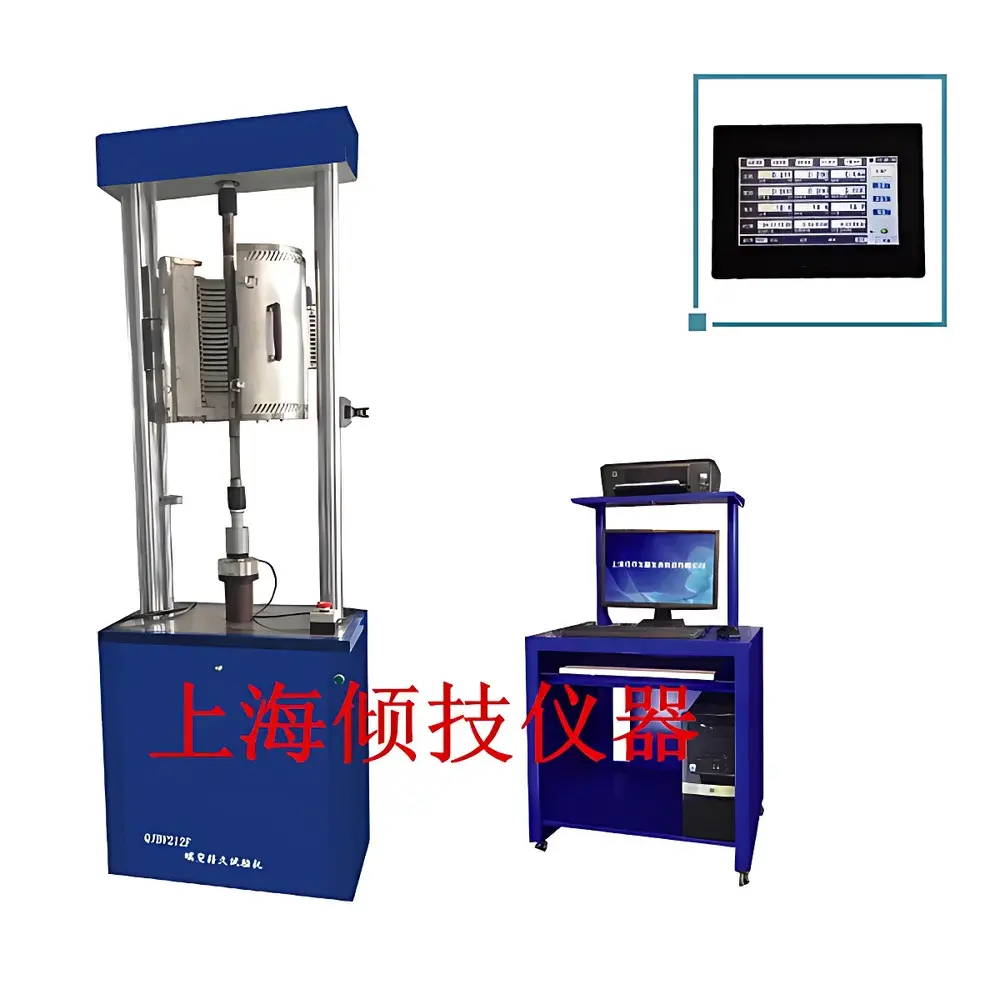
Shanghai Testing Equipment Co. SH Series High-Temperature Creep and Stress-Rupture Testing Machine for Plastics and Metals
| Origin | Shanghai, China |
|---|---|
| Manufacturer Type | Authorized Distributor |
| Origin Category | Domestic (China) |
| Model | SH Series |
| Price | USD 21,000 (FOB Shanghai) |
| Instrument Type | Electromechanical Universal Testing Machine |
| Max Test Load | 10–100 kN (configurable) |
| Temperature Range | RT to 1200 °C |
| Load Control Accuracy | ±1% of setpoint |
| Load Measurement Accuracy | ±0.5% of reading (≥1% FS) |
| Displacement Resolution | 0.1 µm |
| Furnace Bore | φ50 mm |
| Hot Zone Length | >150 mm |
| Temperature Stability | ±0.5 °C |
| Temp Resolution | 0.1 °C |
| Crosshead Speed | 0.01–180 mm/min |
| Stroke | 200 mm |
| Strain Measurement | High-precision linear encoder (range up to 25 mm, ±0.5% accuracy) |
| Power Supply | 3 kW |
| Weight | 850 kg |
Overview
The SH Series High-Temperature Creep and Stress-Rupture Testing Machine is an electromechanical universal testing system engineered for long-term mechanical property evaluation of polymeric and metallic materials under sustained load and elevated temperature conditions. It operates on the principle of uniaxial tensile loading combined with precise thermal control, enabling standardized determination of creep strain rate, time-to-rupture, minimum creep rate, and stress-rupture life—key parameters defined in ASTM E139, ISO 204, GB/T 2039, and HB 5150–5151. Unlike conventional tensile testers, this instrument integrates a high-stability servo-controlled loading train, a programmable high-temperature furnace with axial hot-zone uniformity, and synchronized digital data acquisition to support tests lasting from hours to thousands of hours. Its architecture meets structural and metrological requirements specified in JJG 276–1988 for creep and stress-rupture testing instrumentation, making it suitable for accredited laboratories performing qualification testing in aerospace, power generation, and polymer processing industries.
Key Features
- Modular load frame with rigid four-column design and preloaded ball-screw drive, ensuring minimal deflection and high axial alignment during extended-duration tests
- Five standard load capacity options (10 kN, 20 kN, 30 kN, 50 kN, and 100 kN), each calibrated per ISO 7500-1 Class 0.5 and traceable to national standards
- High-temperature furnace with dual-zone PID control, ceramic fiber insulation, and MoSi₂ heating elements—capable of stable operation from ambient to 1200 °C with ≤±0.5 °C deviation over >150 mm uniform zone
- Non-contact or extensometer-compatible strain measurement using imported optical rotary encoders, offering resolution down to 0.1 µm and linearity error <±0.5% of full scale
- Servo-driven load application with closed-loop feedback; load control resolution of 0.1 N and repeatability within ±1% of set value across full range
- Crosshead speed adjustable from 0.01 to 180 mm/min, supporting both constant-load and constant-rate test protocols per ASTM D2990 and ISO 899-1
- Integrated safety interlocks including over-temperature cutoff, load overload protection, and emergency stop with hardware bypass
Sample Compatibility & Compliance
The SH Series accommodates cylindrical, rectangular, or dog-bone specimens per ISO 527-2, ASTM D638, and GB/T 1040. Specimen grips include pneumatic, wedge-action, and high-temperature alloy variants rated for use up to 1100 °C. The system complies with calibration and verification requirements outlined in JJG 276–1988 and supports audit-ready documentation for GLP and GMP environments. Test reports generated are compatible with FDA 21 CFR Part 11-compliant software modules when integrated with validated third-party data acquisition platforms. All furnace and load train components conform to CE machinery directive (2006/42/EC) and IEC 61000-6-2/6-4 electromagnetic compatibility standards.
Software & Data Management
The system interfaces with PC-based control software supporting multi-channel real-time acquisition (load, displacement, temperature, time) at configurable sampling rates up to 100 Hz. Software features include automated test sequencing, ramp-hold profiles, live curve overlay, and export to CSV, Excel, or XML formats. Raw data files retain embedded metadata (operator ID, calibration date, furnace serial number, load cell ID) to satisfy traceability requirements. Optional add-ons include electronic signature capability, audit trail logging, and integration with LIMS via OPC UA or RESTful API. Firmware updates are delivered through secure HTTPS channels with SHA-256 integrity verification.
Applications
- Determination of creep compliance and rupture life of thermoplastics (e.g., PEEK, PEI, PVDF) and thermosets under service-relevant thermal-mechanical loads
- Evaluation of high-temperature alloy behavior in turbine blade and boiler tube applications per ASME BPVC Section II Part D
- Validation of material models for finite element analysis (FEA) input, including Norton-Bailey and Garofalo constitutive equations
- Quality assurance testing of welded joints and composite laminates subjected to prolonged thermal exposure
- Research into time-dependent deformation mechanisms—including dislocation climb, grain boundary sliding, and polymer chain slippage—under controlled stress states
- Support for certification testing required by ISO 9001, EN 10204 3.1, and AS9100D quality management systems
FAQ
What standards does this machine support for plastic creep testing?
It fully implements ISO 899-1 (plastics – determination of creep behavior), ASTM D2990 (tensile creep of plastics), and GB/T 11546 (creep of plastics under constant load).
Can the system perform both creep and stress-rupture tests simultaneously on multiple specimens?
No—it is a single-station system. However, multi-specimen test sequences can be scheduled consecutively with automatic parameter recall and environmental stabilization.
Is furnace calibration included with delivery?
Yes—a NIST-traceable temperature calibration certificate covering three points (100 °C, 600 °C, 1000 °C) is provided upon factory acceptance testing.
What maintenance intervals are recommended for long-term reliability?
Load cell recalibration every 12 months; furnace thermocouple verification every 6 months; lubrication of lead screws and guides every 2000 operational hours.
Does the controller support remote monitoring via Ethernet or industrial IoT protocols?
Yes—the embedded controller includes Ethernet port with Modbus TCP and optional MQTT support for integration into plant-wide SCADA or predictive maintenance platforms.



