
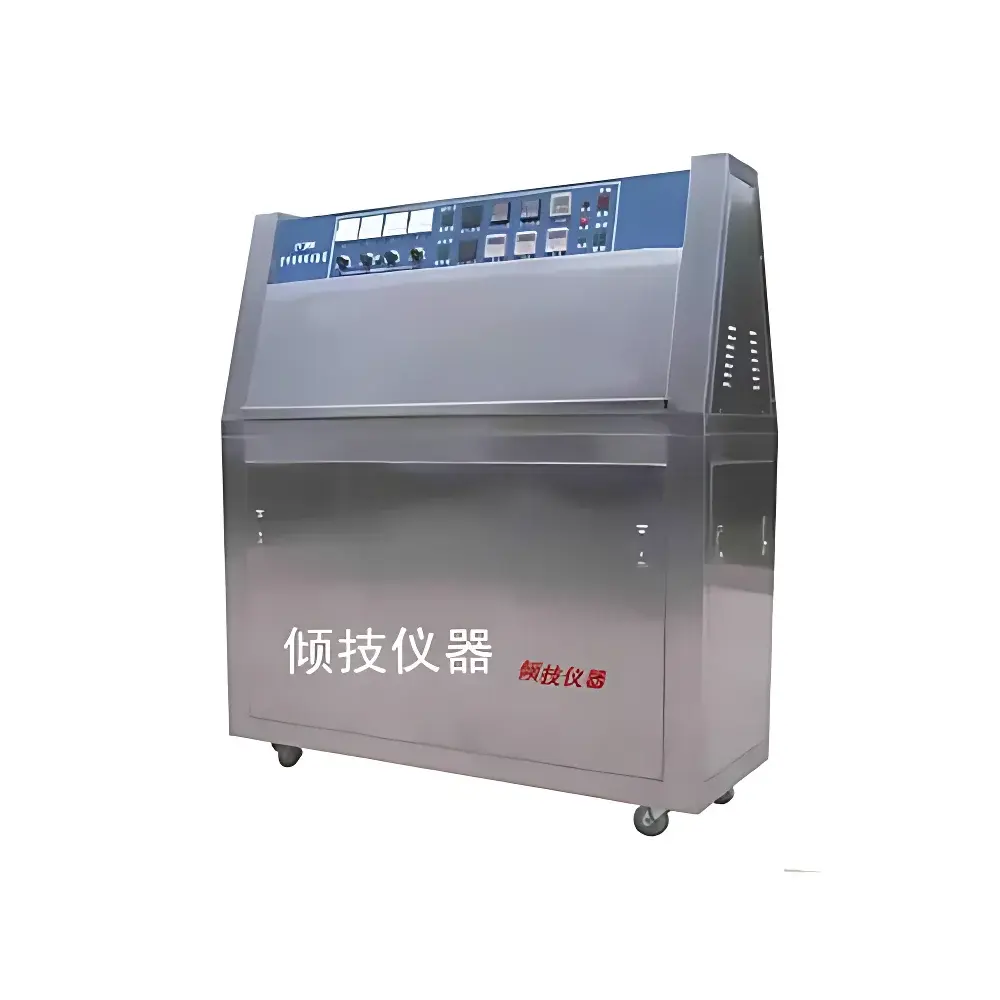
Qingji QUV1003 UV Aging Test Chamber
| Brand | Qingji |
|---|---|
| Origin | Shanghai, China |
| Model | QUV1003 (Spray-type) |
| Illumination Temperature Range | RT+10°C to 70°C |
| Black Panel Temperature Range | RT+10°C to 70°C |
| UV Wavelength | 280–315 nm (UV-B) |
| Chamber Internal Dimensions (L×W×H) | 450 × 1165 × 500 mm |
| Temperature Uniformity | ±3°C |
| Humidity During Condensation | ≥75% RH |
| Cycle Options | 4h UV irradiation / 4h condensation or 8h UV / 4h condensation |
| Lamp Center-to-Center Spacing | 65–70 mm |
| Specimen-to-Lamp Distance | 55 mm |
| Standard Specimen Size | 75 × 150 mm |
| Water Consumption | 8 L/day (deionized or distilled water required) |
| External Dimensions (D×W×H) | 600 × 1325 × 1480 mm |
Overview
The Qingji QUV1003 UV Aging Test Chamber is an engineered environmental test system designed to accelerate material degradation under controlled ultraviolet (UV) radiation, temperature, and moisture exposure. It operates on the principle of UV-B spectral irradiation (280–315 nm), simulating the most photochemically active portion of terrestrial sunlight responsible for polymer chain scission, pigment fading, surface oxidation, and loss of mechanical integrity. Unlike full-spectrum xenon arc testers, the QUV1003 employs fluorescent UV lamps to deliver reproducible, high-intensity UV exposure—enabling rapid evaluation of weathering resistance in plastics, coatings, elastomers, adhesives, and automotive trim materials. Its design complies with core accelerated aging protocols defined in GB/T 14522–1993, and its operational parameters align with internationally recognized practices referenced in ASTM G154 (Standard Practice for Operating Fluorescent Ultraviolet (UV) Lamp Apparatus for Exposure of Non-Metallic Materials) and ISO 4892-3 (Plastics — Methods of Exposure to Laboratory Light Sources — Part 3: Fluorescent UV Lamps).
Key Features
- UV-B fluorescent lamp array (280–315 nm) with calibrated spectral output and stable irradiance over lamp lifetime
- Dual-mode exposure control: programmable UV irradiation cycles (4 h or 8 h) followed by condensation phases (4 h) at precisely regulated black panel temperature (50°C ±3°C)
- Independent illumination and condensation temperature control: RT+10°C to 70°C range for both irradiation and dark/condensation stages
- High-uniformity chamber environment: ±3°C temperature uniformity across specimen plane, ensuring consistent degradation kinetics
- Integrated water spray function (optional configuration) for wet/dry cycling, enabling simulation of rain-induced erosion and thermal shock effects
- Stainless steel interior chamber with corrosion-resistant construction, compatible with long-term exposure to humid and UV-rich atmospheres
- Intuitive digital controller with real-time monitoring of UV intensity, chamber temperature, and condensation duration
Sample Compatibility & Compliance
The QUV1003 accommodates standard test specimens measuring 75 mm × 150 mm, mounted vertically on adjustable specimen racks. Its 450 × 1165 × 500 mm internal volume supports up to 48 standard panels per cycle (depending on fixture configuration). The chamber meets functional requirements for conformance testing per GB/T 14522–1993 and serves as a validated platform for comparative aging studies aligned with ISO 4892-3 Annex A and ASTM D4329 (Standard Practice for Fluorescent UV Exposure of Plastics). While not certified to IEC 60068-2-5 or MIL-STD-810G out-of-the-box, its operational envelope and traceable UV dose delivery support GLP-compliant data generation when paired with external radiometric calibration (e.g., using NIST-traceable UV-A/UV-B sensors). Documentation packages include calibration certificates for temperature sensors and lamp irradiance verification reports.
Software & Data Management
The QUV1003 utilizes an embedded microprocessor-based controller with non-volatile memory for storing up to 10 user-defined test programs. All operational parameters—including UV exposure time, condensation duration, setpoint temperatures, and cycle count—are logged internally with timestamping. Data export is supported via USB interface in CSV format for integration into laboratory information management systems (LIMS) or statistical process control (SPC) software. For regulated environments, optional firmware upgrades enable audit trail functionality compliant with FDA 21 CFR Part 11 requirements, including electronic signatures, user access levels, and immutable event logging for temperature deviations, lamp failure alerts, and program interruptions.
Applications
- Evaluation of UV stability in automotive exterior coatings and plastic fascia components
- Accelerated weathering assessment of architectural sealants, roofing membranes, and PVC window profiles
- Comparative durability testing of aerospace polymer composites exposed to stratospheric UV flux analogs
- Quality assurance of outdoor signage films, textile UV inhibitors, and agricultural mulch films
- R&D screening of photostabilizer efficacy in polyolefin formulations
- Correlation studies between QUV exposure dose (kJ/m² @ 313 nm) and field performance metrics (e.g., gloss retention, ΔE color shift, tensile strength loss)
FAQ
What UV spectrum does the QUV1003 emit, and how is it calibrated?
The chamber uses UV-B fluorescent lamps emitting predominantly between 280–315 nm. Irradiance is calibrated using a broadband UV radiometer traceable to national standards; recommended recalibration every 1,000 operating hours.
Can the QUV1003 replicate xenon arc weathering conditions?
No—it is optimized for UV-B–driven degradation mechanisms, not full-spectrum solar simulation. For broad-band correlation, complementary testing in xenon arc chambers per ISO 4892-2 is advised.
Is distilled water mandatory for condensation and spray functions?
Yes. Conductivity must remain below 5 µS/cm to prevent mineral deposition on lamps and specimens, which would compromise irradiance uniformity and test repeatability.
What maintenance intervals are recommended for routine operation?
Lamp replacement every 1,600–2,000 hours; stainless steel chamber cleaning with pH-neutral detergent biweekly; temperature sensor verification quarterly.
Does the QUV1003 support remote monitoring or Ethernet connectivity?
Standard configuration includes USB data export only. Optional RS-485 or Ethernet modules are available for integration into facility-wide environmental monitoring networks.



