
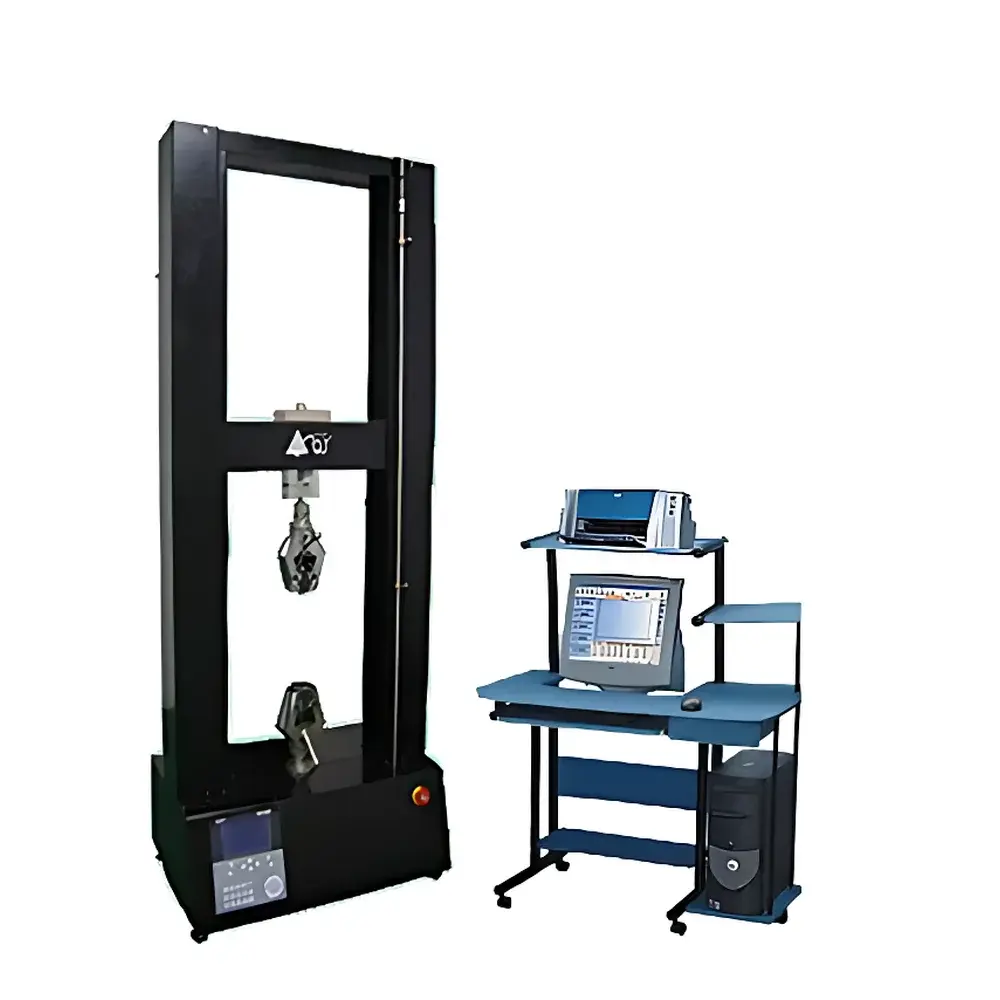
QJ211 Universal Testing Machine (UTM) by Qingji
| Brand | Qingji |
|---|---|
| Origin | Shanghai, China |
| Model | QJ211 |
| Maximum Load Capacity | 30 kN |
| Load Cell Accuracy | 0.01% |
| Measurement Accuracy | < ±0.5% |
| Control System | Windows-based PC control with real-time digital display |
| Effective Test Width | ~420 mm |
| Effective Stroke | ~800 mm |
| Test Speed Range | 0.001–500 mm/min |
| Speed Accuracy | ±0.5% |
| Displacement Accuracy | ±0.5% |
| Deformation Measurement Accuracy | ±0.5% |
| Safety Features | Electronic stroke limit protection, emergency stop button |
| Unit Weight | ~140 kg |
Overview
The QJ211 Universal Testing Machine (UTM) by Qingji is an electromechanical static testing system engineered for precision mechanical property evaluation of solid materials under uniaxial loading conditions. Based on servo-controlled electromechanical actuation and high-resolution load cell transduction, the system implements standardized force-displacement measurement principles in accordance with ISO 7500-1 (Class 0.5), ASTM E4, and ISO 5893. It supports quasi-static tensile, compression, flexural, peel, tear, shear, puncture, and low-cycle fatigue testing—within a maximum capacity of 30 kN—making it suitable for quality control laboratories, R&D centers, and academic institutions conducting routine mechanical characterization per international regulatory frameworks.
Key Features
- High-fidelity load measurement via 0.01% accuracy load cell, traceable to national metrological standards;
- Real-time synchronized digital display of force, displacement, strain, and test speed on integrated controller screen;
- Full Windows-based PC software interface enabling parameter configuration, test sequence programming, and live curve plotting;
- Adjustable crosshead speed range from 0.001 to 500 mm/min with ±0.5% speed fidelity across full range;
- Robust dual-column steel frame architecture with preloaded ball-screw drive system for minimal axial play and high repeatability;
- Comprehensive safety architecture including programmable electronic stroke limits, hardware emergency stop circuitry, and overload cutoff logic;
- Modular fixture interface compatible with standardized wedge-action grips, compression platens, bend fixtures, and custom shear adapters.
Sample Compatibility & Compliance
The QJ211 accommodates specimens ranging from thin polymer films (<0.1 mm thickness) to metallic rods (up to Ø25 mm), composites, elastomers, textiles, adhesives, and biomedical scaffolds. Its effective test width (~420 mm) and stroke (~800 mm) support standard ISO 527, ASTM D638, ASTM D790, ASTM D1876 (T-peel), ASTM D624 (tear), and ISO 37 configurations. The system is validated for compliance with ISO/IEC 17025 documentation requirements and supports audit-ready data generation aligned with GLP and GMP environments. While not inherently 21 CFR Part 11 compliant, the software architecture permits integration with third-party electronic signature and audit trail modules upon customer specification.
Software & Data Management
The proprietary Windows-native software provides full I/O control, real-time graphing (force vs. displacement, stress vs. strain), and post-test analysis tools including modulus calculation (secant/tangent), yield point detection (0.2% offset), elongation at break, and energy absorption (area under curve). All raw data are stored in open-format ASCII or CSV files; no proprietary binary lock-in occurs. Users may perform interactive curve manipulation—such as overlaying multiple tests, zooming, baseline correction, and annotation—without reprocessing. Export options include PDF reports with embedded metadata (operator ID, timestamp, environmental conditions, calibration certificate ID), PNG/SVG vector graphics, and Excel-compatible datasets. Calibration parameters are password-protected and logged with versioned timestamps.
Applications
- Tensile strength and elongation testing of thermoplastics, thermosets, and fiber-reinforced composites per ASTM D638 and ISO 527;
- Compression behavior of foams, ceramics, and pharmaceutical tablets (ISO 13314, USP <1217>);
- Flexural modulus and strength determination of laminates and structural profiles (ASTM D790, ISO 178);
- Peel adhesion assessment of pressure-sensitive tapes and laminated packaging (ASTM D903, ISO 8510-2);
- Shear strength quantification of bonded joints, riveted assemblies, and tissue-engineered constructs using custom shear fixtures;
- Cyclic loading protocols for low-frequency fatigue evaluation (e.g., rubber hysteresis, seal compression set);
- Educational use in materials science curricula for hands-on verification of Hooke’s law, Poisson’s ratio, and plastic deformation theory.
FAQ
What international standards does the QJ211 support out-of-the-box?
The system includes pre-configured test methods for ISO 527, ASTM D638, ASTM D790, ASTM D1876, and ISO 37. Additional standards can be implemented via user-defined test templates.
Is the load cell factory-calibrated and traceable?
Yes—each unit ships with a NIST-traceable calibration certificate issued by an accredited third-party metrology lab, valid for 12 months under normal operating conditions.
Can the machine perform closed-loop strain control?
Strain control requires optional extensometer integration (e.g., clip-on or video-based). The base configuration operates in displacement- or load-controlled modes only.
What maintenance intervals are recommended?
Lubrication of lead screws and inspection of grip jaw surfaces are advised every 500 operational hours; annual recalibration and mechanical alignment verification are strongly recommended.
Does the software support multi-user role-based access?
Standard software offers single-user operation. Role-based permissions (e.g., operator, supervisor, administrator) require enterprise license upgrade and domain integration.



