
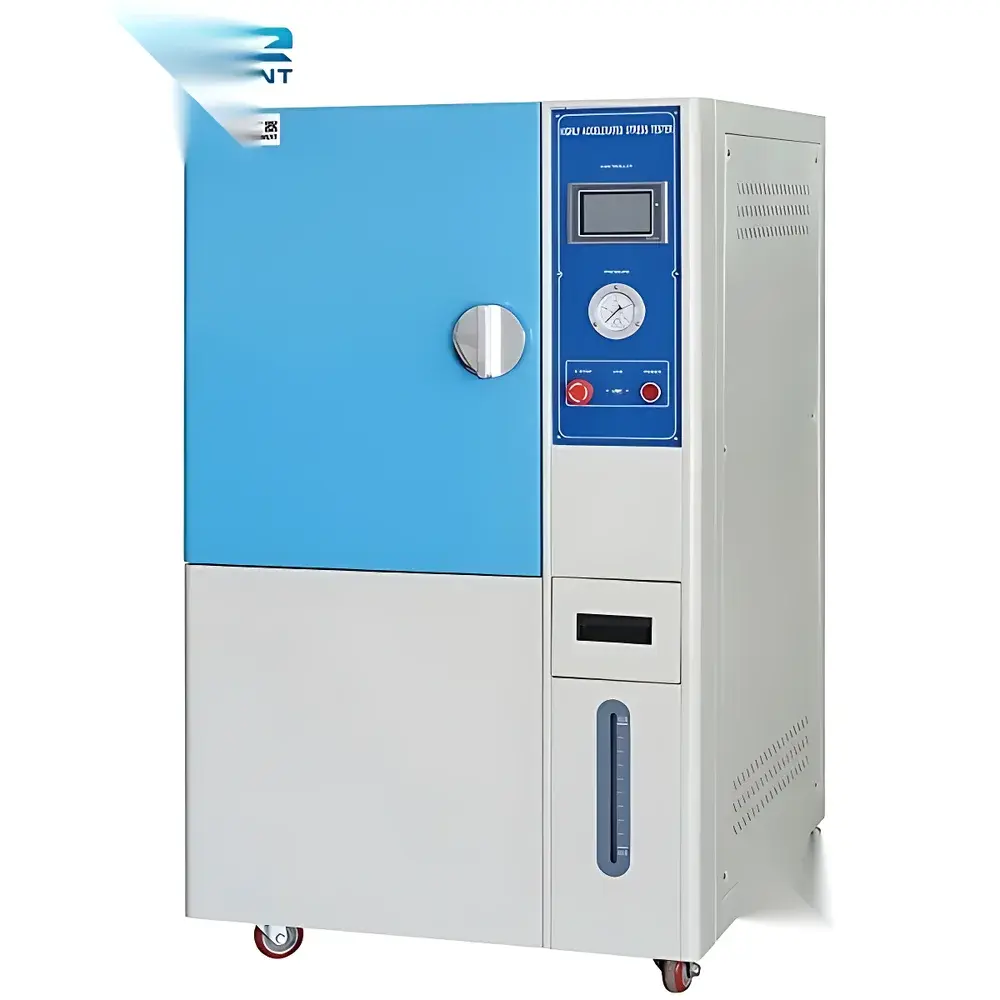
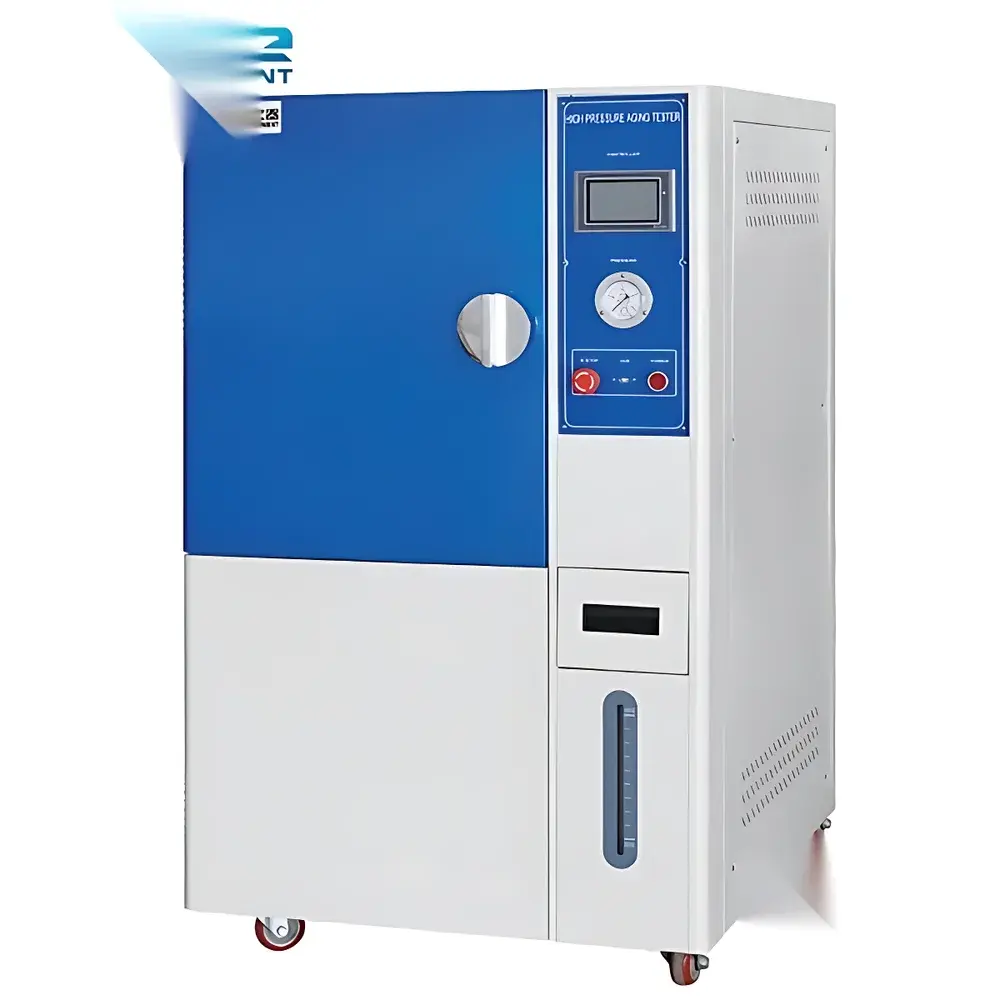
Other Brands HAST-600 High-Accelerated Stress Test Chamber
| Brand | Other Brands |
|---|---|
| Origin | Imported |
| Manufacturer Type | Authorized Distributor |
| Pressure Range | 0–6 kg/cm² (0–0.6 MPa) |
| Operating Pressure | 2.0 kg/cm² (≈200 kPa gauge) |
| Temperature Range | +100°C to +132°C (saturated steam) |
| Humidity Range | 75–100% RH (saturated vapor) |
| Temperature Control | PID microprocessor with K-type thermocouple input, SSR output, RT+10°C to 200°C |
| Time Setting Range | 0.00–999.00 hours |
| Pressurization Time | ≤45 min (0 → 2.0 kg/cm²) |
| Safety Features | Automatic pressure release, vacuum break, door interlock with pressure-dependent sealing, integrated water replenishment (up to 1000 h runtime per fill) |
| Compliance | ASTM D2247, IEC 60068-2-66, JIS C 60068-2-66, MIL-STD-883 Method 1008.3, ISO 16750-4, UL 746C, NACE TM0177, BS EN 60068-2-66 |
Overview
The Other Brands HAST-600 High-Accelerated Stress Test (HAST) Chamber is an engineered environmental stress screening system designed for rapid reliability assessment of hermetically sealed and moisture-sensitive electronic components, printed circuit boards (PCBs), IC packages, LED modules, and automotive electronics. Unlike conventional temperature-humidity storage tests, the HAST-600 operates under elevated temperature, high relative humidity, and controlled overpressure—typically at 130°C and 85% RH at 200 kPa gauge pressure—to accelerate moisture diffusion into encapsulants, die attach materials, and wire bond interfaces. This accelerates failure mechanisms including corrosion, intermetallic growth, delamination, and electrochemical migration (ECM), enabling early detection of design or process weaknesses during product development and qualification phases.
Key Features
- Robust cylindrical horizontal test chamber with seamless stainless-steel inner tank and reinforced door sealing mechanism—designed to eliminate condensate drip and prevent direct steam jet exposure to operators.
- PID-controlled pressurized steam environment using a dedicated computer-based pressure regulator (0–6 kg/cm² range), ensuring stable and repeatable overpressure conditions up to 200 kPa (2.0 kg/cm²) with ≤±5 kPa regulation accuracy.
- Independent dual-loop control: one for saturated steam temperature (100–132°C) and another for chamber pressure—both synchronized to maintain thermodynamic equilibrium and avoid superheated vapor formation.
- Integrated vacuum-assisted air purge system prior to test initiation; removes ambient oxygen and particulates to minimize oxidation and ensure contaminant-free test atmosphere per IEC 60068-2-66 requirements.
- Automated safety sequence: real-time pressure/temperature interlock, door lock activation only when internal pressure drops below atmospheric, automatic depressurization and vacuum break upon cycle completion, and fail-safe water replenishment logic supporting continuous operation up to 1000 hours without manual intervention.
- Microprocessor-based VT-4810 controller with dual digital display (PV/SV), K-type thermocouple input, zero-cross SSR output, and programmable ramp-soak profiles with up to 999-hour duration capability.
Sample Compatibility & Compliance
The HAST-600 accommodates standard JEDEC trays, FR-4 PCB panels (up to 400 × 400 mm), molded IC packages (QFP, BGA, CSP), LED assemblies, and multi-layer flex-rigid boards. Its uniform steam circulation architecture—based on natural convection of saturated vapor—ensures spatial temperature and humidity homogeneity within ±1.5°C and ±3% RH across the working volume. The system meets full compliance with international qualification standards including IEC 60068-2-66 (HAST method), JIS C 60068-2-66, MIL-STD-883 Method 1008.3 (Highly Accelerated Temperature and Humidity Stress Test), ASTM D2247 (for coating integrity), ISO 16750-4 (road vehicle environmental testing), UL 746C (polymeric materials), and NACE TM0177 (sulfide stress cracking evaluation). All operational logs—including pressure, temperature, time, and door status—are timestamped and stored for GLP/GMP audit readiness.
Software & Data Management
While the base configuration utilizes the embedded VT-4810 controller, optional Ethernet-enabled data logging modules support remote monitoring via Modbus TCP or OPC UA protocols. Real-time acquisition of pressure, temperature, and cycle phase enables integration into centralized MES or LIMS platforms. Audit trails comply with FDA 21 CFR Part 11 requirements when paired with validated user access controls and electronic signature modules. Data export formats include CSV and PDF reports with traceable calibration metadata, suitable for regulatory submissions and internal FA (failure analysis) workflows.
Applications
- Rapid qualification of new packaging materials and mold compound formulations against moisture-induced failure modes.
- Design verification of conformal coatings, potting compounds, and hermetic seals in automotive ADAS sensors and power modules.
- Process validation for reflow soldering, wire bonding, and underfill dispensing in high-reliability manufacturing lines.
- Root cause analysis of field returns linked to latent moisture ingress or interfacial degradation.
- Compliance testing for AEC-Q200, IPC-9701, and JEDEC JESD22-A110 reliability standards.
FAQ
What is the difference between HAST and traditional THB (Temperature-Humidity-Bias) testing?
HAST replaces ambient-pressure humidity exposure with pressurized saturated steam, increasing the partial pressure of water vapor and significantly accelerating moisture penetration—typically achieving equivalent failure acceleration in 96–200 hours versus 1000+ hours in THB.
Can the HAST-600 be used for non-electronic materials such as adhesives or elastomers?
Yes, provided material thermal stability exceeds 132°C and chemical compatibility with saturated steam is confirmed; applications include sealant aging, gasket compression set evaluation, and polymer hydrolysis kinetics studies.
Is external cooling water required for condensation management?
No—the system uses internal heat exchange and gravity-driven condensate return; no chiller or external water loop is needed for standard operation.
How is calibration traceability maintained?
The unit supports third-party calibration using NIST-traceable pressure transducers and Class A PT100 probes; calibration certificates and uncertainty budgets are generated per ISO/IEC 17025 guidelines.
Related Products



