
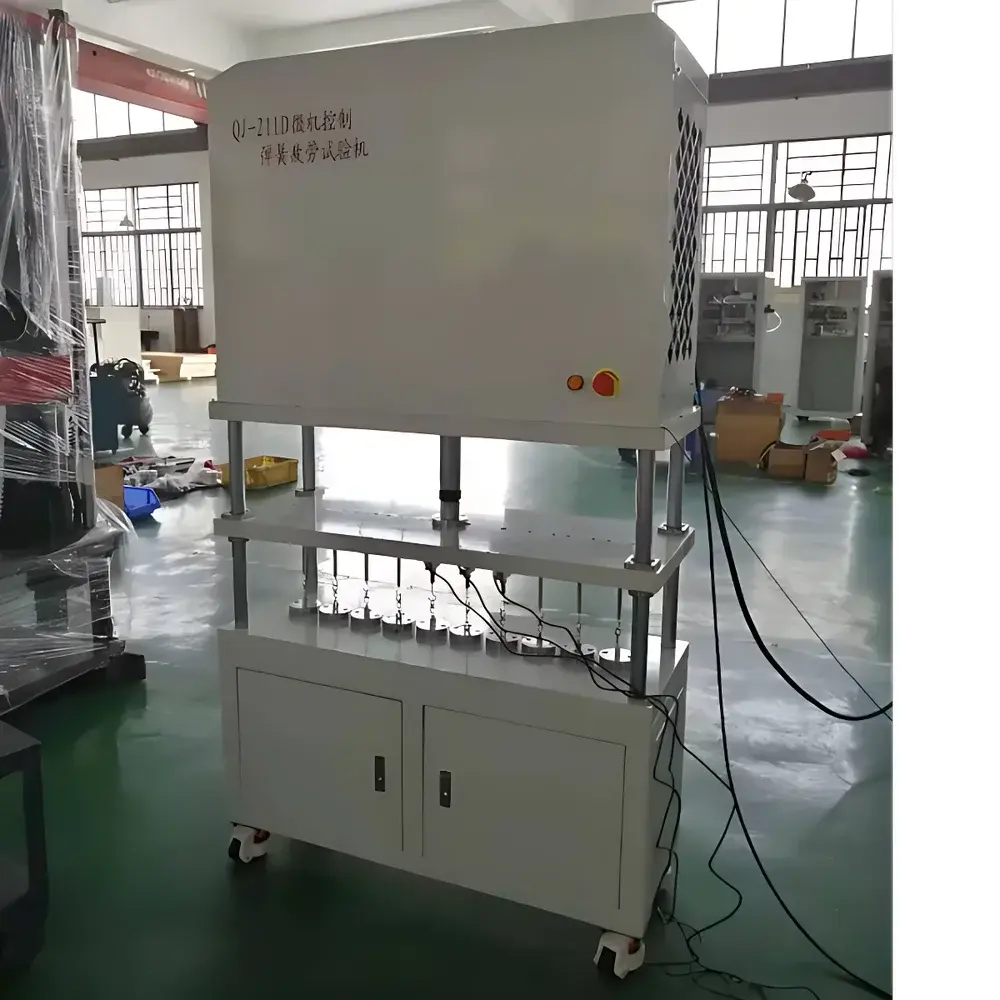
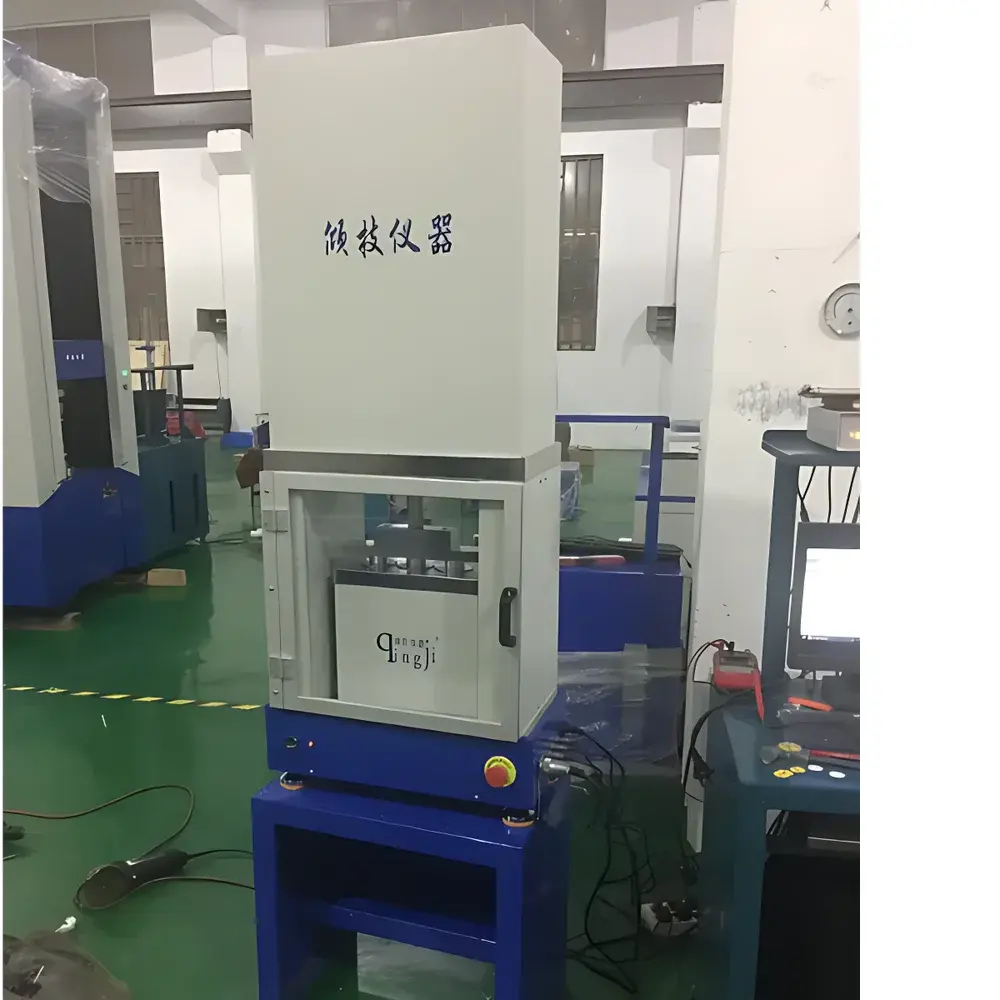
Qinji QJPL-20KN Multi-Station Dynamic Spring Tension-Compression Fatigue Testing Machine
| Brand | Qinji |
|---|---|
| Origin | Shanghai, China |
| Model | QJPL-20KN |
| Max Test Force | 0–50 kN |
| Frequency Range | 0.001–10 Hz (amplitude-dependent) |
| Actuator Stroke | 100 mm |
| Effective Test Width | 60 mm × multiple stations |
| Displacement Resolution | 0.001 mm |
| Load Accuracy | ±0.5% of reading |
| Load Measurement Range | 0.2–100% of full scale |
| Load Resolution | 1/30,000 (dynamic 10 kHz sampling) |
| Overload Protection | +10% of full scale |
| Power Supply | 220 V, 2 kW |
| Host Weight | ~850 kg |
Overview
The Qinji QJPL-20KN Multi-Station Dynamic Spring Tension-Compression Fatigue Testing Machine is an electromechanical servo-hydraulic or electrodynamic fatigue system engineered for high-reproducibility axial cyclic loading of metallic and composite elastic components. It operates on the principle of controlled sinusoidal or user-defined waveform displacement excitation, applying precise tensile-compressive loads to simulate real-world service conditions—including clutch spring engagement cycles, suspension rebound events, valve train dynamics, and pneumatic actuator duty profiles. Unlike single-station systems, its modular multi-position architecture enables parallel testing of up to six identical or heterogeneous springs under synchronized or independent load/displacement control—significantly improving throughput for quality assurance in high-volume spring manufacturing and validation laboratories.
Key Features
- Multi-station configuration supporting 2, 3, 5, or 6 simultaneous test positions—configurable per customer-specified spring geometry and mounting interface
- High-fidelity closed-loop control with dual feedback: load cell (0.5-class accuracy) and linear variable differential transformer (LVDT) displacement sensor (0.001 mm resolution)
- Wide dynamic frequency range: 0.001–10 Hz, adjustable in real time via amplitude constraints; optimized for low-cycle fatigue (LCF), high-cycle fatigue (HCF), and step-stress testing protocols
- Full-scale force capacity of 0–50 kN with uniform resolution across the entire range—no manual range switching required
- 100 mm stroke actuator with mid-stroke adjustability and mechanical limit protection, ensuring safe operation during extended unattended tests
- Dual-speed crosshead control (fast approach/slow test mode) with jog functionality and programmable return-to-start behavior
- Integrated overload cut-off at +10% of selected full-scale load, plus hardware-based end-of-travel limit switches
- Robust structural frame weighing ~850 kg, designed to minimize resonance coupling and maintain measurement stability during multi-channel excitation
Sample Compatibility & Compliance
The system accommodates cylindrical, conical, helical, and disc-type springs with outer diameters up to 60 mm and free lengths within 240 mm. Custom compression fixtures are provided based on client-supplied dimensional drawings—ensuring proper alignment, axial load transmission, and minimal bending moment introduction. All mechanical interfaces comply with ISO 7500-1 (static calibration) and ISO 4965 (dynamic force calibration) traceability requirements. The machine supports test execution in accordance with ASTM E466 (standard practice for conducting force-controlled constant amplitude axial fatigue tests) and ISO 10293 (metallic materials — fatigue testing — axial strain-controlled method). Its control architecture meets GLP audit readiness standards, including electronic signature support and configurable audit trails for test parameter changes.
Software & Data Management
The included PC-based fatigue test software provides ISO/IEC 17025-aligned data acquisition, real-time waveform visualization, and automated cycle counting per ASTM E1012. It supports user-defined test sequences—including block loading, staircase methods, and progressive amplitude sweeps—with automatic pass/fail evaluation against pre-set criteria (e.g., stiffness degradation >5%, cycle count at fracture, or displacement drift beyond threshold). Raw data is stored in vendor-neutral ASCII format with timestamped metadata (test ID, operator, environmental conditions, calibration status). Software includes built-in report generation compliant with FDA 21 CFR Part 11 requirements—featuring electronic signatures, audit logs, and role-based access control. Backup media (DVD-ROM) and full documentation suite—including installation checklist, calibration certificate templates, and maintenance schedule—are supplied.
Applications
- Automotive OEMs and Tier-1 suppliers validating clutch release springs, brake booster diaphragms, and engine valve springs under thermal-cycled fatigue conditions
- Industrial equipment manufacturers certifying vibration-damping coil springs used in compressors, conveyors, and hydraulic accumulators
- Medical device firms assessing fatigue resistance of nitinol-based orthodontic archwires and implantable actuator springs
- Academic research labs studying microstructural evolution in austenitic stainless steels under asymmetric tension-compression cycling
- Third-party certification bodies performing accredited fatigue life verification per EN 13298 (springs for railway applications)
FAQ
What is the maximum number of springs that can be tested simultaneously?
Up to six springs may be tested in parallel using dedicated station modules—each independently instrumented and controllable.
Does the system support non-sinusoidal waveforms such as trapezoidal or sawtooth loading profiles?
Yes—the controller firmware supports arbitrary waveform definition via CSV import or point-by-point segment programming.
Is the software validated for regulated environments (e.g., pharmaceutical or aerospace QA labs)?
The software includes configurable 21 CFR Part 11 compliance features, including electronic signatures, change history tracking, and secure user authentication.
Can the machine perform static tensile/compression tests in addition to fatigue cycling?
Yes—quasi-static modes (e.g., force-ramp, displacement-ramp, stress relaxation) are fully supported and calibrated per ISO 7500-1.
What maintenance intervals are recommended for long-term reliability?
Preventive maintenance is advised every 1,000 operational hours or annually—whichever occurs first—with emphasis on actuator seal inspection, load cell zero-check, and fixture wear assessment.



