
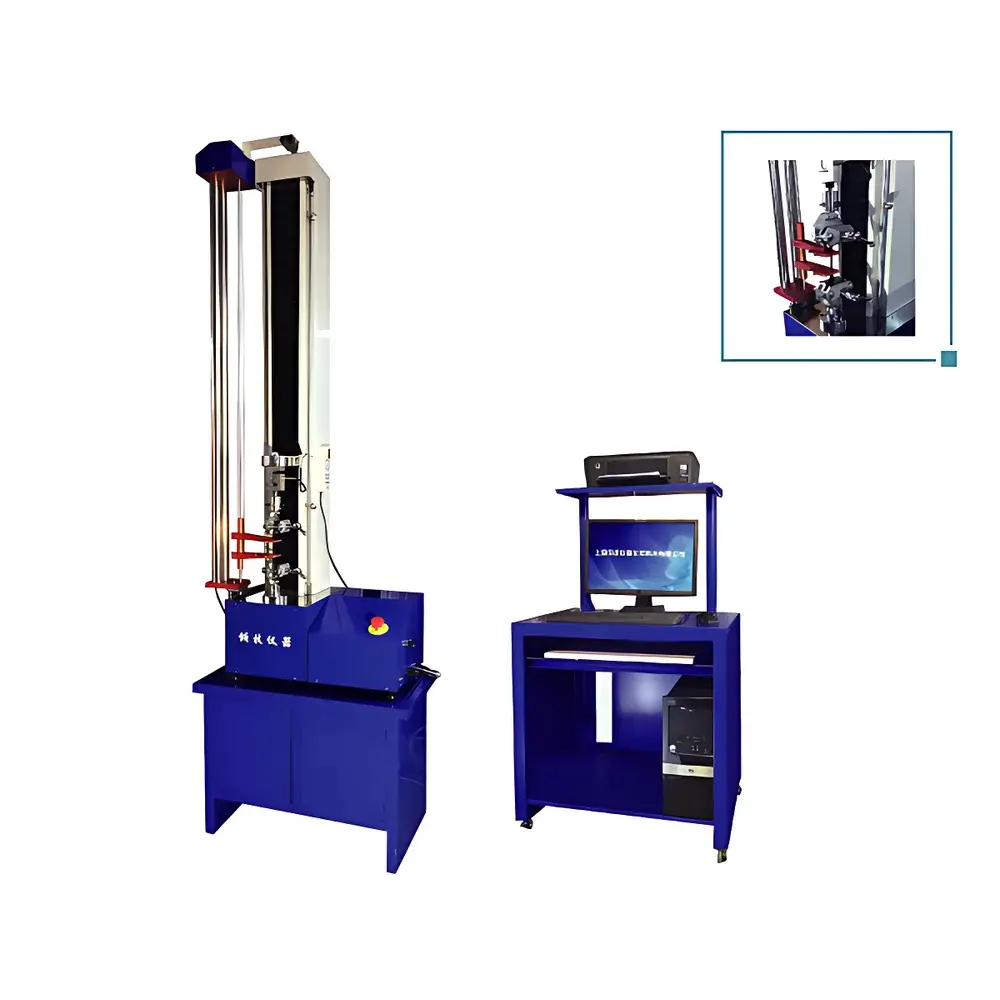
QJ210A Rubber 90° Peel Strength Tester – Electronic Universal Testing Machine
| Origin | Shanghai, China |
|---|---|
| Manufacturer Type | Authorized Distributor |
| Origin Category | Domestic (PRC) |
| Model | QJ210A |
| Price | USD 5,600 (FOB Shanghai) |
| Instrument Type | Electromechanical Universal Testing Machine |
| Accuracy Class | 0.5 |
| Max Load Capacity | 5 kN (with auto-ranging from 5 N to 5,000 N) |
| Effective Test Width | 150 mm |
| Max Travel Distance | 800 mm |
| Speed Range | 0.01–500 mm/min (±0.5% speed accuracy) |
| Force Resolution | 500,000 counts full-scale, no internal range switching |
| Displacement & Strain Accuracy | ±0.5% of reading |
| Sensor Origin | USA-made high-precision load cell |
| Controller | Panasonic all-digital AC servo system |
| Safety Features | Software-based diagnostics, electronic travel limits, 110% overload protection |
| Power Supply | 200 V AC, 400 W |
| Dimensions (L×W×H) | 590 × 355 × 1640 mm |
| Net Weight | 85 kg |
Overview
The QJ210A Rubber 90° Peel Strength Tester is a precision-engineered electromechanical universal testing machine designed for standardized static mechanical characterization of elastomeric, polymeric, and pressure-sensitive adhesive systems. It operates on the principle of controlled displacement-driven force measurement, compliant with ASTM D903, ISO 8510-2, and GB/T 7753 for 90° peel adhesion evaluation — a critical parameter in quality assurance for rubber-to-substrate bonding, tire cord adhesion, medical device laminates, and automotive sealing tapes. The system integrates a high-stiffness dual-column frame, a low-inertia crosshead drive, and closed-loop control of force, displacement, and strain, enabling reproducible execution of tensile, compression, flexural, shear, peel, tear, and hold tests per ISO 527, ASTM D638, ASTM D790, and ASTM D1876. Its 0.5-class accuracy certification ensures traceability to national metrological standards, supporting GLP-compliant test documentation and audit-ready data integrity.
Key Features
- Full-range force sensing from 5 N to 5,000 N with seamless auto-ranging and constant 500,000-count resolution — eliminating manual range switching and preserving signal fidelity across low-load peel initiation and high-force substrate rupture.
- Panasonic all-digital AC servo controller delivering precise velocity control (0.01–500 mm/min) with ≤±0.5% deviation, essential for capturing rate-dependent viscoelastic transitions in rubber compounds and hot-melt adhesives.
- Dual-mode crosshead actuation: independent fast/slow positioning for rapid setup and fine-tuned test initiation; programmable return-to-start function for batch testing efficiency.
- Integrated safety architecture: real-time software diagnostics, hardware-enforced electronic travel limits, and automatic shutdown at 110% of set load limit — meeting IEC 61000-6-2 EMC and ISO 12100 functional safety guidelines.
- Modular fixture interface supporting ISO-standard 90° peel jigs (e.g., ASTM D903 mandrel), pneumatic clamps for low-slippage gripping, and customizable tooling for non-standard substrates (metal foil, fabric, EPDM gaskets).
- Compliance-ready firmware with configurable audit trails, user-level access controls, and timestamped metadata — facilitating alignment with FDA 21 CFR Part 11 requirements for regulated laboratories.
Sample Compatibility & Compliance
The QJ210A accommodates specimens up to 150 mm wide and 800 mm effective stroke length, suitable for standard 25 mm-wide rubber strips, laminated composite coupons, and flexible packaging films. It supports both rigid and highly extensible materials through adaptive grip pressure control and slip-resistant jaw surfacing (optional serrated or coated platens). Test protocols adhere to international standards including ASTM D903 (peel strength), ASTM D412 (tensile properties of vulcanized rubber), ISO 37 (rubber tensile testing), and ISO 1133 (melt flow index correlation studies). All calibration certificates are issued per ISO/IEC 17025-accredited procedures, with optional third-party verification available upon request.
Software & Data Management
The system ships with proprietary WinTest v4.2 software — a Windows-based platform compliant with 21 CFR Part 11 Annex 11 requirements. It provides real-time graphical monitoring of load-displacement curves, automated calculation of peel strength (N/mm), tensile modulus, elongation at break, yield point, and energy-to-break (area under curve). Data export formats include CSV, XML, and PDF reports with embedded digital signatures. Audit logs record operator ID, test parameters, calibration events, and modification history. Optional integration with LIMS via OPC UA or RESTful API enables centralized data aggregation and statistical process control (SPC) charting.
Applications
- Quantification of interfacial bond strength between cured rubber and steel cord, brass-coated wire, or textile reinforcement in tire manufacturing.
- Quality control of pressure-sensitive adhesives (PSAs) used in medical transdermal patches, where peel consistency directly correlates with patient compliance and dosing accuracy.
- Evaluation of aging effects (heat, ozone, UV exposure) on rubber–adhesive interfaces via comparative peel testing before/after accelerated weathering per ASTM G154.
- R&D validation of novel silicone-based release liners and fluoropolymer-coated substrates requiring ultra-low peel forces (<100 mN/mm).
- Failure mode analysis of multi-layer elastomer composites subjected to cyclic peel loading, supporting fatigue life modeling per ISO 6988.
FAQ
What standards does the QJ210A support for rubber peel testing?
ASTM D903, ISO 8510-2, GB/T 7753, and JIS K 6854-2 — with preconfigured test templates and report formats.
Can the system perform simultaneous force and displacement control during peel tests?
Yes — it supports dual-closed-loop control modes: force-controlled ramp-to-peel, displacement-controlled constant-rate peel, and hybrid load-hold sequences.
Is third-party calibration and ISO/IEC 17025 certification available?
Yes — factory calibration includes NIST-traceable load cell verification; accredited calibration services are offered with turnaround within 10 business days.
What is the minimum measurable peel force resolution?
At full 5 kN capacity, resolution is 0.01 N; at 5 N range, it achieves 0.0001 N — sufficient for micro-peel characterization of thin-film coatings.
Does the software support multi-user environments with role-based permissions?
Yes — administrator, technician, and reviewer roles with password protection, electronic signatures, and immutable audit trails per 21 CFR Part 11.



