
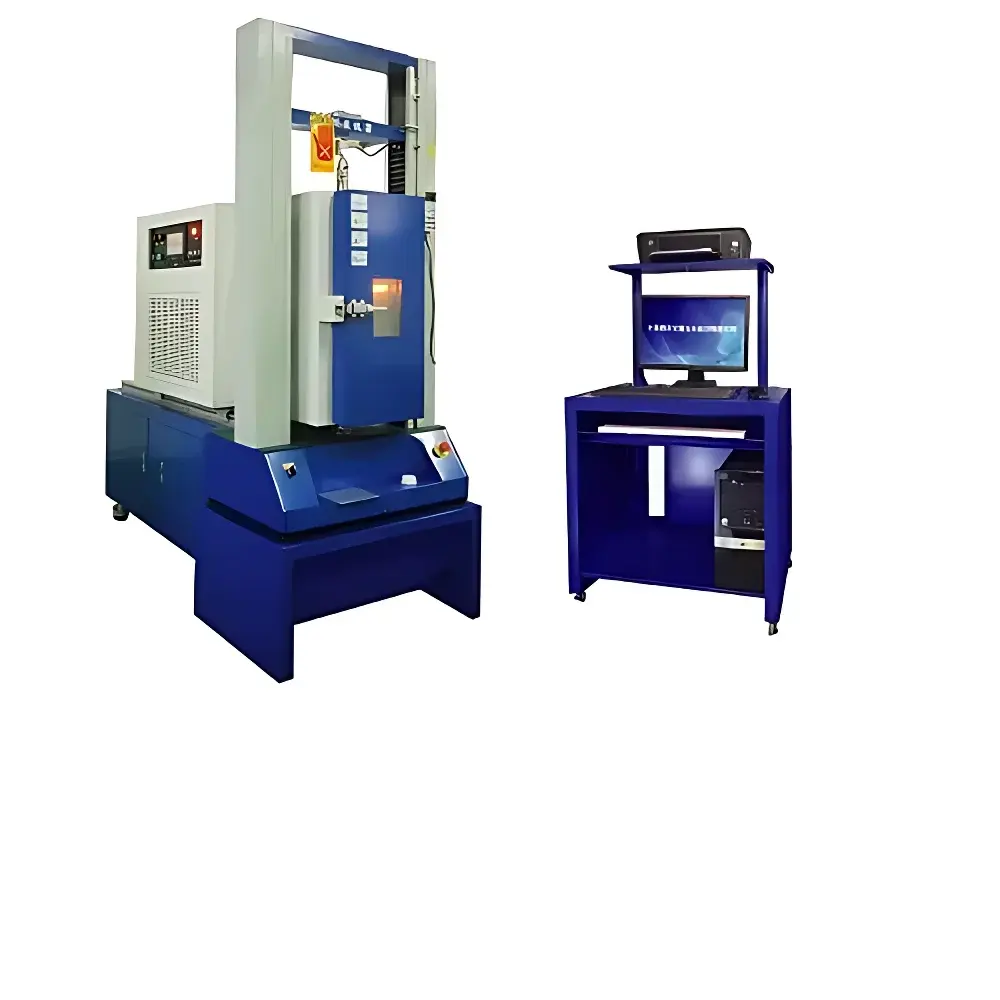
QJ211B High-Temperature Tensile Testing Machine
| Key | Origin: Shanghai, China |
|---|---|
| Manufacturer Type | Authorized Distributor |
| Country of Origin | China |
| Model | QJ211B |
| Maximum Test Load | 30 kN |
| Load Range | 0–30 kN (adjustable) |
| Load Accuracy Class | Class 1 (per ISO 7500-1) |
| Crosshead Travel | 420 mm |
| Displacement Resolution | ±0.5% of reading |
| Temperature Range | –7 °C to +350 °C (stable at 350 °C) |
| Heating/Cooling Rate | ≥5 °C/min |
| Temperature Control Resolution | 0.1 °C |
| Test Speed Range | 0.01–500 mm/min (extendable to 1000 mm/min) |
| Speed Accuracy | ±0.5% |
| Strain Measurement Accuracy | ±0.5% |
| Safety Features | Electronic limit switches, emergency stop circuit |
| Machine Weight | 265 kg |
Overview
The QJ211B High-Temperature Tensile Testing Machine is an electromechanical universal testing system engineered for precise mechanical property evaluation of metallic, polymeric, ceramic, and composite materials under controlled thermal conditions. It operates on the principle of servo-controlled axial force application combined with real-time load-displacement feedback, enabling static and quasi-static tensile, compression, flexure, peel, tear, shear, and low-cycle fatigue testing. Its integrated high-temperature chamber—capable of stable operation up to 350 °C and rapid thermal ramping (≥5 °C/min)—allows direct correlation of microstructural evolution with macroscopic mechanical response. Unlike ambient-only testers, the QJ211B maintains ASTM E8/E8M, ISO 6892-1, GB/T 228.1, JIS Z 2241, and DIN 50125 compliance across its full temperature range, making it suitable for R&D labs, quality control departments, and certification bodies requiring traceable, standards-aligned data.
Key Features
- Modular thermal chamber design: Removable high-temperature furnace enables seamless transition to ambient-condition testing—maximizing lab flexibility without hardware reconfiguration.
- Class 1 load measurement per ISO 7500-1: Achieved via a high-stability 30 kN load cell with 0.01% full-scale resolution and temperature-compensated signal conditioning.
- Precision crosshead actuation: Brushless servo motor drive with closed-loop position control ensures speed accuracy within ±0.5% across the full 0.01–500 mm/min range (optional extension to 1000 mm/min).
- Thermal stability architecture: Dual-zone PID temperature controller with 0.1 °C resolution and active chamber insulation minimizes thermal gradient effects on load frame integrity.
- Comprehensive safety integration: Redundant electronic travel limits, hardware-based emergency stop circuitry, and software-enforced operational boundaries comply with ISO 13857 and IEC 61508 functional safety requirements.
- Robust mechanical construction: Cast-iron base and reinforced steel load frame ensure long-term dimensional stability and minimal deflection (<0.02 mm/kN) during high-load testing.
Sample Compatibility & Compliance
The QJ211B accommodates standard test specimens per ISO 6892-1 (dog-bone, flat, round), ASTM E8 (tensile bars), and GB/T 228.1 (metallic materials), with adjustable grips supporting widths up to 420 mm and effective test lengths up to 800 mm (extendable). Its thermal chamber permits direct mounting of extensometers rated for ≤350 °C, enabling true strain measurement under elevated temperatures. The system meets GLP documentation requirements through audit-trail-enabled software and supports FDA 21 CFR Part 11 compliance when configured with electronic signatures and user access controls. All calibration certificates are traceable to NIM (National Institute of Metrology, China) and NIST-equivalent reference standards.
Software & Data Management
Built-in Windows-based control and analysis software provides synchronized acquisition of load, displacement, temperature, and optional strain channels at up to 1 kHz sampling rate. Real-time curve overlay, automatic yield point detection (0.2% offset method), modulus calculation (tangent/secant), and fracture energy integration are preconfigured per ISO 6892-1 Annex A. Raw data exports in CSV, Excel, and XML formats include metadata (test parameters, environmental conditions, operator ID, timestamp). Software supports batch report generation compliant with ISO/IEC 17025 reporting requirements, including uncertainty estimation per GUM (Guide to the Expression of Uncertainty in Measurement).
Applications
- Evaluation of creep resistance and thermal softening behavior in aerospace superalloys (e.g., Inconel 718, Ti-6Al-4V) at service-relevant temperatures.
- Characterization of polymer melt strength and viscoelastic transitions (Tg, Tm) in thermoplastics and elastomers.
- Validation of brazed or welded joint integrity under thermal cycling protocols per ASME BPVC Section IX.
- Quality assurance of high-temperature sealants, refractory composites, and ceramic matrix materials used in energy infrastructure.
- Material qualification for automotive exhaust components subject to cyclic thermal-mechanical loading.
FAQ
What standards does the QJ211B support for high-temperature tensile testing?
It complies with ISO 6892-2 (metallic materials at elevated temperatures), ASTM E21 (tensile tests at elevated temperatures), GB/T 4338 (metallic materials—tensile testing at elevated temperatures), and JIS Z 2271.
Can the system perform strain-controlled fatigue tests?
Yes—when equipped with a high-temperature extensometer and optional fatigue module, it supports low-cycle fatigue (LCF) testing with programmable strain amplitude and hold time profiles.
Is third-party calibration included with purchase?
A full factory calibration certificate traceable to national metrology institutes is provided; on-site verification by accredited third-party labs is available upon request.
What maintenance intervals are recommended for the thermal chamber?
Chamber insulation integrity and heater element resistance should be verified quarterly; thermocouple calibration is recommended before each high-temperature test series.
Does the system support automated specimen identification via barcode scanning?
Yes—the software API allows integration with LIMS systems and external barcode readers for unattended test initiation and sample tracking.



