
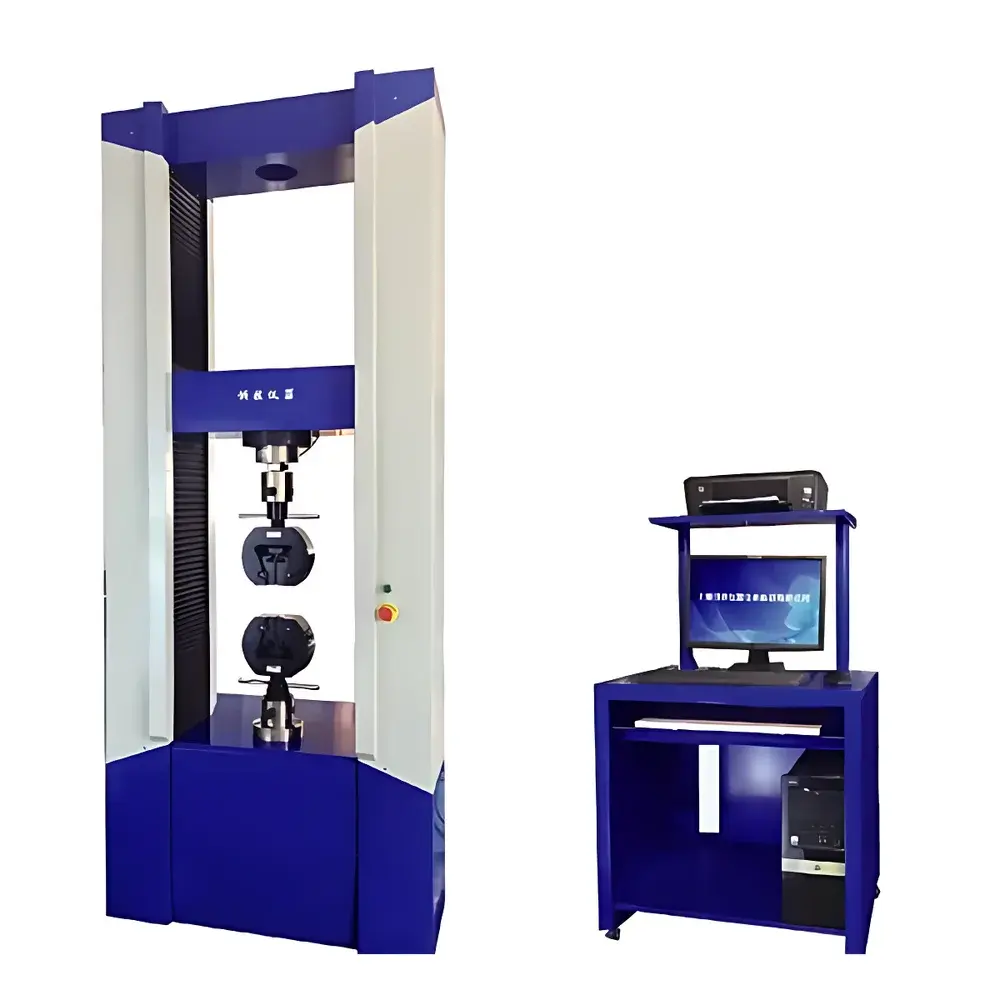
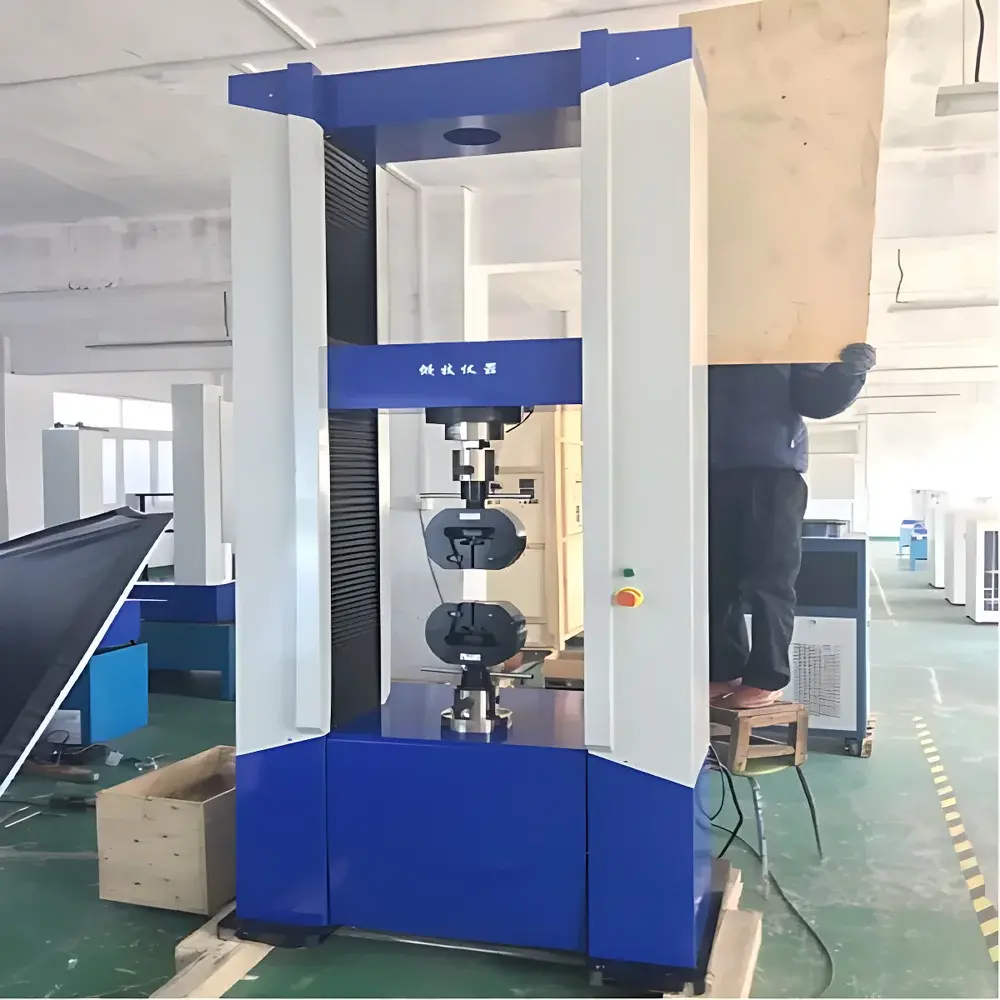
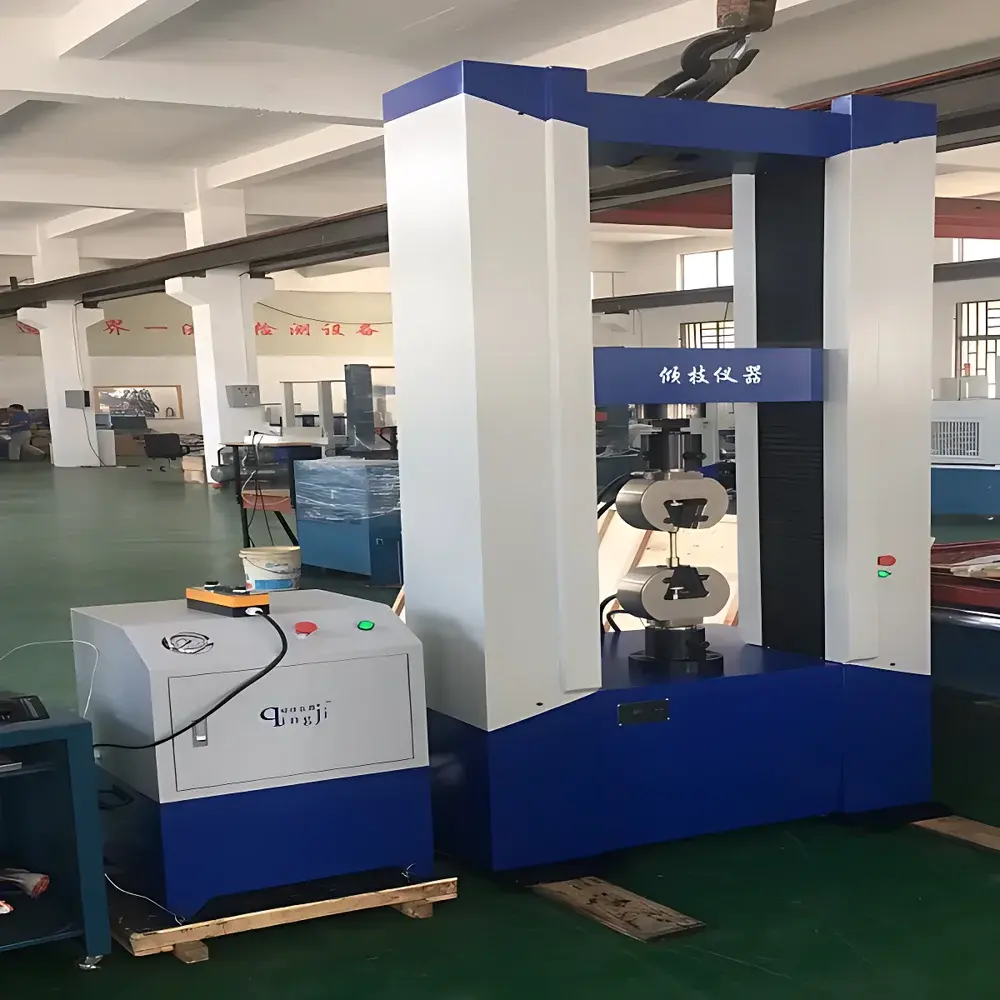
QJ212C Universal Tensile Testing Machine by Qinskey
| Brand | Qinskey |
|---|---|
| Origin | Shanghai, China |
| Model | QJ212C |
| Maximum Test Load | 500 kN |
| Load Range | 0.02–100% of full scale (FS) |
| Load Accuracy | Class 0.5 per ISO 7500-1 / ASTM E4 |
| Crosshead Travel | 500 mm |
| Displacement Resolution | ±0.5% of reading |
| Effective Test Width | 520 mm |
| Effective Tensile Stroke | 800 mm |
| Speed Range | 0.01–1000 mm/min (standard: 300 mm/min) |
| Speed Accuracy | ±0.5% of set value |
| Strain Measurement Accuracy | ±0.5% of reading |
| Load Cell | High-precision U.S.-sourced load sensor |
| Controller | Panasonic all-digital AC servo drive system |
| Control System | Full-digital closed-loop control supporting constant load, constant strain, and constant displacement modes |
| Safety Protection | Software-based diagnostics, electronic limit switches, overload protection at 110% of rated capacity |
| Power Requirement | 2–5 kW |
| Dimensions (W×D×H) | 1000 × 680 × 2450 mm |
| Weight | ~1450 kg |
Overview
The QJ212C Universal Tensile Testing Machine by Qinskey is a high-capacity, floor-standing electromechanical testing system engineered for precision mechanical property evaluation of metallic and non-metallic materials under uniaxial tensile, compression, bending, peel, tear, and shear loading conditions. Based on the fundamental principles of Hooke’s law and standardized force-displacement transduction, the system delivers traceable, repeatable mechanical data in compliance with international test standards including ISO 6892-1 (metallic materials), ASTM D638 (plastics), ASTM D412 (rubber), ISO 13934-1 (textiles), and GB/T 228.1 (China national standard). Its rigid portal frame construction—fabricated from high-strength steel with optimized column geometry—minimizes deflection and ensures axial alignment stability during high-load tests up to 500 kN. The machine integrates a high-resolution load cell calibrated to ISO 7500-1 Class 0.5 accuracy, enabling reliable quantification of yield strength, ultimate tensile strength, elongation at break, modulus of elasticity, and Poisson’s ratio across diverse material classes.
Key Features
- Rigid double-column portal frame with 1450 kg mass and 2450 mm height for exceptional structural stability and minimal vibration transmission during dynamic or high-force testing.
- Full-scale load capacity of 500 kN with seamless internal range selection—no manual range switching required—supported by a 500,000-count A/D resolution system ensuring consistent sensitivity across 0.02–100% FS.
- Panasonic all-digital AC servo motor and controller delivering precise speed control from 0.01 to 1000 mm/min, with speed accuracy maintained within ±0.5% of setpoint per ISO 5893.
- Integrated dual-mode crosshead actuation: independent fast/slow speed adjustment for rapid positioning and fine-tuned test initiation, reducing setup time without compromising repeatability.
- Comprehensive safety architecture including software-driven fault diagnosis, programmable electronic end-limit switches, automatic overload shutdown at 110% of nominal capacity, and mechanical emergency stop.
- Modular fixture interface compliant with ISO 26203 and ASTM E1012 guidelines—enabling rapid interchange of wedge-action grips, pneumatic clamps, bend fixtures, peel jigs, and custom-designed tooling per specimen geometry and standard requirements.
Sample Compatibility & Compliance
The QJ212C accommodates specimens ranging from thin polymer films (<0.1 mm) to structural steel plates (up to 50 mm thick) and reinforced composite laminates. Standard test widths up to 520 mm support wide-area textiles, geotextiles, and roofing membranes; extended stroke (800 mm) enables full-strain characterization of elastomers and high-elongation polymers. All measurement subsystems—including load, displacement, and optional extensometry—are validated per ISO/IEC 17025-accredited calibration protocols. The system supports full traceability through NIST-traceable load cell certification and documented uncertainty budgets. It meets essential regulatory expectations for GLP-compliant laboratories and satisfies baseline requirements for ISO 9001:2015 quality management systems. While not pre-certified for FDA 21 CFR Part 11, its audit trail functionality—including user login logs, parameter change timestamps, and raw data immutability—can be configured to align with Part 11 readiness when deployed with validated software environments.
Software & Data Management
The QJ212C operates via a vendor-supplied full-digital closed-loop control platform compatible with Windows OS. The software provides real-time graphical display of stress–strain, load–displacement, and time-based curves with adjustable sampling rates up to 1 kHz. Users may import and execute predefined test methods per ASTM, ISO, or GB standards—including automatic calculation of Rp0.2, Rm, A%, and E—without manual post-processing. All raw data are stored in binary format with embedded metadata (operator ID, timestamp, environmental conditions, calibration status), and export options include CSV, Excel, PDF reports, and XML for LIMS integration. Audit trails record every parameter modification, test start/stop event, and calibration action—supporting laboratory accreditation audits. Optional modules include video-synchronized deformation analysis and DIC-compatible trigger outputs for third-party optical strain measurement systems.
Applications
- Mechanical qualification of structural alloys (aluminum, stainless steel, titanium) per aerospace (AMS, EN) and automotive (VDA, SAE) specifications.
- Quality control of extruded polymer profiles, injection-molded components, and thermoplastic composites in manufacturing environments.
- Research-grade tensile and cyclic fatigue characterization of biomedical implants and biodegradable scaffolds under simulated physiological loading.
- Performance validation of civil engineering materials including geogrids, HDPE geomembranes, and fiber-reinforced concrete reinforcements.
- Standards-compliant testing of wire ropes, cable assemblies, and lifting slings for occupational safety certification (OSHA, EN 12195).
- Validation of adhesive bond strength in electronics packaging and automotive bonding applications using peel and shear fixtures.
FAQ
What international standards does the QJ212C support out-of-the-box?
The system includes preloaded test templates for ISO 6892-1, ASTM D638, ASTM D412, ISO 13934-1, and GB/T 228.1. Custom method creation is supported via editable parameter sets and scripting interfaces.
Is the load cell factory-calibrated and traceable?
Yes—each unit ships with a NIST-traceable calibration certificate issued by an ISO/IEC 17025-accredited lab, valid for 12 months under normal use conditions.
Can the system integrate with existing LIMS or MES platforms?
Via TCP/IP or RS232 serial communication, the controller supports ASCII-based command protocols and structured data export (CSV/XML), enabling interoperability with most laboratory informatics systems.
What maintenance intervals are recommended for long-term accuracy?
Biannual verification of load and displacement accuracy is advised; annual recalibration of the load cell and encoder is recommended for ISO 17025 compliance. Preventive maintenance includes lubrication of lead screws and inspection of grip jaw surfaces.
Does the system support extensometer inputs?
Yes—the controller features dedicated analog inputs for clip-on or video extensometers (LVDT or digital image correlation), with configurable gain and filtering to meet ASTM E83 or ISO 9513 requirements.



