
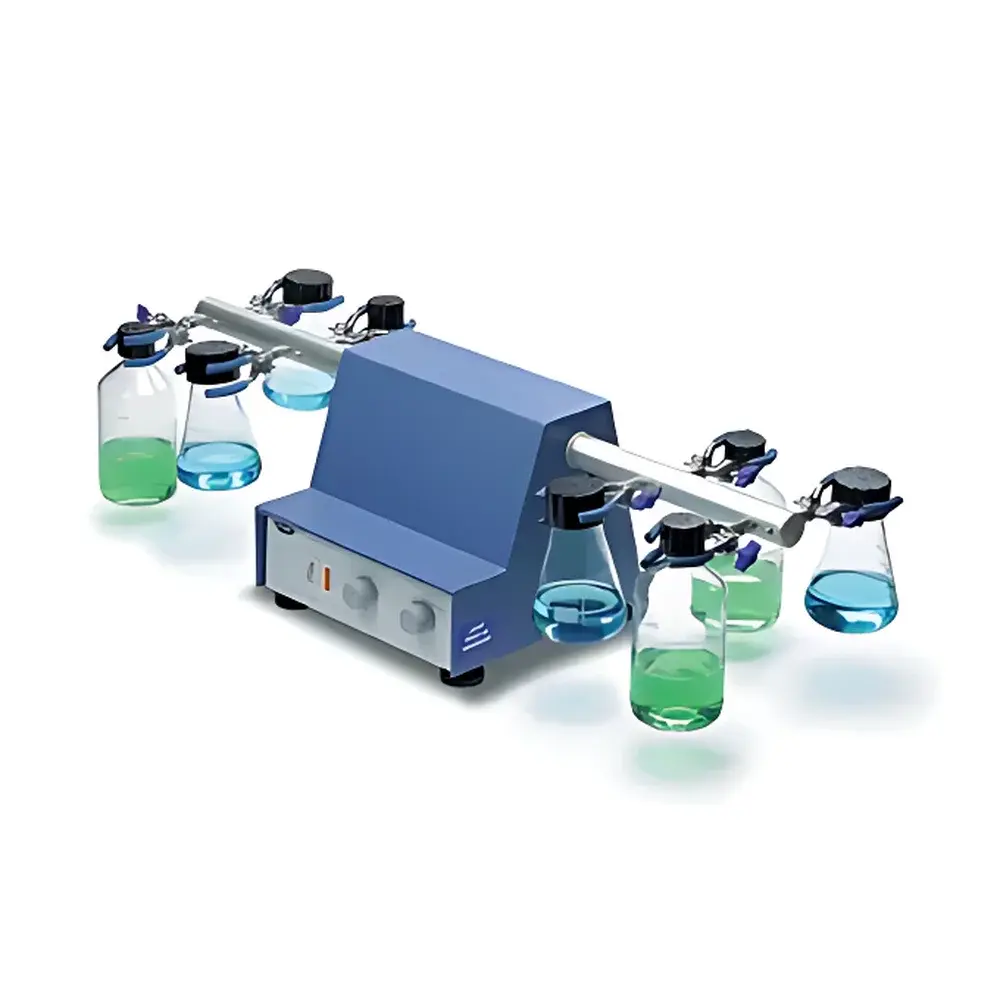
Stuart SF1 Orbital Shaker for Erlenmeyer Flasks
| Brand | Stuart |
|---|---|
| Model | SF1 |
| Type | Orbital Flask Shaker |
| Origin | United Kingdom |
| Speed Range | 8–800 oscillations/min |
| Amplitude | 1.5 mm |
| Dimensions (W×D×H) | 780 × 270 × 240 mm |
| Max Load Capacity | 3 kg |
| Net Weight | 8.3 kg |
| Power Supply | 230 V / 50 Hz, 50 W |
| Timer Range | 10–60 min (or continuous operation) |
| Standard Configuration | 2 swing arms, 8 universal flask clamps, hex key included |
| Optional Accessory | SF1/2 extension arm kit (adds 4 clamps, total capacity up to 12 flasks) |
| Compliance | CE-marked, RoHS-compliant, designed per IEC 61010-1 for laboratory equipment safety |
Overview
The Stuart SF1 Orbital Shaker is a precision-engineered benchtop instrument designed specifically for consistent, reproducible orbital agitation of Erlenmeyer flasks and volumetric flasks in life science, microbiology, and analytical chemistry laboratories. It operates on the principle of controlled orbital motion—generating uniform circular displacement with a fixed 1.5 mm amplitude—ensuring homogeneous suspension of cultures, efficient extraction of analytes, and reliable mixing without splashing or vortex formation. Unlike reciprocating or linear shakers, the SF1’s wrist-action orbital drive mechanism minimizes shear stress on sensitive biological samples while maintaining high mechanical stability across its full speed range (8–800 oscillations per minute). Its robust steel frame, reinforced base, and four vacuum-adhesive rubber feet provide exceptional vibration damping and positional integrity—even under unbalanced loads up to 3 kg. The device is engineered for long-term reliability in regulated environments and conforms to IEC 61010-1 safety standards for electrical laboratory equipment.
Key Features
- Electronic feedback-controlled motor delivering constant speed across the entire operating range—no drift during extended runs or load variations.
- Programmable mechanical timer with adjustable settings from 10 to 60 minutes, plus dedicated continuous operation mode for uninterrupted incubation or extraction protocols.
- Modular clamp system: two rigid swing arms pre-fitted with eight universal stainless-steel clamps compatible with 50–500 mL Erlenmeyer flasks and standard volumetric bottles.
- Optional SF1/2 extension kit enables rapid reconfiguration to support up to twelve vessels—ideal for parallel sample processing in QC, bioprocessing, or environmental testing workflows.
- Compact footprint (780 × 270 × 240 mm) optimized for crowded fume hoods or multi-tier lab benches; low power consumption (50 W) supports energy-conscious facility operations.
- Hex-key tool included for quick clamp adjustment and maintenance; all hardware is corrosion-resistant and autoclavable-compatible for sterile applications.
Sample Compatibility & Compliance
The SF1 accommodates a broad range of vessel geometries via its adjustable clamp jaws—supporting conical flasks (50–500 mL), graduated cylinders, and wide-mouth bottles with neck diameters from 25 to 45 mm. Optional tube rack adapters (sold separately) allow secure handling of microcentrifuge tubes (1.5–2.0 mL) for small-volume homogenization or reagent resuspension. The unit meets CE marking requirements and adheres to RoHS Directive 2011/65/EU for hazardous substance restrictions. While not intrinsically certified for GMP or GLP environments, its stable performance, traceable speed calibration, and mechanical repeatability make it suitable for use within validated workflows where instrument qualification documentation (IQ/OQ) is performed by end users per ISO/IEC 17025 guidelines.
Software & Data Management
The SF1 is a stand-alone electromechanical instrument with no embedded firmware or digital interface. All operational parameters—including speed, timer setting, and run status—are controlled via front-panel mechanical dials and toggle switches. This analog architecture eliminates cybersecurity risks, ensures immunity to software crashes, and simplifies compliance with FDA 21 CFR Part 11 requirements in contexts where electronic records are not mandated. For laboratories requiring audit trails, manual log entries (e.g., operator ID, start/stop time, speed setting, flask count) can be recorded in bound lab notebooks or LIMS-integrated forms aligned with ALCOA+ data integrity principles.
Applications
- Microbial culture propagation in aerobic suspension conditions for antibiotic susceptibility testing or bioreactor seed train preparation.
- Solid-phase extraction (SPE) and liquid–liquid extraction (LLE) protocols requiring gentle yet thorough phase contact over defined time intervals.
- Buffer equilibration, antibody conjugation reactions, and ELISA plate coating steps where uniform mixing prevents localized precipitation.
- Environmental water analysis—extraction of heavy metals or organic pollutants from filtered samples using chelating resins or organic solvents.
- Cell dissociation support prior to flow cytometry or viability assays, especially when enzymatic digestion requires precise agitation control.
- Standardization of dissolution testing in pharmaceutical development labs where orbital motion mimics physiological agitation more closely than rotary shaking.
FAQ
What is the maximum flask size supported by the SF1?
The SF1 is calibrated for optimal performance with Erlenmeyer flasks up to 500 mL. Larger vessels may compromise stability and amplitude fidelity due to moment-arm effects.
Can the SF1 operate in cold rooms or incubators?
Yes—the unit is rated for ambient operation between 5 °C and 40 °C and relative humidity ≤80% non-condensing. Ensure adequate ventilation around the motor housing to prevent thermal buildup.
Is speed calibration traceable to national standards?
Stuart provides factory calibration certificates upon request. Users may perform in-house verification using a handheld tachometer compliant with ISO 2954 for vibration measurement.
Does the SF1 require routine maintenance beyond cleaning?
No scheduled maintenance is required. Wipe external surfaces with 70% ethanol; inspect clamps and swing arms quarterly for wear or deformation.
Can I integrate the SF1 into a networked lab automation system?
Not natively—the device lacks digital I/O ports or communication protocols. For automated scheduling, external relay controllers or programmable logic controllers (PLCs) may be used to trigger on/off cycles via the main power switch.




