
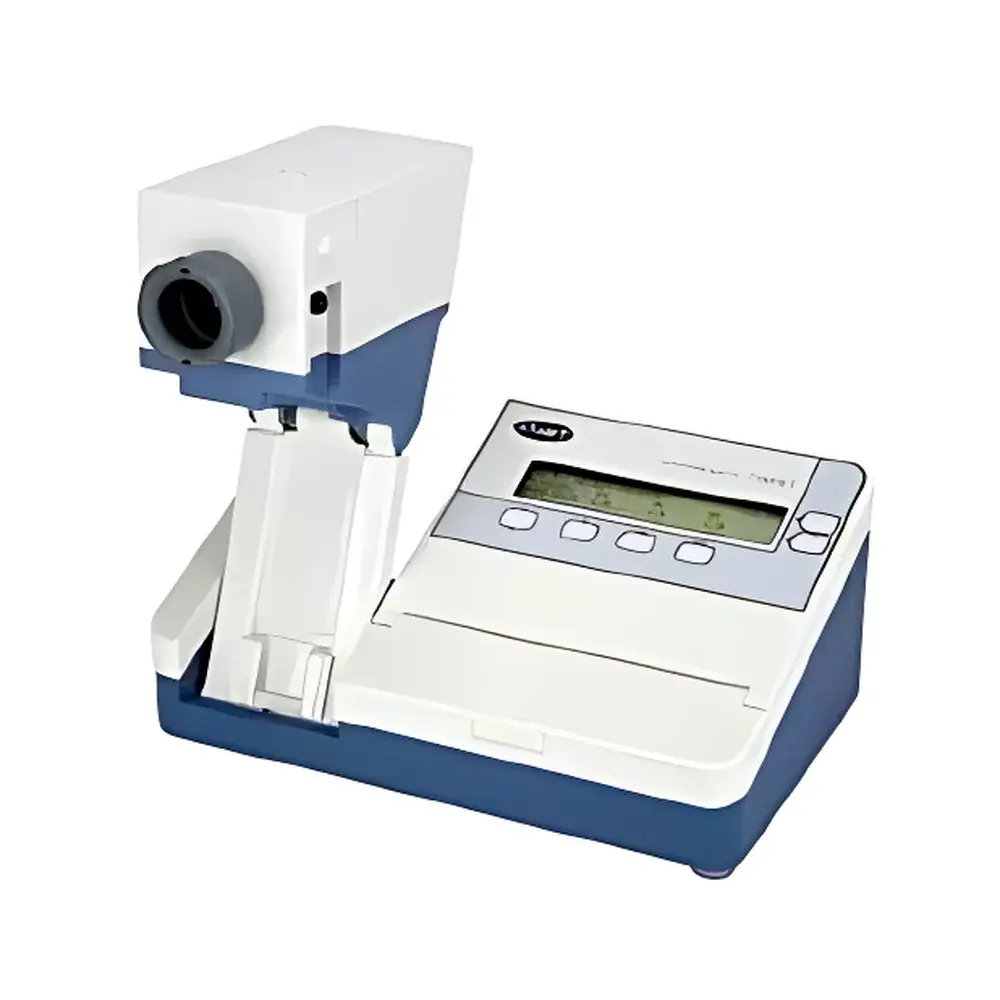
Stuart SMP30 Advanced Digital Melting Point Apparatus
| Brand | Stuart |
|---|---|
| Origin | United Kingdom |
| Model | SMP30 |
| Temperature Range | Ambient to 400 °C |
| Temperature Resolution | 0.1 °C |
| Heating Rate | 0.5–10.0 °C/min (adjustable in 0.1 °C increments) |
| Cooling Time (350 °C → 50 °C) | 12 min |
| Heating Time (50 °C → 350 °C) | 6 min |
| Sample Capacity | 3 capillaries simultaneously |
| Temperature Memory | 8 readings per sample |
| Display | 40×4 character LCD |
| Sensor | PT100 platinum resistance thermometer |
| Power Supply | 230 V, 50 Hz, 60 W |
| Dimensions (W×D×H) | 325 × 200 × 170 mm |
| Net Weight | 3.6 kg |
| Capillary Storage Compartment | Integrated |
| Observation Chamber | Dual-height adjustable |
| Illumination | Integrated high-intensity LED lighting |
| Surface Finish | Biocote® antimicrobial coating |
Overview
The Stuart SMP30 Advanced Digital Melting Point Apparatus is a precision thermal analysis instrument engineered for reliable, repeatable determination of solid-phase transition temperatures in pharmaceuticals, polymers, organic chemicals, and fine chemical intermediates. It operates on the classical capillary tube method—where a finely powdered sample is packed into a thin-walled glass capillary and subjected to a controlled, linear heating ramp—enabling visual detection of the onset and completion of melting under direct optical observation. The SMP30 integrates real-time temperature monitoring with simultaneous video-grade visual inspection via an optically optimized observation chamber, eliminating the need to shift gaze between display and sample—a critical ergonomic and metrological advantage during endpoint identification. Its temperature control architecture employs a calibrated PT100 sensor embedded in close thermal proximity to the heating block, ensuring traceable accuracy within ±0.1 °C across its full operating range (ambient to 400 °C). Designed for compliance-ready laboratory environments, the SMP30 supports documented workflows aligned with GLP principles and is routinely deployed in QC laboratories performing USP <741>, Ph. Eur. 2.2.14, and ISO 6391 testing protocols.
Key Features
- Real-time dual-display functionality: Simultaneous observation of sample morphology and digital temperature readout on a 40×4 character LCD—no visual interruption during endpoint judgment.
- Dual-height adjustable observation chamber: Optimized vertical positioning reduces operator neck strain during extended analytical sessions, supporting ISO 9241-5 ergonomic guidelines.
- High-intensity LED illumination system: Uniform, shadow-free lighting ensures consistent contrast for accurate phase-change detection—even for low-contrast or translucent samples.
- Precise programmable heating: Linear ramp rates from 0.5 to 10.0 °C/min, adjustable in 0.1 °C/min increments, enabling method optimization for thermally sensitive or highly crystalline materials.
- Multi-sample capability: Three independent capillary positions allow parallel assessment of replicate or reference standards—each storing up to eight temperature points (onset, clear point, plateau) for traceability.
- Rapid thermal cycling: Achieves 50 °C → 350 °C in ≤6 minutes and cools from 350 °C → 50 °C in ≤12 minutes, minimizing turnaround time between determinations.
- Biocote® antimicrobial surface coating: Integrated silver-ion technology inhibits microbial growth on frequently contacted surfaces, supporting cleanroom-compatible operation and reducing cross-contamination risk.
- Integrated capillary storage compartment: Secure onboard housing for standardized 1-mm OD glass capillaries (supplied with SMP30 as 100× one-end sealed units).
Sample Compatibility & Compliance
The SMP30 accommodates standard 1.0 mm outer-diameter glass capillaries (available in both single- and double-end sealed configurations), compatible with ICH Q5C, USP <741>, and ASTM E324 test methods. Sample preparation follows pharmacopoeial guidance: dry, finely powdered material packed to 3–5 mm height with uniform density. The instrument’s temperature calibration is traceable to NPL (UK) standards via factory-certified PT100 verification. While the base unit does not include electronic audit trail functionality, its manual operation mode supports fully documented paper-based SOP execution—including handwritten recording of ramp rate, observed melt intervals, and operator ID—meeting minimum requirements for non-automated GLP environments. Optional SMP30/1 thermal printer enables hardcopy output compliant with 21 CFR Part 11 Annex 11 documentation expectations when paired with lab-controlled procedural controls.
Software & Data Management
The SMP30 operates via embedded firmware with no external PC dependency. All configuration, real-time display, and data logging occur locally on the device. Temperature values are stored internally (8 readings per sample × 3 positions = 24 total entries), accessible via front-panel navigation. Data export is manual: users record results directly into lab notebooks or LIMS using standardized templates. For regulated environments requiring electronic records, integration is achieved through the optional SMP30/1 thermal printer (RS232 interface), generating time-stamped, tamper-evident printouts with instrument ID, date/time stamp, ramp parameters, and observed melt range. No proprietary software installation or cloud connectivity is required—ensuring data sovereignty and compatibility with air-gapped QC networks.
Applications
- Pharmaceutical QC: Identity confirmation and purity assessment of active pharmaceutical ingredients (APIs) and excipients per USP monographs.
- Polymorph screening: Detection of solid-state transitions and eutectic behavior in crystalline drug substances.
- Chemical synthesis validation: Verification of product identity and batch consistency in fine chemical manufacturing.
- Academic research: Teaching and method development in undergraduate and graduate physical chemistry laboratories.
- Materials science: Characterization of thermal stability and phase behavior in organic semiconductors and liquid crystals.
- Regulatory submission support: Generation of reproducible, auditable melt data for IND, NDA, and DMF dossiers.
FAQ
What capillary types are supported by the SMP30?
The SMP30 accepts standard 1.0 mm OD glass capillaries, supplied either single-end sealed (SMP10/1) or double-end sealed (SMP2/1). Capillary length must be 80–100 mm for proper insertion depth and thermal coupling.
Is calibration certificate included with the instrument?
Yes—each SMP30 ships with a UKAS-traceable calibration certificate verifying PT100 sensor accuracy at three points (100 °C, 200 °C, and 300 °C) against NPL reference standards.
Can the SMP30 be used for decomposition point determination?
While not designed for formal decomposition analysis (e.g., TGA), experienced operators may observe discoloration, bubbling, or charring onset during ramped heating up to 400 °C—providing qualitative thermal stability indicators when correlated with DSC or TGA data.
Does the instrument meet CE and RoHS directives?
Yes—the SMP30 complies with EU Directive 2014/30/EU (EMC), 2014/35/EU (LVD), and 2011/65/EU (RoHS), with full Declaration of Conformity supplied with shipment.
How is cleaning of the sample chamber performed?
The observation chamber features a removable quartz window and open-access heating block design; routine maintenance requires only lint-free wipes and isopropyl alcohol—no disassembly or tools needed.
Related Products



