
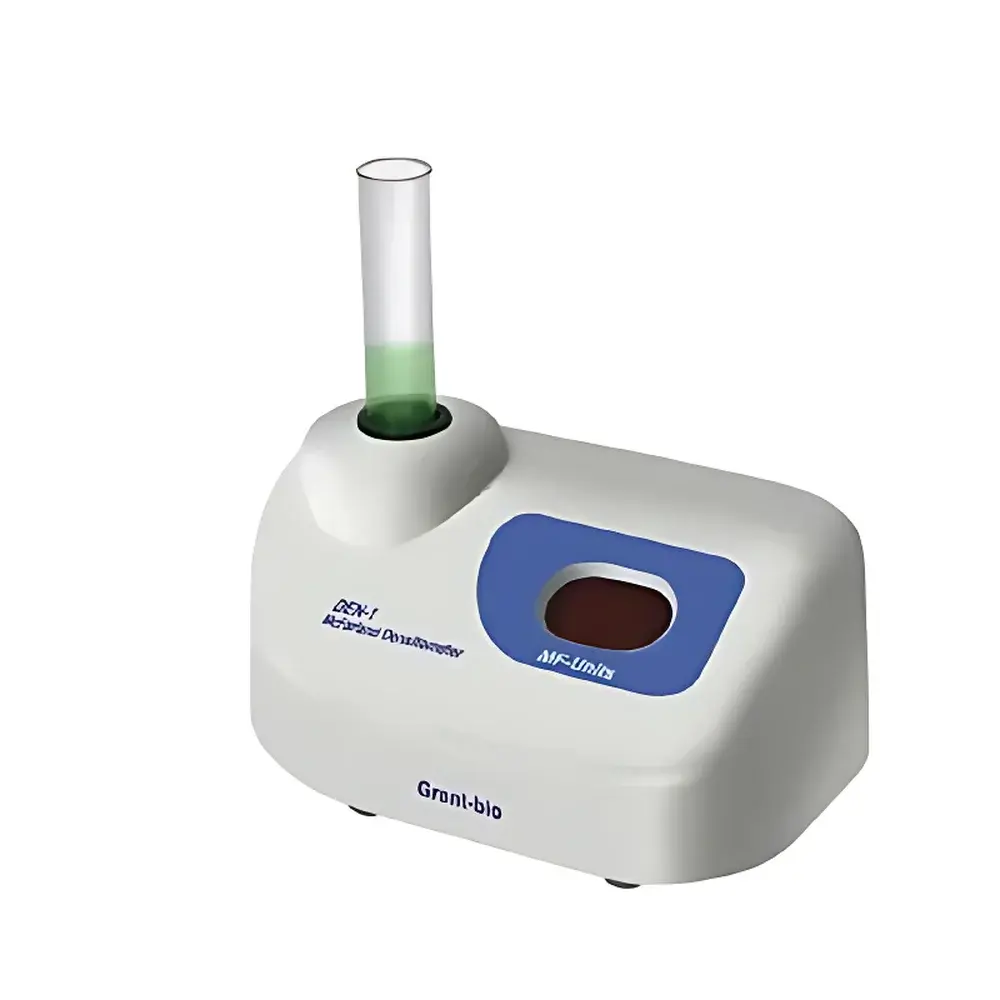
Grant DEN-1 McFarland Turbidimeter
| Brand | Grant |
|---|---|
| Origin | United Kingdom |
| Model | DEN-1 |
| Light Source | LED (565 ± 15 nm) |
| Measurement Range | 0.3–15.0 McFarland Units |
| Accuracy | ±3% |
| Standard Deviation (3.0 McF) | ±0.1 McF |
| Measurement Time | 1 s |
| Sample Tube OD | 18 mm (16 mm with D16 adapter) |
| Sample Volume | ≥2 mL |
| Display | 2-digit LED |
| Power Supply | 12 V, 300 mA |
| Operating Temperature | 4–45 °C |
| Dimensions (W×D×H) | 165 × 115 × 75 mm |
| Weight | 0.9 kg |
Overview
The Grant DEN-1 McFarland Turbidimeter is a compact, benchtop optical density instrument engineered for rapid, reproducible quantification of microbial suspension turbidity in accordance with the McFarland standard scale. It operates on the principle of absorbance-based photometry at a fixed wavelength of 565 ± 15 nm—optimized to align with the spectral absorption profile of standardized barium sulfate suspensions used in clinical and industrial microbiology. Unlike spectrophotometers requiring wavelength selection or cuvette calibration, the DEN-1 delivers direct McFarland unit readouts without conversion calculations, minimizing operator variability and ensuring consistency across labs. Its LED light source emits no thermal radiation, eliminating heat-induced convection currents in temperature-sensitive samples (e.g., live cultures incubated in situ), and maintains stable output over extended operational lifetimes—critical for high-throughput QC workflows in fermentation monitoring, antimicrobial susceptibility testing, and strain characterization.
Key Features
- Single-wavelength LED photometer (565 ± 15 nm) with drift-free output and >50,000-hour lifetime
- Direct McFarland unit display (0.3–15.0 McF) with 1-second measurement cycle and ±3% accuracy
- User-accessible calibration routine using commercially available or lab-prepared McFarland standards (e.g., 0.5, 3.0, 6.0 McF)
- Non-volatile calibration memory: retains factory and user-defined calibration settings even during power-off cycles
- Dual-tube compatibility: accepts standard 18 mm OD culture tubes; optional D16 adapter enables use with 16 mm OD tubes
- Low-profile, space-efficient design (165 × 115 × 75 mm) with 12 V DC input—enabling seamless integration into incubators via feed-through cable routing
- Robust mechanical architecture with IP20-rated enclosure suitable for ISO Class 5–8 cleanroom-adjacent environments and GLP-compliant laboratories
Sample Compatibility & Compliance
The DEN-1 is validated for use with aqueous bacterial and yeast suspensions—including Escherichia coli, Staphylococcus aureus, Candida albicans, and Saccharomyces cerevisiae—within the specified McFarland range. It complies with core methodological references under CLSI M07-A10 (Methods for Dilution Antimicrobial Susceptibility Tests for Bacteria That Grow Aerobically) and EUCAST guidelines for inoculum standardization. While not a regulated medical device, its performance traceability supports adherence to ISO/IEC 17025:2017 (Clause 7.7 — Ensuring Validity of Results) when integrated into accredited microbiology testing protocols. No reagent consumption or consumable parts are required—reducing cost-per-test and eliminating lot-to-lot variability associated with pre-calibrated standards.
Software & Data Management
The DEN-1 operates as a standalone instrument with no embedded software or digital connectivity. All measurements are displayed locally on a dual-digit LED screen, ensuring deterministic real-time output without firmware dependencies or cybersecurity exposure vectors. This architecture satisfies regulatory expectations for audit-trail simplicity in GMP environments where electronic records are not mandated. For labs requiring documentation, manual transcription into LIMS or ELN systems is supported by its consistent 1-second response time and unambiguous unit labeling. Calibration verification logs—performed using NIST-traceable McFarland reference suspensions—can be maintained as paper-based or scanned records compliant with FDA 21 CFR Part 11 Annex 11 principles for non-electronic data integrity.
Applications
- Standardization of microbial inocula prior to disk diffusion or broth microdilution antimicrobial susceptibility testing (AST)
- In-process monitoring of bacterial and yeast biomass in aerobic and anaerobic bioreactors and shake-flask fermentations
- Quality control of lyophilized culture stocks and working cell banks in biopharmaceutical manufacturing
- Rapid assessment of growth kinetics during strain isolation, media optimization, and stress-response profiling
- Verification of suspension homogeneity and clumping artifacts prior to flow cytometry or plating assays
- Teaching laboratory implementation for undergraduate microbiology courses emphasizing quantitative culture techniques
FAQ
Does the DEN-1 require periodic recalibration by the manufacturer?
No. The instrument retains calibration indefinitely via non-volatile memory. Users may verify or adjust calibration at any time using certified McFarland standards.
Can the DEN-1 measure optical density at wavelengths other than 565 nm?
No. It is a fixed-wavelength turbidimeter optimized exclusively for McFarland equivalence. For variable-wavelength OD measurements, a dedicated spectrophotometer is required.
Is the D16 adapter included with the base unit?
No. The D16 adapter is an optional accessory ordered separately to support 16 mm OD tubes.
What is the minimum sample volume required for reliable measurement?
A minimum of 2 mL is required to ensure full beam path immersion and avoid meniscus-related scatter artifacts.
How does temperature affect measurement stability?
The instrument is rated for operation between 4 °C and 45 °C. Ambient temperature fluctuations outside this range may induce condensation on optics or thermal drift in LED output—both of which compromise repeatability.




