
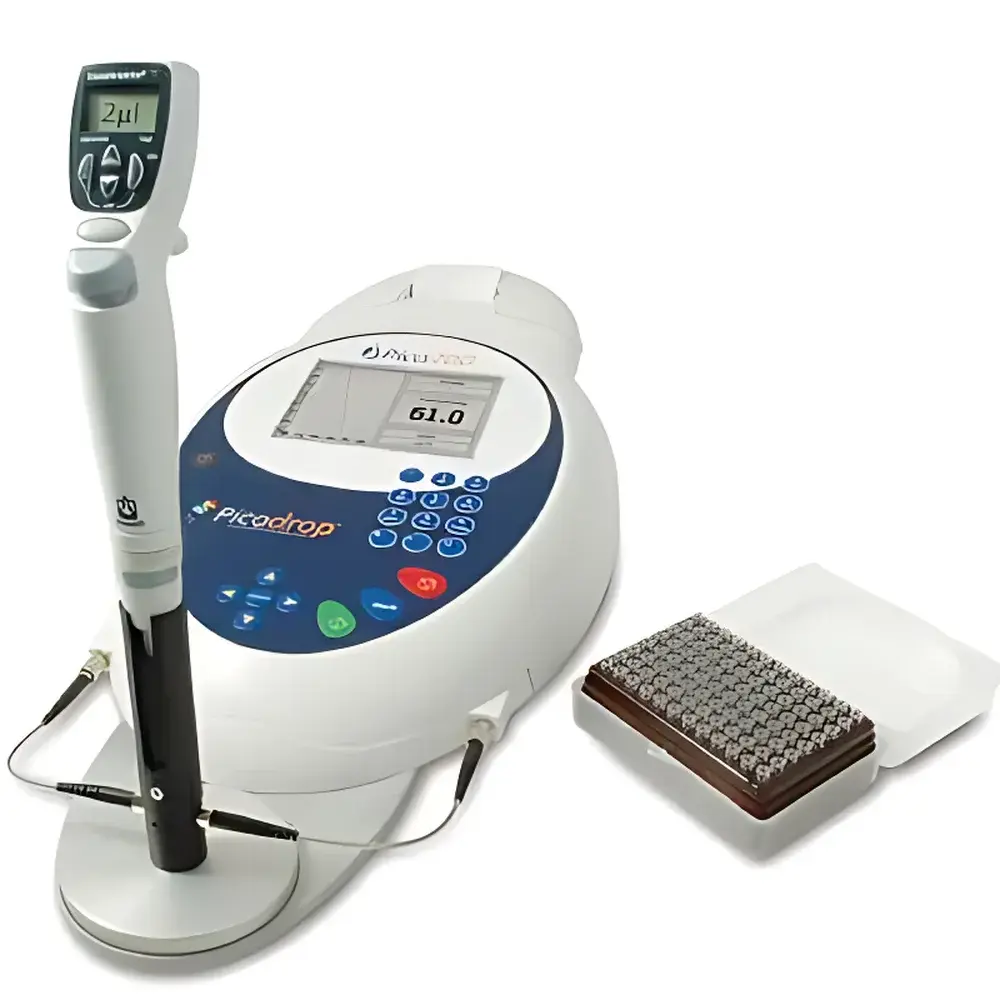
Picodrop P200 Microvolume Nucleic Acid and Protein Spectrophotometer
| Origin | UK |
|---|---|
| Manufacturer Type | Authorized Distributor |
| Origin Category | Imported |
| Model | P200 |
| Optical Design | Single-Beam |
| Light Source | Pulsed Xenon Lamp |
| Detector | 2048-Pixel CCD Array |
| Wavelength Range | 220–950 nm |
| Spectral Bandwidth | 5 nm |
| Wavelength Repeatability | ±1 nm |
| Photometric Linearity | <1% at 546 nm |
| Absorbance Accuracy | ±0.003 A |
| Absorbance Range | –2 to 2 A (extended to –22 A.U. with digital offset compensation) |
| Minimum Sample Volume | 2 µL |
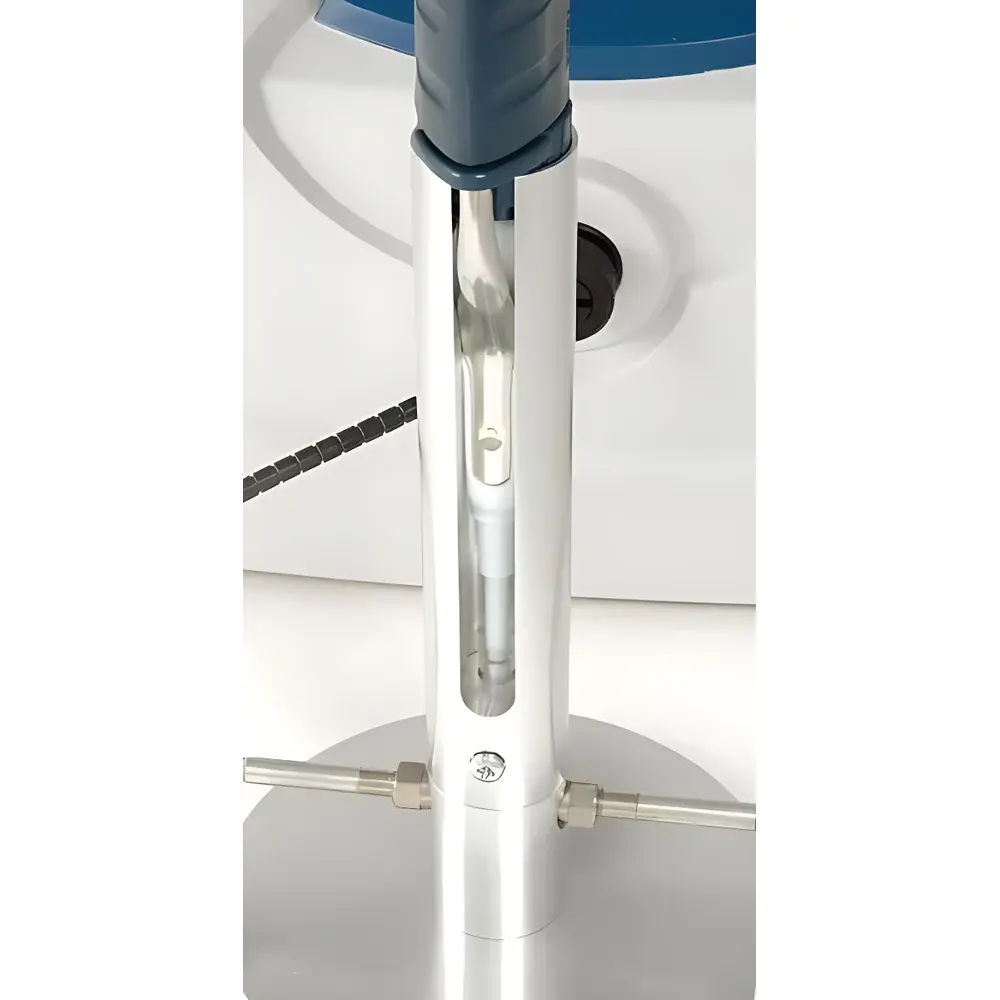
| Pathlength | 1 mm (capillary tip mode) or 10 mm (cuvette mode) |
| Measurement Time | ≤3 seconds per full-spectrum scan |
| Dimensions | 26 × 39 × 10 cm |
| Weight | 4.2 kg |
| Data Interfaces | USB, Bluetooth, SD card |
| Output Options | Onboard thermal printer (optional), PC export via Picodrop Analysis Software |
| DNA Quantification Range | 0.4–1200 ng/µL |
| BSA Quantification Range (Direct UV) | 0.02–25 mg/mL |
| OD₆₀₀ Mode | Enabled |
| Kinetic Assay Support | Yes (time-resolved absorbance series) |
Overview
The Picodrop P200 is a benchtop microvolume ultraviolet-visible (UV-Vis) spectrophotometer engineered for rapid, precise quantification and purity assessment of nucleic acids and proteins in research and quality control laboratories. Operating on the principle of single-beam absorption spectroscopy, the P200 employs a pulsed xenon lamp and a high-resolution 2048-pixel CCD array detector to acquire full spectral data across 220–950 nm in under three seconds. Its microvolume capability—requiring only 2 µL of sample—eliminates the need for dilution or cuvette filling, significantly reducing reagent consumption and contamination risk. The instrument supports both fixed-pathlength (1 mm via disposable pipette tips) and standard 10 mm cuvette modes, enabling seamless transition between high-throughput screening and traditional absorbance measurements. Designed for compliance-critical environments, the P200 delivers traceable photometric performance aligned with ISO 8579-1 (spectrophotometer verification) and supports audit-ready data handling when integrated with validated software workflows.
Key Features
- Microvolume analysis with 2 µL sample requirement and dual-pathlength flexibility (1 mm tip-based or 10 mm cuvette)
- Full UV-Vis spectral acquisition (220–950 nm) in ≤3 seconds using a stable pulsed xenon light source and thermally stabilized CCD detector
- Photometric accuracy of ±0.003 A and linearity deviation <1% at 546 nm—validated per ISO 8579-1 calibration protocols
- Integrated OD600 module for bacterial and yeast culture density monitoring, with automatic blank subtraction and multi-point averaging
- Preloaded kinetic assay routines for enzyme activity profiling (e.g., NADH oxidation, pNPP hydrolysis), generating time-resolved absorbance curves and initial rate calculations
- On-device operation with intuitive touchscreen interface; optional PC connectivity via USB/Bluetooth/SD card for GLP-compliant data archiving
Sample Compatibility & Compliance
The P200 accommodates a broad range of biological samples without dilution: double-stranded DNA (dsDNA), single-stranded RNA, oligonucleotides, purified proteins (BSA, IgG, lysozyme), crude lysates, and cell suspensions. Its 1 mm pathlength mode ensures accurate quantification across the full dynamic range (0.4–1200 ng/µL for dsDNA; 0.02–25 mg/mL for BSA), while minimizing inner-filter effects common in concentrated samples. For regulatory environments—including those governed by FDA 21 CFR Part 11, ISO/IEC 17025, or EU GMP Annex 11—the instrument supports electronic signatures, user access levels, and audit-trail-enabled software (Picodrop Analysis Suite v4.2+). All measurement parameters—including wavelength calibration date, lamp usage hours, and detector gain settings—are automatically embedded in exported data files.
Software & Data Management
The Picodrop Analysis Software provides a secure, configurable platform for method development, data visualization, and report generation. It includes pre-validated nucleic acid and protein quantification modules (A260/A280, A260/A230, direct 280 nm, Bradford, Lowry, BCA, Biuret), each with editable extinction coefficients and standard curve templates compliant with USP and ASTM E275. Raw spectral data are stored in vendor-neutral .csv and .jdx formats. Software validation documentation (IQ/OQ/PQ protocols) is available upon request for laboratory qualification under GLP or GMP frameworks. Data encryption, role-based permissions, and automated backup to network drives ensure integrity and traceability.
Applications
- High-fidelity nucleic acid quantification and purity screening (A260/A280, A260/A230) for NGS library preparation and CRISPR guide RNA validation
- Routine QC of recombinant protein expression batches using direct UV or colorimetric assays
- Real-time monitoring of microbial growth kinetics in bioreactor inoculum development
- Enzyme kinetics studies requiring high-temporal-resolution absorbance tracking (e.g., lactate dehydrogenase, alkaline phosphatase)
- Verification of oligonucleotide synthesis yield and desalting efficiency prior to HPLC purification
- Support for academic teaching labs through guided assay wizards and exportable student datasets
FAQ
Does the P200 require external calibration standards for routine nucleic acid quantification?
No—factory-calibrated optical pathlength and detector response eliminate the need for daily standardization. However, users may perform optional verification using NIST-traceable neutral density filters or certified DNA reference materials.
Can the P200 be integrated into an LIMS environment?
Yes—via ASCII-formatted CSV export and configurable metadata headers, the P200 supports direct ingestion into major LIMS platforms including LabVantage, STARLIMS, and Thermo Fisher SampleManager.
Is the 1 mm pathlength mode compatible with all standard pipette tips?
It is validated for use with universal low-retention 10–200 µL filter tips (e.g., Eppendorf Research Plus, Gilson Pipetman Ultra). Tip geometry and surface tension characteristics directly influence meniscus formation and pathlength consistency.
How does the P200 handle turbid or particulate-containing samples?
The instrument applies real-time scatter correction algorithms during spectral acquisition and offers a dedicated “Turbidity Mode” that subtracts baseline scattering contributions at 320–350 nm before calculating A260 or A280.
What software validation support is provided for regulated laboratories?
Picodrop supplies full GxP-aligned validation packages—including URS, FRS, test scripts, and summary reports—for IQ/OQ/PQ execution under internal QA oversight or third-party audit conditions.



