
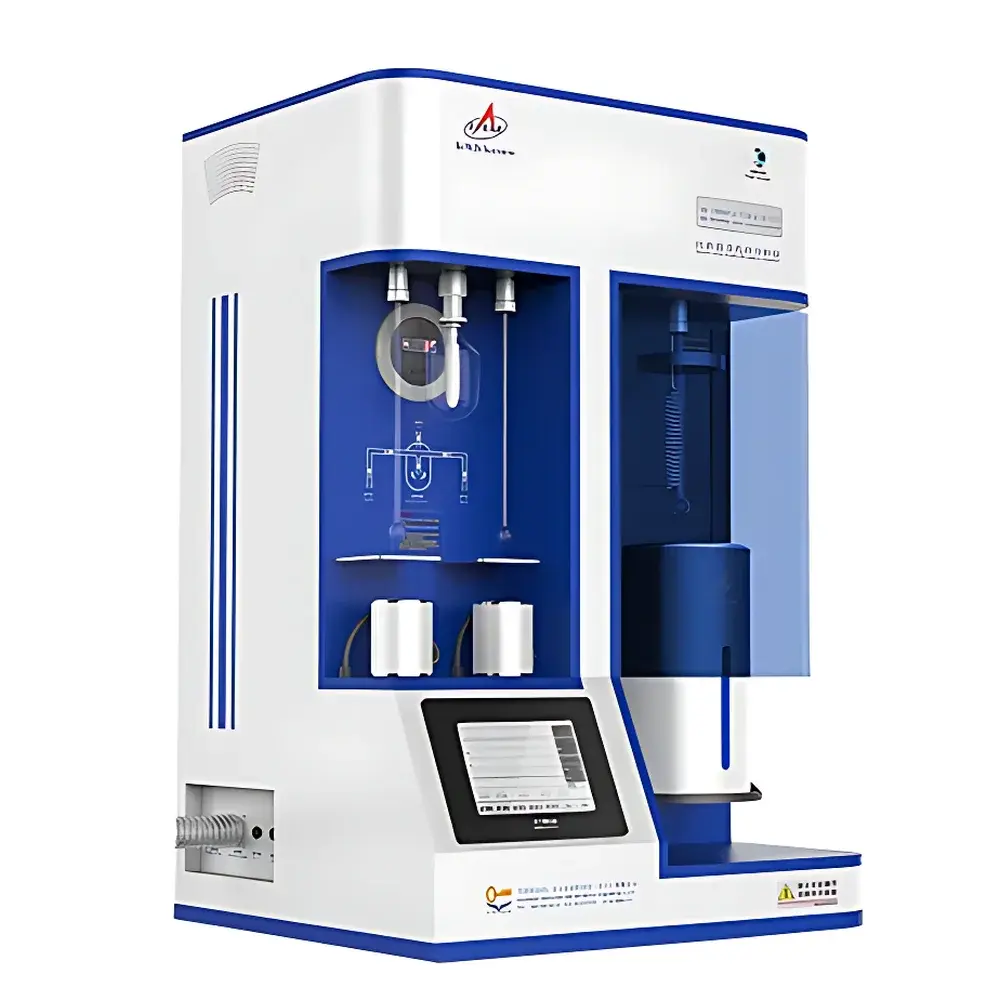
Beishide 3H-2000PS1X Static Volumetric Specific Surface Area and Pore Size Analyzer for Magnesium Stearate
| Brand | Beishide Instrument |
|---|---|
| Origin | Beijing, China |
| Manufacturer Type | Direct Manufacturer |
| Product Category | Domestic |
| Model | 3H-2000PS1X |
| Instrument Type | Specific Surface Area and Pore Size Analyzer |
| Measurement Principle | Static Volumetric Method (Static Capacity Method) |
| Number of Analysis Stations | 1–8 configurable |
| Specific Surface Area Range | 0.0005 m²/g to unlimited |
| Pressure Range | 10⁻² Pa |
| Repeatability | ≤ ±0.01 (relative standard deviation) |
Overview
The Beishide 3H-2000PS1X is a high-precision static volumetric gas adsorption analyzer engineered for rigorous determination of specific surface area, pore size distribution, and total pore volume in pharmaceutical excipients—particularly magnesium stearate—and other fine particulate materials. It operates on the fundamental principles of physical gas adsorption, applying the Brunauer–Emmett–Teller (BET) theory for surface area quantification and the Barrett–Joyner–Halenda (BJH), Density Functional Theory (DFT), and Non-Local Density Functional Theory (NLDFT) models for pore characterization. Designed to meet the stringent metrological requirements of QC laboratories in regulated pharmaceutical manufacturing, the instrument delivers traceable, reproducible results aligned with ISO 9277, ASTM D3663, and USP . Its dual-vacuum architecture, helium-based dead-volume calibration, and real-time P₀ monitoring ensure compliance with GLP and GMP data integrity expectations.
Key Features
- Modular BSD manifold system: Fully integrated, weld-free vacuum architecture with no threaded or compression fittings; leak rate <1×10⁻¹⁰ Pa·m³/s, exceeding ISO 20483 vacuum integrity benchmarks.
- Dual independent vacuum systems: Separate degassing and analysis vacuum lines prevent cross-contamination and maintain base pressure ≤10⁻² Pa during measurement cycles.
- High-fidelity pressure sensing: Dual capacitive silicon diaphragm transducers per station (0–1000 torr and 0–1 torr ranges); accuracy ≤±0.15% full scale, enabling precise P/P₀ control up to 0.998 near capillary condensation thresholds.
- Automated liquid nitrogen level regulation: Proprietary servo-controlled cryostat maintains constant immersion depth in a 3 L narrow-neck glass Dewar (thermal hold time >140 h), eliminating dead-volume drift during extended micropore analysis (e.g., CO₂ at 273 K).
- Helium-based thermal calibration: Dedicated He gas inlet and certified 99.999% purity supply enable accurate void volume determination without nitrogen adsorption artifacts—critical for low-surface-area excipients like magnesium stearate.
- Configurable station architecture: 1–8 analysis stations with individual temperature-controlled sample ports, each equipped with SMC pneumatic valves to eliminate thermal expansion errors from solenoid heating.
Sample Compatibility & Compliance
The 3H-2000PS1X accommodates powders, granules, fibers, and thin films that fit standard 6–12 mm OD quartz sample tubes. It supports multi-gas analysis (N₂, Ar, CO₂, Kr) with dedicated, isolated gas inlets—essential for differentiating microporous carbon (CO₂ at 273 K) from mesoporous silica (N₂ at 77 K). All hardware and software comply with FDA 21 CFR Part 11 requirements for electronic records and signatures, including full audit trail logging, user role-based access control, and immutable raw data archiving. Calibration certificates are NIST-traceable, and validation documentation supports IQ/OQ protocols per ASTM E2656 and EU Annex 15.
Software & Data Management
The proprietary BETAware™ software provides fully automated isotherm acquisition, multi-point BET linear regression (with automatic outlier rejection), t-plot and αs-plot analysis, and DFT/NLDFT kernel selection based on material class. Raw isotherm data is stored in HDF5 format with embedded metadata (operator ID, timestamp, calibration history, gas lot number). Export options include ASTM-compliant CSV, PDF reports with digital signatures, and direct integration into LIMS via OPC UA. The system logs all parameter changes, manual interventions, and hardware status events—ensuring full traceability for regulatory inspections.
Applications
- Pharmaceutical solid dosage forms: Quantifying surface area changes in magnesium stearate after milling or blending—correlating with tablet lubricity and dissolution variability.
- Excipient qualification: Verifying batch-to-batch consistency of silica aerogels, microcrystalline cellulose, and calcium phosphate carriers per ICH Q5C guidelines.
- Catalyst support characterization: Measuring pore narrowing in Pt/Al₂O₃ after thermal aging using Ar adsorption at 87 K.
- Battery electrode materials: Assessing mesopore collapse in silicon anodes following electrochemical cycling via N₂ isotherms.
- Quality control in GMP environments: Routine release testing of inhalation-grade lactose with ≤±1.0% RSD surface area repeatability across 30-day stability studies.
FAQ
Does the 3H-2000PS1X support automated P₀ measurement during analysis?
Yes—each station includes a dedicated, thermally isolated P₀ reference port with continuous saturation pressure tracking throughout the isotherm scan.
Can helium dead-volume calibration be performed without interrupting sample analysis?
Yes—the system executes He calibration sequences in parallel with ongoing N₂ or CO₂ adsorption measurements using time-multiplexed valve scheduling.
Is the software validated for use in FDA-regulated facilities?
Yes—BETAware™ includes pre-validated installation qualification (IQ) and operational qualification (OQ) packages compliant with Annex 11 and 21 CFR Part 11.
What maintenance intervals are recommended for the dual-stage mechanical pump?
Oil change every 3,000 operating hours; full pump service every 12,000 hours—both tracked automatically in the maintenance log module.
How is thermal equilibration verified prior to isotherm acquisition?
The system performs real-time thermal drift compensation using dual platinum RTD sensors in the sample and reference manifolds, requiring <0.01 K/h stability before initiating adsorption steps.



