
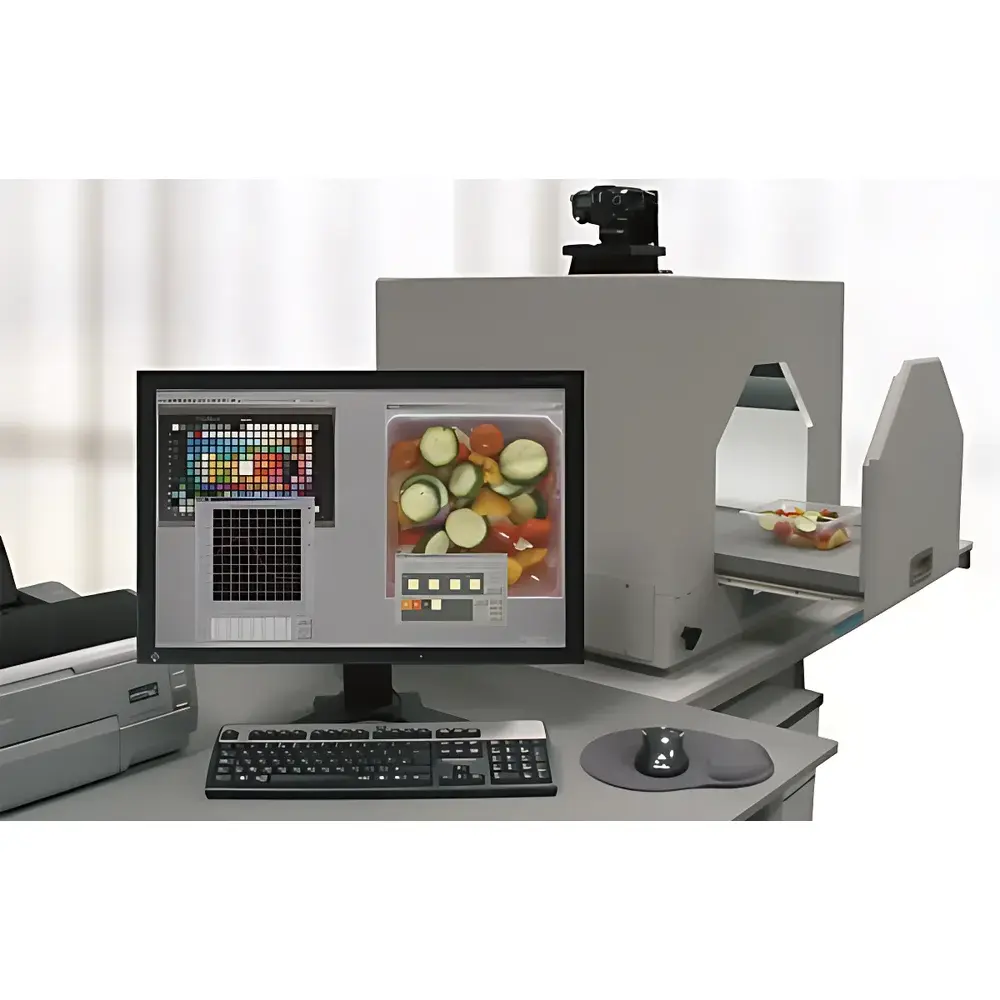
VeriVide Digieye Digital Imaging Color Measurement System
| Brand | VeriVide |
|---|---|
| Origin | United Kingdom |
| Model | Digieye |
| Product Type | Spectrophotometric Imaging Color Measurement System |
| Instrument Form Factor | Benchtop |
| Optical Geometry | 0°/45° and d/8° dual-mode compliant |
| Illuminant | Standard D65 (integrated in light booth) |
| Spectral Range | 380–730 nm (visible spectrum) |
| Repeatability | ΔE₀₀ < 0.1 (within-subject, same conditions) |
| Camera Resolution | 17 MP DSLR |
| Light Booth Dimensions | 700 W × 800 D × 860 H mm |
| Max Sample Size | 300 W × 210 D × 80 H mm |
| Display Characterization Accuracy | ΔE₀₀ < 1.2 (after calibration) |
| Camera Characterization Accuracy | ΔE₀₀ < 1.2 (image-to-CIE conversion) |
| Booth Imaging Accuracy | ΔE₀₀ < 1.0 (under controlled illumination) |
| UV Excitation Source | Optional LED-based UV control module |
| Calibration Standards | >150-tile verification chart + neutral gray sample holder (Munsell N5) + diffuse white tile |
Overview
The VeriVide Digieye Digital Imaging Color Measurement System is a benchtop, non-contact spectrophotometric imaging platform engineered for high-fidelity color capture, spatial color analysis, and texture-informed color evaluation across heterogeneous, irregular, and multi-component surfaces. Unlike conventional tristimulus or single-spot spectrophotometers—whose measurement apertures demand uniform, flat, opaque, and physically stable samples—the Digieye leverages calibrated digital imaging under metrologically traceable illumination to extract CIE L*a*b*, CIEDE2000 (ΔE₀₀), chroma (C*), hue angle (h°), and spectral reflectance data from pixel-level regions of interest (ROIs). Its dual optical geometry support (0°/45° and d/8°) enables compliance with both ISO 13655:2017 (graphic technology) and ASTM D2244 (standard practice for calculation of color tolerances) under standardized viewing conditions. The system integrates a 17-megapixel DSLR camera, VeriVide’s proprietary D65-standard light booth, and full-spectrum characterization software to deliver spatially resolved color metrics without physical contact, sample preparation, or destructive handling.
Key Features
- Non-contact, spatially resolved color measurement: captures full-field RGB imagery and converts to CIE-compliant colorimetric values (L*, a*, b*, C*, h°, ΔE₀₀, ΔE₇₆, ΔEcmc) at user-defined ROIs or automated segmentation zones.
- Dual optical geometry capability: supports both 0°/45° (for gloss-sensitive surface evaluation) and d/8° (diffuse illumination, integrating sphere equivalent) configurations within the same light booth—enabling cross-platform correlation with HunterLab, Konica Minolta, and Datacolor instruments.
- End-to-end color pipeline traceability: includes camera spectral characterization (ΔE₀₀ < 1.2), display profiling (ΔE₀₀ < 1.2), and light booth imaging validation (ΔE₀₀ < 1.0), all aligned to CIE 15:2018 and ISO/CIE 11664 series standards.
- Texture-aware color analysis: builds representative texture databases and enables re-coloring simulations while preserving spatial structure—critical for textile, packaging, and food appearance assessment.
- Multi-illuminant simulation: evaluates metamerism by rendering captured imagery under D65, A, F2, F7, F11, and optional UV-augmented D65+UV conditions per CIE S 014-2/E:2020.
- Comprehensive quality control suite: supports pass/fail tolerance mapping, multi-parameter deviation thresholds (dL*, dC*, dH*, MI), whiteness/yellowness indices (CIE/ASTM E313), opacity, color strength, grey scale staining, and spectral reflectance curve export (380–730 nm, 10 nm intervals).
Sample Compatibility & Compliance
The Digieye accommodates samples that are incompatible with aperture-based colorimeters—including irregular geometries (e.g., fruits, baked goods, molded plastics), low-opacity materials (gels, sauces, translucent films), textured surfaces (woven fabrics, brushed metals), thermally sensitive items (chilled dairy, confectionery), and multi-color assemblies (printed labels, multi-layer packaging). Its non-destructive workflow eliminates grinding, pelleting, or dilution—preserving sample integrity and perceptual relevance. All measurements comply with ISO 11664-4 (CIE L*a*b*), ISO 11664-6 (CIEDE2000), ISO 13655 (spectral measurement geometry), and ASTM D2244 (color difference calculation). For regulated environments, the system supports audit-ready metadata logging, user access controls, and electronic signature-capable reporting aligned with FDA 21 CFR Part 11 requirements when deployed with validated IT infrastructure.
Software & Data Management
Digieye’s proprietary software provides a unified interface for image acquisition, spectral characterization, ROI definition, batch analysis, and database archiving. It features full CIE XYZ → L*a*b* conversion using measured camera spectral sensitivity curves and D65 illuminant SPDs. Reflectance spectra are output as ASCII-compatible CSV files with wavelength (nm) and %R columns, suitable for third-party spectral analysis tools. Color data is stored in a relational SQLite database with timestamp, operator ID, instrument configuration, and environmental metadata (ambient lux, booth temperature). Reports are exportable in PDF, Excel, and XML formats—with configurable templates for internal QC, supplier certification, or regulatory submissions. Optional integration with LIMS via ODBC ensures traceability across enterprise quality workflows.
Applications
The Digieye serves critical roles in R&D, production QA/QC, and regulatory compliance across industries where visual appearance drives consumer perception and product acceptance. In food & beverage, it quantifies surface color heterogeneity of fresh produce, roasted coffee beans, or extruded snacks—without homogenization artifacts. In textiles and apparel, it validates dye lot consistency across patterned weaves and knits. In pharmaceuticals, it assesses tablet coating uniformity and blister pack print fidelity. In automotive interiors, it verifies color match across stitched leather, injection-molded trim, and metallic accents. In cosmetics, it characterizes pigment dispersion in foundations and lipsticks on skin-mimetic substrates. Its ability to report color proportion distributions (e.g., “62% L* 48±2, 28% L* 32±1.5”) makes it indispensable for specification development and failure root-cause analysis.
FAQ
How does Digieye differ from traditional spectrophotometers?
It replaces point-measurement geometry with spatial imaging—capturing full-field color distribution, texture context, and multi-region statistics in a single acquisition, without requiring sample flattening or aperture alignment.
Can Digieye measure transparent or translucent samples?
Yes—via backlit diffuse transmission mode or front-lit 45°/0° configuration, enabling accurate color assessment of gels, beverages, and thin films without dilution or cuvette constraints.
Is UV fluorescence compensation supported?
An optional UV LED module allows precise control of UV radiant flux (per ISO 13655 Annex B), facilitating fluorescent whitener assessment in paper, textiles, and detergents.
What color difference formulas are implemented?
CIEDE2000 (ΔE₀₀), CIELAB (ΔE₇₆), CMC(l:c), and DIN99d—all selectable per application and aligned with ISO 11664-6 and ASTM D2244.
Does Digieye support GLP/GMP documentation requirements?
When deployed with validated software configuration, electronic signatures, and audit trail logging, it meets core elements of GLP (OECD 1998) and GMP (ICH Q7) for color-critical release testing.





