
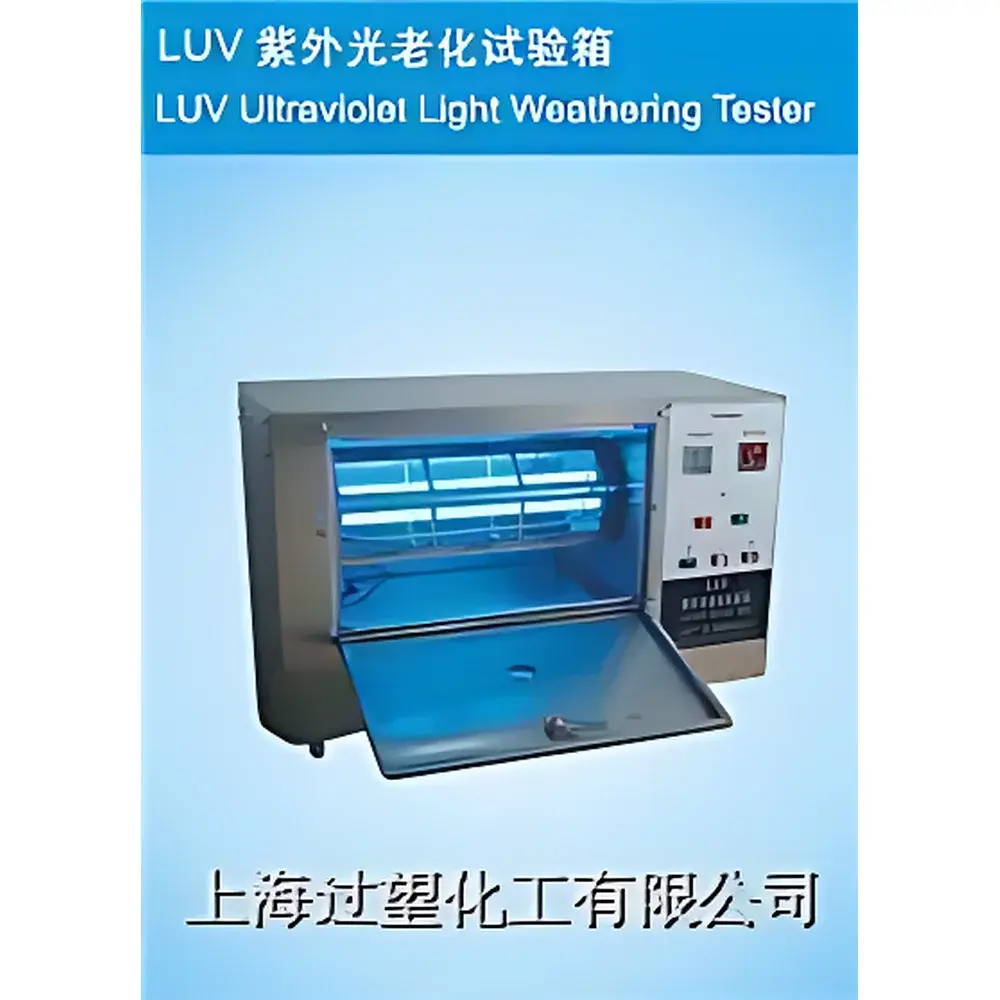
LUV-I UV Aging Test Chamber
| Origin | Shanghai, China |
|---|---|
| Manufacturer Type | Authorized Distributor |
| Origin Category | Domestic (China) |
| Model | LUV-I |
| Quotation | Available Upon Request |
| UV Wavelength | 313 nm |
| Rated Power | 0.2 kW |
| Water Pump Flow Rate | 47 L/min |
| Rotating Rack Speed | ≥3 rpm |
| Sample-to-Axis Vertical Distance | 145 mm |
| Weight | 48.5 kg |
| Dimensions (L×W×H) | 895 × 395 × 550 mm |
| Temperature Range | 40–60 °C |
| Compliance | GB/T 14522–1993, ISO 11507:1997 |
Overview
The LUV-I UV Aging Test Chamber is an engineered environmental test system designed to accelerate the photodegradation and hygrothermal aging of non-metallic materials—particularly organic coatings, plastics, elastomers, and adhesives—under controlled ultraviolet radiation and moisture exposure. It operates on the principle of fluorescent UV lamp irradiation (UVA-313 lamps, peak emission at 313 nm), which replicates the most damaging short-wavelength UV component of natural sunlight. Unlike full-spectrum solar simulation, this wavelength-specific approach enables accelerated, reproducible degradation mechanisms consistent with outdoor weathering pathways, including chain scission, oxidation, chalking, color fading, and loss of gloss. The chamber integrates cyclic water spray and condensation cycles to simulate dew formation and rain-induced stress, thereby modeling synergistic UV–moisture degradation—a critical failure mode in real-world service environments. Its compact benchtop architecture and precise thermal regulation (40–60 °C) support rapid qualification testing in R&D labs and QC departments where throughput, repeatability, and compliance with international standards are essential.
Key Features
- Triple UVA-313 fluorescent UV lamps (313 nm peak), delivering stable, calibrated irradiance for accelerated photochemical aging
- Programmable water spray and condensation cycles to emulate diurnal wet/dry transitions and moisture-driven hydrolysis
- Rotating sample rack (≥3 rpm) ensuring uniform irradiance distribution across all specimens
- Precise temperature control (40–60 °C) via integrated heating and feedback-regulated air circulation
- Compact footprint (895 × 395 × 550 mm) optimized for laboratory space efficiency without compromising test volume capacity (up to 18 standard specimens)
- Robust stainless-steel interior construction with corrosion-resistant components for long-term reliability under humid UV conditions
- Front-access transparent quartz viewing window enabling real-time visual monitoring without interrupting test cycles
Sample Compatibility & Compliance
The LUV-I accommodates flat-panel specimens up to 150 mm × 75 mm × 10 mm (L×W×H), mounted vertically on the rotating rack at a fixed 145 mm radius from the central axis. It supports standardized substrate configurations per ASTM D4329, ISO 11507:1997, and GB/T 14522–1993, including coated metal panels, polymer films, and composite laminates. All operational parameters—including irradiance intensity, cycle timing, temperature setpoints, and spray duration—are configurable to meet method-specific requirements. The system’s design facilitates traceable validation: lamp output can be verified using NIST-traceable UV radiometers, and chamber temperature uniformity conforms to ±2 °C tolerance across the sample plane per ISO 11507 Annex B. While not inherently 21 CFR Part 11 compliant (as it lacks electronic audit trail functionality), the unit may be integrated into GLP/GMP workflows when paired with external data loggers and documented SOPs for manual parameter recording and result reporting.
Software & Data Management
The LUV-I operates via an intuitive analog/digital hybrid controller with LED display and tactile push-button interface. It features preset programs aligned with ISO 11507 Cycle A (UV irradiation + condensation) and Cycle B (UV + water spray), as well as user-defined sequences for custom exposure protocols. Real-time status indicators show active phase (UV ON/OFF, spray ON/OFF, condensation, heating), elapsed time, and current chamber temperature. Though the base model does not include PC connectivity or automated data export, optional RS-485 or USB interfaces can be added for integration with lab-wide LIMS or SCADA systems. For regulatory environments requiring electronic records, users typically supplement operation with external calibrated thermocouple loggers and periodic irradiance calibration reports—practices widely accepted in ISO/IEC 17025-accredited testing laboratories.
Applications
- Comparative ranking of coating durability (e.g., acrylic vs. polyurethane topcoats) under UV/moisture stress
- Formulation screening for UV stabilizers, HALS additives, and pigment dispersion stability
- Pre-qualification of automotive interior trim materials per OEM-specific aging specifications
- Accelerated weathering validation of architectural sealants and facade membranes
- Supporting root-cause analysis of field failures linked to photooxidative degradation
- Generating input data for predictive service-life modeling (e.g., Arrhenius-based extrapolation of failure onset)
FAQ
What UV wavelength does the LUV-I emit, and why is 313 nm selected?
The LUV-I uses UVA-313 fluorescent lamps with peak spectral output at 313 nm. This wavelength lies within the most aggressive region of terrestrial solar UV (295–320 nm), where photon energy exceeds the bond dissociation energy of C–C and C–H bonds in polymers—enabling rapid initiation of photooxidation without requiring solar simulator complexity.
Can the LUV-I replicate full-spectrum sunlight?
No. It is intentionally designed for UV-accelerated, mechanism-specific aging—not broadband solar simulation. For broad-spectrum correlation, instruments such as xenon-arc weatherometers (e.g., Q-SUN or Atlas Ci series) are recommended.
Is calibration documentation provided with the unit?
Yes—each shipment includes a factory calibration certificate for temperature uniformity and lamp electrical parameters. Users are advised to perform quarterly irradiance verification using a calibrated UV radiometer traceable to NIST or equivalent national metrology institute.
How is specimen mounting standardized?
Specimens are secured to aluminum or stainless-steel frames using non-reactive clips or double-sided tape, positioned perpendicular to the lamp array at 145 mm radial distance. Mounting fixtures comply with ISO 11507 Figure 2 geometry to ensure consistent angular irradiance incidence.
Does the system support continuous unattended operation?
Yes—designed for 24/7 cycling with thermal cut-off protection, overcurrent fusing, and sealed pump housing. Recommended maintenance includes bi-weekly cleaning of lamp sleeves and monthly inspection of spray nozzles and condensate drain lines.



