
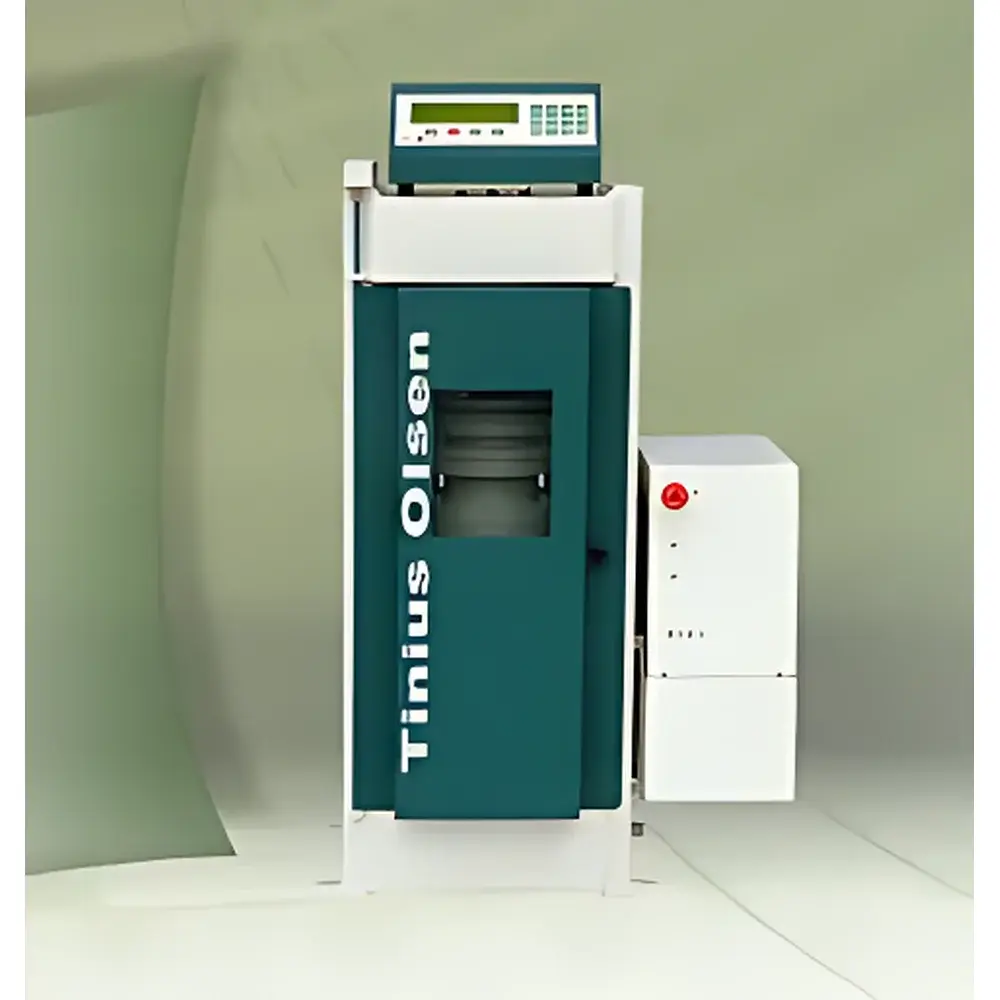
Tinius Olsen FA Series Automatic Compression Testing Machine
| Brand | Tinius Olsen |
|---|---|
| Origin | United Kingdom |
| Model | FA |
| Load Capacity Options | 50 kN to 3000 kN |
| Compliance | ASTM C39, ASTM C469, ASTM C78, AASHTO T22, EN 12390-3, BS 1881-116 |
| Control System | Microprocessor-based with dual-speed hydraulic pump |
| Data Storage | Up to 2000 test records |
| Display | 4-line alphanumeric LCD with real-time load rate, peak load, and pressure readout |
| Interfaces | RS232 and parallel port |
| Calibration Range | 1–100% of full scale (±1% accuracy across range) |
| Strain Measurement Option | LVDT-compatible (0.001 mm resolution) |
| Flexural Testing Capability | Optional with dedicated fixtures |
| Safety | Interlocked front/rear access doors, debris chute, automatic load release, emergency stop |
Overview
The Tinius Olsen FA Series Automatic Compression Testing Machine is a high-precision, microprocessor-controlled universal testing system engineered for standardized compressive strength evaluation of construction materials—including concrete cylinders, cubes, bricks, mortar, grout, and geological specimens. Built upon a rigid, fully welded monolithic frame with hardened and ground platens, the FA Series implements a dual-speed servo-hydraulic actuation system to deliver precise, repeatable loading profiles in accordance with ASTM, AASHTO, EN, and BS regulatory frameworks. Its core measurement principle relies on closed-loop load control via a calibrated load cell integrated into the upper crosshead assembly, enabling traceable force application from 1% to 100% of full-scale capacity with ±1% accuracy across the entire range. The machine operates under deterministic real-time control logic—automatically ramping to target stress rates, capturing peak compressive load at fracture, and terminating load application upon specimen failure. All operational parameters—including date/time stamping, test ID assignment, and unit selection (SI, imperial, or metric)—are managed through an intuitive menu-driven interface housed within the integrated controller.
Key Features
- Rigid all-welded structural frame with precision-ground hydraulic piston mounted directly to the base and hardened, lapped, and polished upper/lower platens
- Automatic self-aligning upper platen with standard spherical seating and included spacer sets for rapid adaptation to common specimen geometries (e.g., 100 mm cubes, 150 mm × 300 mm cylinders)
- Dual-speed hydraulic pump system enabling both rapid approach and fine-load control via single-lever operation with real-time load-rate feedback on display
- Interlocked front and rear safety doors compliant with ISO 13857 and EN 954-1 Category 3 requirements; rear-mounted debris chute facilitates immediate post-test specimen removal
- Integrated controller with 4-line alphanumeric LCD showing simultaneous real-time load, load rate, peak load, and pressure—plus configurable time/date stamping and selectable units (MPa, psi, kgf/cm²)
- Onboard memory storing up to 2000 complete test records with metadata (test ID, operator code, date/time), exportable via RS232 or parallel port
- Automatic load release and emergency shutdown functions; programmable auto-shutdown after test completion or idle timeout
Sample Compatibility & Compliance
The FA Series accommodates a broad spectrum of standardized civil engineering specimens without mechanical reconfiguration. Standard configurations support ASTM C39 (concrete cylinders), ASTM C469 (static modulus), ASTM C78 (flexural strength of concrete), AASHTO T22, EN 12390-3 (compressive strength of hardened concrete), and BS 1881-116. Optional accessories extend capability to prism compression (TO-314-LU-SPL, TO-320-LU-SPL), splitting tensile tests (TO-320-5528), flexural testing (TO-33101-ASTM/BS), and custom mold casting (TO-343, TO-344 series). All platen surfaces meet flatness tolerances per ASTM E10 and ISO 7500-1 Class 1 requirements. The system supports optional strain measurement via LVDT transducers (TO-31727-1), enabling full stress–strain curve generation, Young’s modulus calculation, and Poisson’s ratio derivation when used with radial extensometry.
Software & Data Management
The FA Series interfaces bidirectionally with Tinius Olsen’s Horizon software via RS232, providing full remote control, advanced data visualization, and GLP-compliant reporting. Horizon implements audit-trail functionality meeting FDA 21 CFR Part 11 requirements—including electronic signatures, user-level permissions, and immutable test record archiving. Software features include real-time load–time and stress–time plotting, automated fracture-point identification, batch summary reports with statistical analysis (mean, SD, CoV), and customizable templates for ASTM/EN-compliant certificates. Test databases link specimen metadata (batch ID, curing age, mix design) to raw and processed results. Export formats include CSV, PDF, and XML for LIMS integration. Horizon also supports third-party calibration certificate import and traceability mapping to national standards (NIST, UKAS).
Applications
Primary applications span quality assurance and R&D laboratories in cement manufacturing, precast concrete production, infrastructure testing agencies, and academic materials science departments. Typical use cases include compressive strength validation of structural concrete per ACI 318 and Eurocode 2; modulus of elasticity determination for seismic design modeling; evaluation of supplementary cementitious materials (SCMs); long-term strength development studies under controlled curing conditions; and durability assessment of alkali-silica reaction (ASR)-susceptible aggregates. The FA Series also serves geotechnical labs performing unconfined compressive strength (UCS) testing of rock cores and soil-cement blocks per ASTM D2166 and ISRM standards. With optional bending fixtures, it supports flexural strength characterization of fiber-reinforced concrete and asphaltic binders.
FAQ
What load capacities are available in the FA Series?
The FA Series is offered in nine standard capacities: 50 kN, 100 kN, 250 kN, 500 kN, 1000 kN, 1500 kN, 2000 kN, 3000 kN—with voltage/frequency variants (110 VAC/60 Hz, 220 VAC/50 Hz, 220 VAC/60 Hz) for global deployment.
Is the system compliant with ISO/IEC 17025 requirements for accredited testing labs?
Yes—the FA Series meets mechanical and metrological requirements of ISO/IEC 17025:2017 Clause 6.4 (equipment) and 6.5 (traceability), especially when paired with UKAS/NIST-traceable calibration services and Horizon’s Part 11-compliant audit trail.
Can the machine perform both compression and flexural tests on the same platform?
Flexural testing requires optional fixtures (e.g., TO-33101) and is supported only on models ≥100 kN capacity; bending tests must be conducted separately from compression routines due to fixture geometry and loading axis constraints.
What is the minimum resolvable displacement for strain measurement?
With the optional TO-31727-1 LVDT kit, axial displacement resolution is 0.001 mm over a 10 mm full-scale range, supporting high-fidelity stress–strain curve acquisition per ASTM E111.
How is system calibration maintained over time?
Calibration verification is performed across three points (20%, 60%, and 100% of capacity) using certified deadweight standards or reference load cells traceable to NPL or NIST; Horizon logs all calibration events with operator ID and timestamp.



