
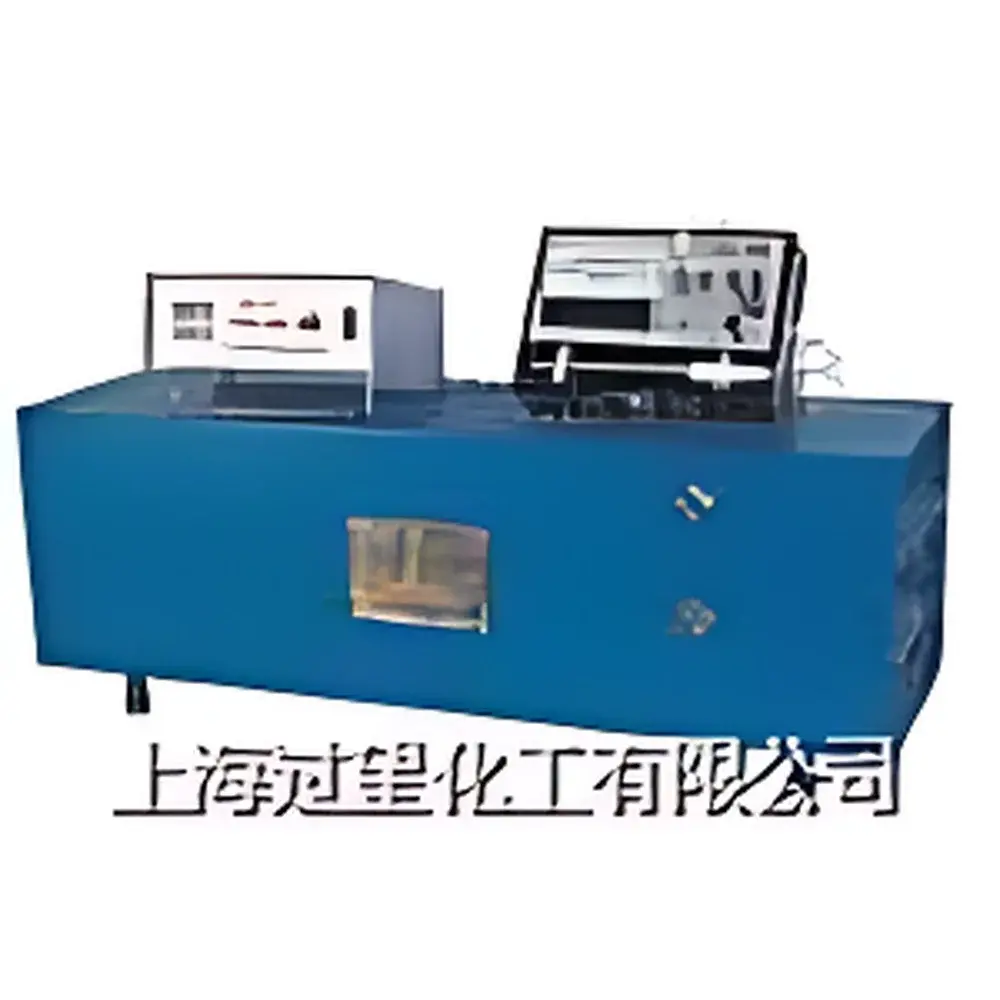
GW Initial Drying Crack Resistance Tester for Architectural Coatings
| Origin | Shanghai, China |
|---|---|
| Manufacturer Type | Authorized Distributor |
| Origin Category | Domestic (China) |
| Model | GW |
| Power Consumption | 100 W |
| Airflow Velocity Range | 0–10 m/s (adjustable, calibrated at 3.0 ± 0.3 m/s) |
| Dimensions (Main Unit) | 1000 × 300 × 360 mm (L × W × H) |
| Dimensions (Controller) | 240 × 210 × 110 mm (L × W × H) |
| Net Weight | 27 kg |
Overview
The GW Initial Drying Crack Resistance Tester is a purpose-built laboratory instrument engineered to evaluate the early-stage drying behavior and crack resistance of textured or multi-layer architectural coatings—particularly elastic, stucco-like, or decorative exterior systems. It operates on the principle of controlled convective airflow simulation, replicating accelerated surface-drying conditions under standardized environmental parameters. Unlike generic drying cabinets or fan-assisted ovens, this tester delivers uniform, laminar airflow across the coated substrate at precisely regulated velocity and direction, enabling reproducible assessment of micro-crack initiation during the critical first 30–120 minutes of film formation. Designed in strict alignment with GB/T 9779–1988 (“Test Method for Initial Drying Crack Resistance of Textured Architectural Coatings”), it supports quality assurance workflows in R&D labs, formulation centers, and third-party testing facilities serving the construction materials industry.
Key Features
- High-stability axial-flow blower system with continuously variable speed control, ensuring precise airflow delivery at 3.0 ± 0.3 m/s (calibrated per GB/T 9779–1988 requirements)
- Dedicated digital anemometer (0–10 m/s range) integrated into the test chamber for real-time, traceable air velocity verification
- Modular mechanical architecture: separate main unit (coating exposure zone) and compact controller unit, facilitating benchtop installation and service access
- Robust aluminum-alloy chassis and corrosion-resistant internal surfaces, optimized for long-term use in humid or solvent-exposed lab environments
- No external exhaust ducting required—self-contained airflow path minimizes laboratory footprint and eliminates cross-contamination risk between test cycles
Sample Compatibility & Compliance
The GW tester accommodates standard ASTM D609–22 or ISO 1514–2019-compliant test panels (typically 150 × 70 mm or 200 × 100 mm steel or glass substrates), coated with textured acrylic, silicone-acrylic, or polymer-modified cementitious systems. Sample mounting fixtures ensure consistent standoff distance (150 mm) from the nozzle exit plane, maintaining laminar flow boundary conditions across all trials. The instrument satisfies the physical configuration and operational criteria defined in GB/T 9779–1988, including airflow uniformity, directional consistency, and temporal stability over ≥90-minute test durations. While GB/T 9779–1988 remains the primary reference, data generated are routinely accepted in GLP-compliant reports supporting CE marking submissions (EN 1504–2), ASTM D7234 (pull-off adhesion after drying stress), and ISO 20340 (protective coating performance in offshore environments).
Software & Data Management
This is a hardware-only, manually operated instrument with no embedded firmware or digital interface. All operational parameters—including start time, airflow setpoint, ambient temperature/humidity (recorded externally), and visual crack evaluation timestamps—are documented via standardized paper-based test logs aligned with ISO/IEC 17025 documentation templates. Users may integrate the GW tester into LIMS or ELN platforms by assigning unique equipment IDs and linking test records to batch-specific coating formulations. For regulatory audits (e.g., FDA 21 CFR Part 11 or EU Annex 11), laboratories implement handwritten logbooks with dual-signature verification or scanned entries with timestamped digital signatures—ensuring full traceability without proprietary software dependencies.
Applications
- Formulation screening of crack-inhibiting additives (e.g., polyacrylate thickeners, cellulose ethers, nano-silica dispersions)
- Batch-to-batch quality verification of textured elastomeric coatings prior to dispatch
- Comparative assessment of drying modifiers (e.g., coalescing agents vs. slow-evaporating solvents) under identical airflow stress
- Supporting technical dossiers for green building certifications (LEED v4.1 MR Credit: Building Product Disclosure and Optimization – Sourcing of Raw Materials)
- Root-cause analysis of field-reported cracking incidents by correlating lab-scale crack morphology (via optical microscopy) with controlled drying kinetics
FAQ
Does the GW tester comply with international standards beyond GB/T 9779–1988?
Yes—it is physically compatible with test protocols referenced in ASTM D3359 (adhesion after drying stress), ISO 2409 (cross-cut test post-drying), and EN 13523–16 (coil-coated metal drying crack evaluation), though formal validation against those standards requires user-defined correlation studies.
Can the airflow velocity be validated independently?
Absolutely. The integrated 0–10 m/s anemometer allows in-situ calibration using NIST-traceable handheld hot-wire or vane anemometers; calibration certificates are recommended annually per ISO/IEC 17025 Clause 6.5.
Is the unit suitable for volatile organic compound (VOC)-rich coatings?
It is not explosion-proof and lacks fume extraction. Testing VOC-emitting systems requires operation inside a certified chemical fume hood with appropriate airflow interlock and PPE compliance.
What maintenance is required for long-term accuracy?
Biannual inspection of blower bearings, cleaning of inlet filters, and verification of anemometer zero-point drift using static air reference conditions are advised per manufacturer’s maintenance log template.



