
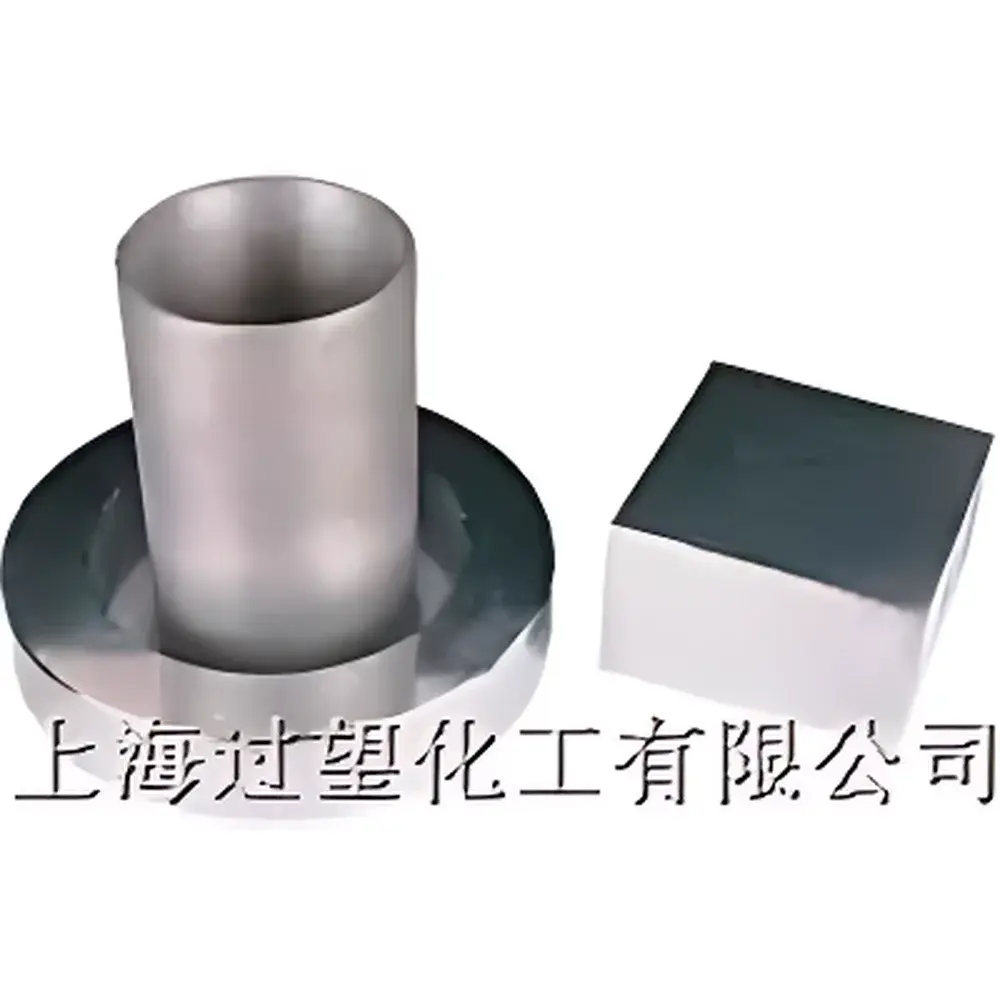
GW Dry-Heat Resistance Test Pot for Decorative Surface Panels
| Origin | Shanghai, China |
|---|---|
| Manufacturer Type | Authorized Distributor |
| Regional Origin | Domestic (China) |
| Model | GW |
| Pricing | Available Upon Request |
| Outer Diameter of Test Pot | Ø87 ± 1 mm |
| Height | 150 ± 5 mm |
| Bottom Thickness | 2.5 ± 0.5 mm |
| Pressure Ring | Outer Diameter Ø180 ± 1 mm, Inner Diameter Ø120 ± 1 mm, Mass: 4 kg |
| Pressure Block | 100 mm × 100 mm × 64 mm (L × W × H), Mass: 5 kg |
Overview
The GW Dry-Heat Resistance Test Pot is a precision-engineered physical property testing instrument designed to evaluate the thermal resistance of decorative surface layers on engineered wood products—including laminated particleboard, medium-density fiberboard (MDF), and decorative high-pressure laminates. It operates on the principle of controlled dry-heat exposure under standardized static load conditions, simulating real-world contact with hot objects such as cookware or heated appliances. The test method replicates the thermal stress applied to surface finishes without moisture involvement, enabling quantifiable assessment of discoloration, blistering, cracking, or delamination after defined exposure durations and temperatures. This apparatus complies with established Chinese national standards governing quality assurance in wood-based panel manufacturing and surface finishing industries.
Key Features
- Stainless steel construction of the test pot ensures dimensional stability, thermal uniformity, and long-term corrosion resistance during repeated heating cycles.
- Precision-machined pressure ring and block provide consistent, reproducible loading—4 kg applied via the annular ring and 5 kg via the square block—to maintain standardized contact pressure per GB/T 15102–1994 and GB/T 17657–1999.
- Geometric tolerances strictly adhere to specification limits: pot outer diameter (Ø87 ± 1 mm), height (150 ± 5 mm), and bottom thickness (2.5 ± 0.5 mm), ensuring conformity with calibration and inter-laboratory comparability requirements.
- Modular design facilitates easy cleaning, traceable calibration, and integration into routine QC workflows within certified testing laboratories and production QA departments.
- No electrical or electronic components—purely mechanical operation eliminates variability from power fluctuations or firmware dependencies, supporting GLP-aligned manual testing protocols.
Sample Compatibility & Compliance
The GW Dry-Heat Resistance Test Pot accommodates standard specimen sizes per GB/T 18102–2000 (e.g., 150 mm × 150 mm panels). It is validated for use with thermosetting resins (melamine, phenolic), thermoplastic overlays (PVC, PET), and veneer-based decorative systems. Testing is conducted at fixed temperatures—typically 100 °C, 120 °C, or 150 °C—maintained externally via calibrated heating plates or ovens. Results are assessed visually and documented according to ASTM D2244 (color difference) or ISO 105-A02 (gray scale for staining), where applicable. Full traceability is supported through documented calibration of mass standards (pressure components) and temperature monitoring devices used in conjunction with the pot.
Software & Data Management
As a manually operated mechanical test device, the GW Dry-Heat Resistance Test Pot does not incorporate embedded software or digital interfaces. However, it is fully compatible with laboratory information management systems (LIMS) and electronic lab notebooks (ELN) when paired with external data capture tools—such as calibrated thermocouple loggers, digital calipers, and imaging stations—for structured recording of test parameters, environmental conditions, and pass/fail evaluations. Audit trails comply with GLP and GMP documentation practices, including operator identification, date/time stamps, and reference to relevant standard clauses (e.g., GB/T 15102–1994 Section 6.4.3).
Applications
- Quality control of decorative laminate surfaces in furniture and interior fit-out manufacturing.
- Pre-certification testing for CE-marked panel products exported to EU markets requiring compliance with EN 438-2 (high-pressure decorative laminates).
- R&D validation of new resin formulations and surface coating technologies under accelerated thermal stress.
- Third-party certification testing by CNAS-accredited laboratories performing conformity assessments against GB, ISO, and JIS standards.
- Supplier qualification audits where dry-heat resistance serves as a critical performance criterion in procurement specifications.
FAQ
What standards does the GW Dry-Heat Resistance Test Pot support?
It is explicitly designed for GB/T 15102–1994, GB/T 17657–1999, and GB/T 18102–2000. With appropriate procedural adaptation, it may also support ISO 4611 and EN 438-2 Annex B for comparative evaluation.
Is calibration documentation provided with the unit?
Yes—certified dimensional verification reports for all critical components (pot, ring, block) are supplied upon delivery, traceable to national metrology institutes in China.
Can the test pot be used with automated temperature-controlled chambers?
Absolutely. The pot is intended for placement inside externally regulated ovens or hot plates; its passive design ensures compatibility with any ISO/IEC 17025-compliant thermal environment.
What maintenance is required?
Routine visual inspection for surface oxidation or deformation, periodic re-verification of mass values using NIST-traceable weights, and cleaning with non-abrasive stainless steel cleaners between test cycles.
Does the system meet FDA 21 CFR Part 11 requirements?
As a standalone mechanical device without electronic records generation, it does not fall under Part 11 scope—but when integrated into a validated LIMS workflow, its associated test records may be included in Part 11-compliant audit trails.
Related Products



