
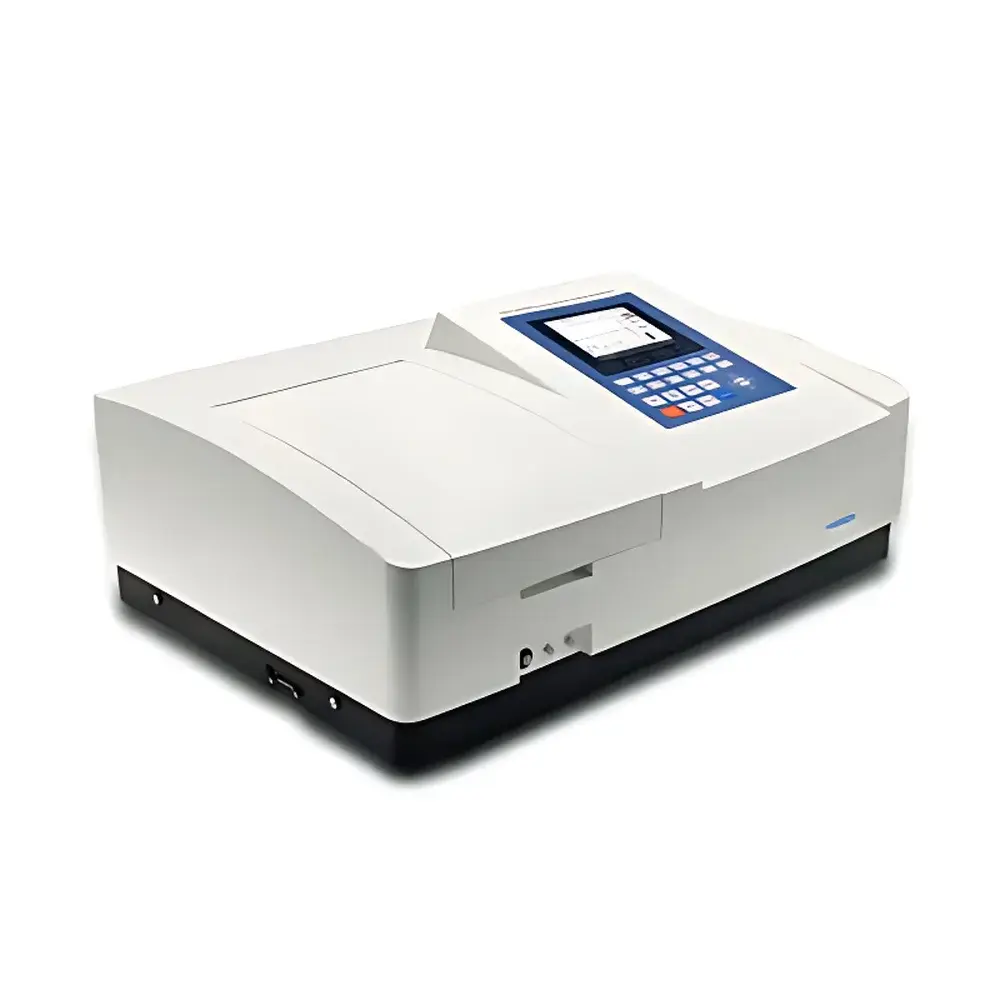
Mapada UV-6300 Scanning Double-Beam Ultraviolet-Visible Spectrophotometer
| Brand | Mapada |
|---|---|
| Origin | Shanghai, China |
| Manufacturer Type | Direct Manufacturer |
| Origin Category | Domestic (China) |
| Model | UV-6300 |
| Price Range | USD 7,000–10,000 (FOB Shanghai) |
| Optical Design | Pseudo-Double-Beam |
| Detector | Photodiode Array (PDA) |
| Wavelength Range | 190–1100 nm |
| Wavelength Accuracy | ±0.3 nm |
| Spectral Bandwidth | 1 nm |
| Wavelength Scanning Speed | Up to 3800 nm/min (High Mode) |
| Display | 320 × 240 LCD (5-inch) |
| Data Interface | USB 2.0 |
| Print Interface | Parallel Port |
| Power Supply | AC 220 V/50 Hz or AC 110 V/60 Hz |
| Dimensions (W×D×H) | 590 × 420 × 260 mm |
| Net Weight | 26 kg |
Overview
The Mapada UV-6300 is a scanning pseudo-double-beam ultraviolet-visible (UV-Vis) spectrophotometer engineered for routine quantitative and qualitative analysis in academic laboratories, quality control environments, and pharmaceutical R&D settings. It operates on the principle of absorbance measurement based on the Beer–Lambert law, utilizing a high-stability optical path architecture with a 1200 lines/mm holographic grating to ensure consistent spectral resolution across its full 190–1100 nm wavelength range. Unlike true double-beam systems that split light into reference and sample beams simultaneously, the UV-6300 employs a time-shared pseudo-double-beam configuration—alternating rapidly between reference and sample paths using a mechanical chopper—to compensate for source drift and detector instability without requiring dual optical trains. This design delivers high photometric reproducibility (<±0.002 A at 0.5 A, 546 nm) and long-term baseline stability, making it suitable for kinetic assays, spectral scanning, and multi-point calibration workflows under GLP-compliant conditions.
Key Features
- 5-inch high-contrast monochrome LCD (320 × 240 pixels) with integrated graphical interface for real-time display of absorbance (A), transmittance (T), concentration (C), and energy (E) modes—as well as full-spectrum scans and time-based kinetics plots
- Optimized optical train featuring imported long-life deuterium and tungsten-halogen lamps, with ozone-reduced deuterium lamp housing compliant with IEC 61000-4-3 electromagnetic compatibility standards
- Plug-and-play lamp module design eliminates post-replacement optical alignment; lamp usage hours are tracked automatically and logged in non-volatile memory
- Wide sample compartment accommodating cuvettes from 5 mm to 100 mm pathlength, compatible with standard 12.5 mm square or 16 mm round cells
- Three-step selectable scan speed (low/medium/high), enabling optimized signal-to-noise ratio for high-resolution spectral acquisition or rapid screening applications
- Onboard GLP self-validation function supports periodic verification of wavelength accuracy (via holmium oxide or didymium filters) and photometric linearity (using neutral density filters), generating timestamped compliance reports
- Embedded firmware supports USB mass storage mode for direct export of spectra (.csv, .txt) and method files; parallel port enables connection to legacy dot-matrix or thermal printers
Sample Compatibility & Compliance
The UV-6300 accepts standard quartz, fused silica, or high-quality optical glass cuvettes within the specified pathlength range. Its 1 nm spectral bandwidth meets the resolution requirements for most pharmacopeial methods (e.g., USP , EP 2.2.25) and environmental testing protocols (e.g., EPA Method 450.1). The instrument conforms to ISO 9001 manufacturing quality systems and includes traceable factory calibration against NIST-traceable standards. While not pre-certified for 21 CFR Part 11, its audit trail functionality—including user login timestamps, parameter change logs, and report generation metadata—provides foundational support for GMP/GLP documentation requirements when deployed with appropriate procedural controls.
Software & Data Management
The UV-6300 is fully operable via Mapada’s proprietary MapadaScan v3.x Windows-based software (Windows 10/11, 64-bit), which provides advanced data processing capabilities including peak detection, derivative spectroscopy, multi-wavelength quantitation, and custom calibration curve fitting (linear, quadratic, cubic, and 4-parameter logistic models). All acquired spectra and method configurations are stored with embedded metadata (operator ID, date/time, instrument serial number, lamp hours). Raw data exports retain full wavelength-intensity pairs without interpolation, ensuring traceability for regulatory review. Software installation packages include digital signature validation and optional password-protected user role assignment (Operator, Supervisor, Administrator).
Applications
- Pharmaceutical assay development and release testing of active pharmaceutical ingredients (APIs) and excipients per USP/EP monographs
- Enzyme kinetics studies (e.g., NADH/NADPH oxidation at 340 nm) and protein quantification (Bradford, Lowry, BCA)
- Water and wastewater analysis—including nitrate (220 nm/275 nm dual-wavelength correction), phosphate (880 nm), and COD estimation
- Food and beverage quality control: color index determination (e.g., AOAC 993.02), preservative quantification (sorbic acid at 264 nm), and antioxidant capacity assays
- Academic teaching labs: demonstration of electronic transitions, conjugation effects, and solvent polarity impacts on λmax
FAQ
What is the difference between “pseudo-double-beam” and “true double-beam” optical design?
The UV-6300 uses a single-beam optical path with a rotating mirror chopper to alternate illumination between reference and sample positions at high frequency (~10 Hz). This time-multiplexed approach corrects for source intensity drift but does not eliminate path-length or detector response variability inherent in simultaneous dual-path systems.
Can the UV-6300 perform DNA/RNA purity assessment at 260/280 nm?
Yes—the instrument’s 0.3 nm wavelength accuracy and 1 nm bandwidth meet the resolution and repeatability criteria specified in common molecular biology protocols (e.g., Thermo Fisher NanoDrop validation guidelines) for A260/A280 ratio calculation.
Is spectral calibration required before each use?
No—routine operation does not require daily recalibration. However, GLP-compliant environments should perform wavelength and photometric validation at least once per shift or per analytical batch using certified reference materials.
Does the instrument support external triggering or integration with autosamplers?
The UV-6300 does not feature TTL or RS-232 hardware triggers; it is designed for manual or PC-controlled operation only. Integration with third-party autosamplers requires custom scripting via the MapadaScan SDK.
What maintenance is recommended for long-term performance stability?
Lamp replacement every 1,000–2,000 hours (deuterium) or 2,000–3,000 hours (tungsten); quarterly cleaning of the sample compartment and optical window with lint-free wipes and spectroscopic-grade methanol; annual verification of grating alignment by authorized service personnel.





