
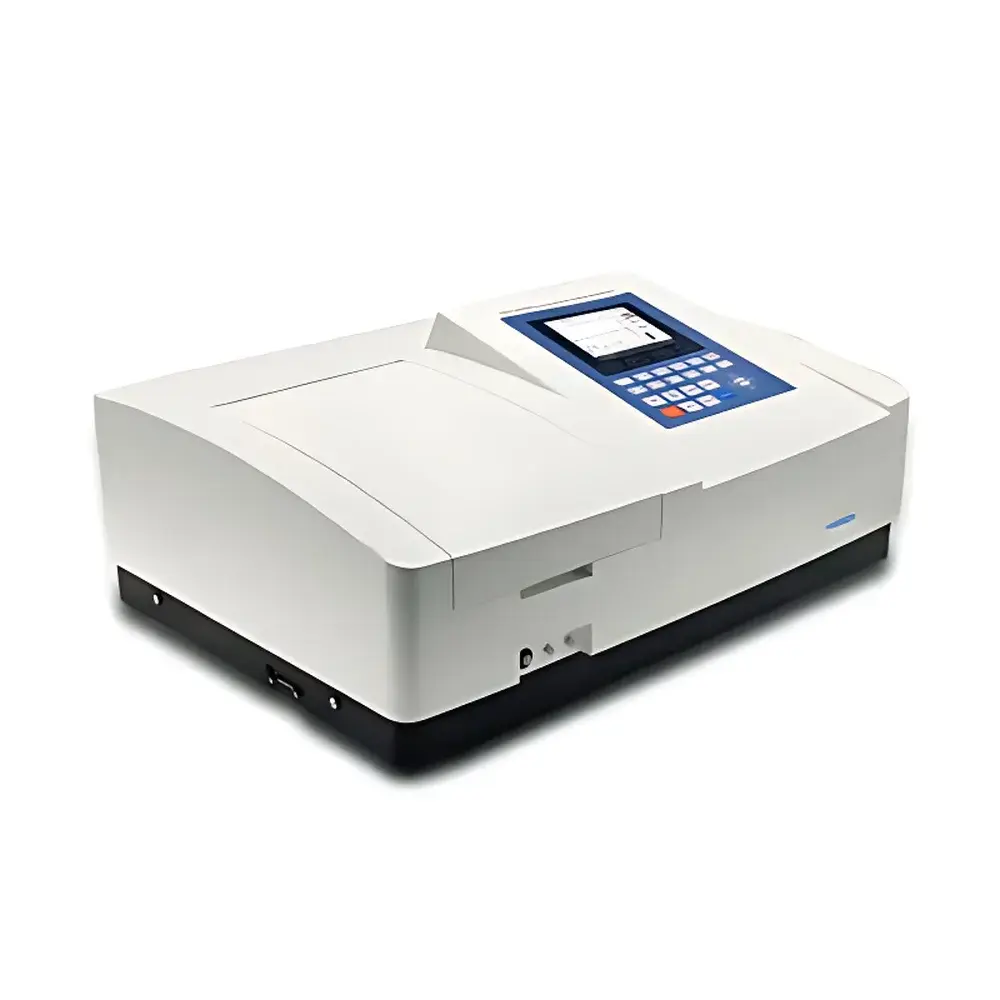
Mapada UV-3100 Scanning Ultraviolet-Visible Spectrophotometer
| Brand | Mapada |
|---|---|
| Origin | Shanghai, China |
| Manufacturer Type | Original Equipment Manufacturer (OEM) |
| Instrument Architecture | Pseudo-Double-Beam |
| Detector | Silicon Photodiode |
| Wavelength Range | 190–1100 nm |
| Spectral Bandwidth | 2 nm |
| Wavelength Accuracy | ±0.3 nm |
| Wavelength Scanning Speed | Up to 3800 nm/min (High Mode) |
| Photometric Range | 0–200% T, –4.0 to +4.0 A |
| Display | 320 × 240 pixel LCD (5-inch) |
| Interface | USB data output, Parallel port for printer |
| Power Supply | AC 220 V/50 Hz or AC 110 V/60 Hz |
| Dimensions | 490 × 360 × 240 mm |
| Net Weight | 14 kg |
Overview
The Mapada UV-3100 is a high-performance scanning ultraviolet-visible (UV-Vis) spectrophotometer engineered for routine and research-grade quantitative and qualitative analysis in academic laboratories, quality control environments, and industrial R&D settings. Based on the principle of absorption spectroscopy, the instrument measures the attenuation of monochromatic light as it passes through a sample solution—enabling precise determination of analyte concentration via the Beer-Lambert law. Its pseudo-double-beam optical architecture compensates for source intensity drift and detector response variation in real time, delivering improved photometric stability and baseline reproducibility compared to single-beam systems. The UV-3100 covers a broad spectral range from 190 nm (deep UV, suitable for nucleic acid and aromatic compound analysis) to 1100 nm (near-infrared), supporting applications across pharmaceuticals, environmental testing, food science, and materials characterization.
Key Features
- Precision optical design incorporating a 1200 lines/mm holographic grating for high dispersion and resolution, ensuring accurate spectral separation across the full 190–1100 nm range.
- Imported long-life deuterium and tungsten-halogen lamps with intelligent lamp-hour monitoring—providing traceable operational history for maintenance scheduling and GLP compliance.
- Plug-and-play lamp module design eliminates post-replacement optical alignment, reducing downtime and technician dependency.
- 5-inch backlit LCD display (320 × 240 pixels) with native Chinese and English interface support; capable of real-time visualization of absorbance/transmittance spectra, kinetic time-course plots, and multi-point calibration curves.
- Three selectable scan speed modes (high/medium/low), with maximum scanning velocity of 3800 nm/min—optimized for rapid screening without compromising signal-to-noise ratio.
- Integrated GLP self-validation function enabling on-demand verification of wavelength accuracy (±0.3 nm certified) and photometric accuracy—generating timestamped validation reports compliant with internal audit requirements.
- Spacious sample compartment accommodating cuvettes from 5 mm to 100 mm pathlength, including standard 10 mm quartz, glass, or plastic cells.
Sample Compatibility & Compliance
The UV-3100 accommodates liquid, suspension, and soluble solid samples in standard spectrophotometric cuvettes. It supports both transmission and reflectance measurements (with optional accessories) and is compatible with common solvents—including water, ethanol, acetonitrile, and hexane—within standard safety limits. The instrument meets fundamental performance criteria outlined in ISO 6425 (spectrophotometer specifications), ASTM E275 (standard practices for UV-Vis spectrophotometry), and USP (Spectrophotometric Absorbance). While not pre-certified for 21 CFR Part 11, its data logging, user-access controls, and audit-trail-capable software (via optional Mapada ScanPro) support implementation in regulated environments under GMP/GLP frameworks when validated per site-specific SOPs.
Software & Data Management
The UV-3100 operates natively via onboard firmware with full local control, but achieves enhanced functionality when paired with Mapada ScanPro—a Windows-based PC application distributed separately. ScanPro enables method storage, multi-wavelength quantitation, spectral subtraction, derivative spectroscopy, and kinetic modeling. All acquired data—including spectra, calibration tables, and validation logs—are exportable in CSV, TXT, and BMP formats. USB connectivity ensures seamless transfer to LIMS or ELN platforms. Internal memory retains up to 200 measurement records, including full spectral datasets, with automatic timestamping and operator ID tagging where enabled.
Applications
- Pharmaceutical assay development and release testing (e.g., active pharmaceutical ingredient quantification per USP monographs).
- Environmental water quality analysis: nitrate, phosphate, COD, and heavy metal complexation studies.
- Food and beverage QC: color index evaluation (e.g., AOAC methods), antioxidant capacity (DPPH assay), and preservative concentration.
- Biochemical research: protein quantification (Bradford/Lowry/BCA), DNA/RNA purity assessment (A260/A280 ratios), and enzyme kinetics.
- Materials science: bandgap estimation of semiconductors, dye degradation kinetics, and nanoparticle surface plasmon resonance profiling.
FAQ
What is the optical configuration of the UV-3100, and how does it affect measurement stability?
The UV-3100 employs a pseudo-double-beam design, using a rotating sector mirror to alternate light between sample and reference beams at high frequency. This architecture minimizes errors from lamp instability and detector drift—improving baseline flatness and long-term repeatability.
Can the UV-3100 be used for kinetic measurements?
Yes. The instrument supports time-scan mode with adjustable interval (100 ms–999 s) and duration (up to 999 minutes), enabling enzyme reaction monitoring, dissolution profiling, and photochemical decay studies.
Is the UV-3100 compliant with FDA 21 CFR Part 11?
Out-of-the-box, the standalone unit does not include electronic signature or audit trail features required for Part 11 compliance. However, when integrated with Mapada ScanPro under controlled IT infrastructure and documented validation protocols, it may serve as part of a compliant analytical system.
What lamp lifetime can be expected under typical usage conditions?
Deuterium lamps typically operate for ≥1000 hours; tungsten-halogen lamps exceed 2000 hours. Real-time lamp-hour counters are logged in system memory and accessible via the setup menu.
Does the UV-3100 support spectral deconvolution or multicomponent analysis?
Basic multicomponent quantitation (up to three wavelengths) is supported via built-in calibration functions. Advanced spectral deconvolution requires external software such as MATLAB or Origin, using exported CSV data.
Related Products




