
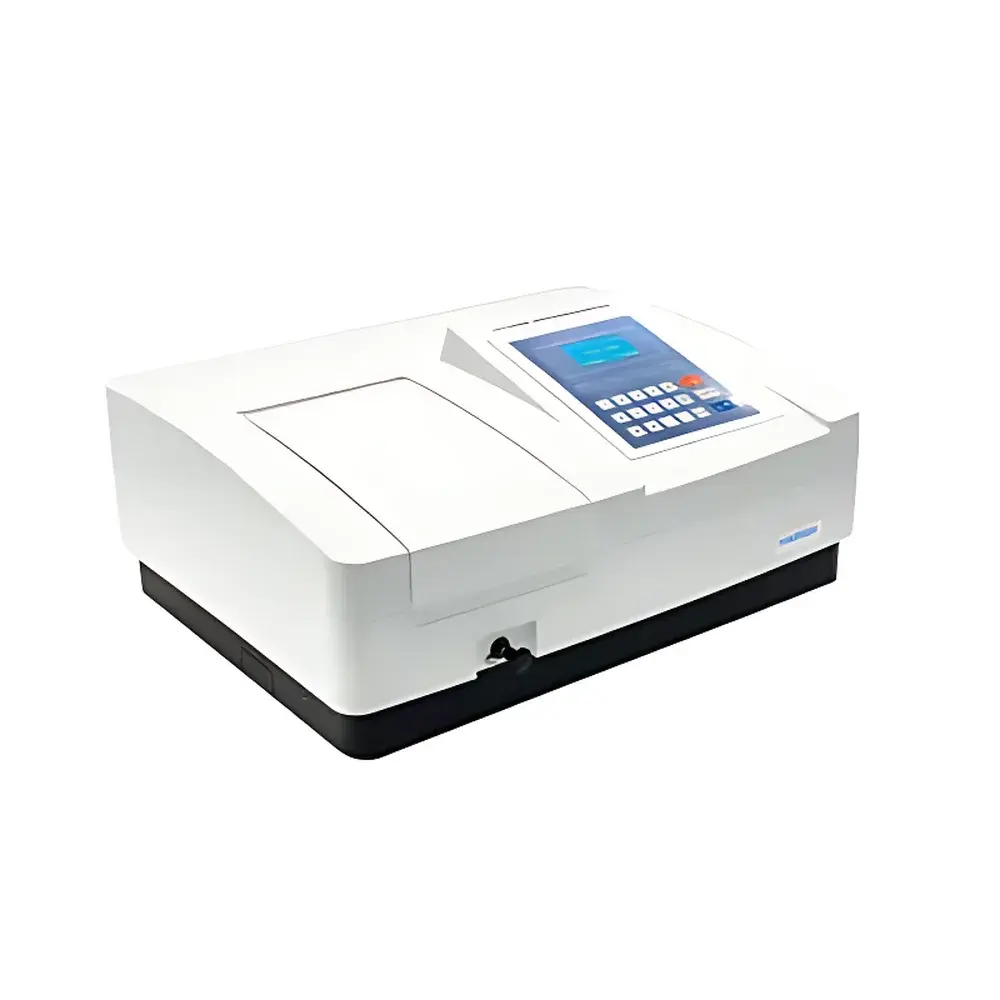
Mapada UV-1600PC Ultraviolet-Visible Spectrophotometer
| Brand | Mapada |
|---|---|
| Origin | Shanghai, China |
| Manufacturer Type | Direct Manufacturer |
| Instrument Architecture | Pseudo-Double-Beam |
| Detector Type | Silicon Photodiode |
| Wavelength Range | 190–1100 nm |
| Wavelength Accuracy | ±0.5 nm |
| Spectral Bandwidth | 4 nm |
| Wavelength Setting | Automatic |
| Display | 128×64 Dot-Matrix LCD |
| Photometric Range | 0–200% T, –0.3 to 3.0 A |
| Light Sources | Imported Deuterium Lamp & Tungsten-Halogen Lamp |
| Data Interface | USB Port |
| Power Supply | AC 220 V/50 Hz or AC 110 V/60 Hz |
| Dimensions (W×D×H) | 490 × 360 × 240 mm |
| Net Weight | 14 kg |
Overview
The Mapada UV-1600PC Ultraviolet-Visible Spectrophotometer is a precision optical instrument engineered for routine and research-grade absorbance, transmittance, and concentration measurements across the ultraviolet, visible, and near-infrared spectral regions (190–1100 nm). Based on pseudo-double-beam optical architecture, it employs a high-stability optical path design that minimizes baseline drift and enhances photometric reproducibility during extended measurement sessions. The system integrates a 1200 lines/mm holographic grating monochromator with imported deuterium and tungsten-halogen lamps—ensuring stable continuum output from deep UV through the NIR. Its 4 nm spectral bandwidth complies with common analytical requirements for pharmaceutical, environmental, biochemical, and quality control laboratories operating under ISO/IEC 17025 or GLP frameworks.
Key Features
- Pseudo-double-beam optical design with real-time reference beam compensation for improved stability and reduced noise in kinetic and scanning applications.
- High-resolution 128×64 dot-matrix LCD display supporting simultaneous visualization of spectral scans, kinetic curves, calibration plots, and up to 200 stored data sets.
- Automated wavelength calibration and lamp switching logic: the instrument automatically selects and activates the optimal light source (deuterium lamp below 350 nm; tungsten lamp above) and monitors cumulative lamp operation time for predictive maintenance.
- Modular lamp housing with socket-type installation—enabling rapid lamp replacement without optical realignment or recalibration.
- Spacious sample compartment accommodating cuvettes from 5 mm to 100 mm pathlength, compatible with standard quartz, glass, and plastic cells.
- Integrated USB interface compliant with USB 2.0 specifications for direct connection to Windows-based PCs; supports plug-and-play communication without proprietary drivers.
- Robust mechanical construction with aluminum alloy chassis and EMI-shielded electronics, ensuring long-term reliability in shared laboratory environments.
Sample Compatibility & Compliance
The UV-1600PC accepts standard 10 mm square cuvettes as well as variable-pathlength cells (5, 20, 50, and 100 mm), facilitating both high-sensitivity trace analysis and low-absorbance matrix studies. It meets fundamental performance criteria outlined in ASTM E275 (Standard Practices for Describing and Measuring Performance of UV-Vis Spectrophotometers) and aligns with key elements of ISO 6223 (Molecular absorption spectrometry — Vocabulary and general principles). While not certified for regulated GMP production environments, its hardware architecture—including non-volatile memory storage for calibration parameters and audit-ready operation logs via Mapada software—supports internal validation protocols required by ISO 9001 and GLP-compliant labs.
Software & Data Management
The instrument operates with Mapada ScanPro, a Windows-native application supporting full spectral acquisition, quantitative analysis (single- and multi-point calibration with linear/nonlinear regression), kinetic time-scan mode, multi-wavelength quantitation, and dedicated nucleic acid/protein analysis modules (A260/A280 ratio, extinction coefficient calculation, concentration derivation). All raw spectra and processed results are saved in vendor-neutral CSV and XML formats. ScanPro implements local user account management, parameter locking for SOP enforcement, and timestamped event logging—facilitating traceability in non-regulated QA/QC workflows. Though not 21 CFR Part 11 compliant out-of-the-box, the software architecture permits integration with third-party LIMS platforms via ODBC or API extension.
Applications
The UV-1600PC serves as a foundational tool in academic teaching labs, municipal water testing facilities, food safety screening units, and pharmaceutical R&D departments. Typical use cases include: quantification of nitrate/nitrite in drinking water per EPA Method 353.2; verification of dye concentrations in textile effluent; determination of protein content via Bradford or Lowry assays; verification of DNA purity (A260/A280 ≥ 1.8); kinetic monitoring of enzyme-catalyzed reactions (e.g., NADH oxidation at 340 nm); and spectral characterization of nanomaterials and organic dyes. Its 0.5 nm wavelength accuracy and 4 nm bandwidth ensure reliable conformity with pharmacopoeial methods such as USP and EP 2.2.25.
FAQ
What is the difference between pseudo-double-beam and true double-beam architecture?
Pseudo-double-beam instruments use a single detector with time-shared reference and sample beam paths via a rotating mirror or chopper. This reduces cost and complexity while maintaining adequate baseline stability for most QC applications—unlike true double-beam systems that require two matched detectors.
Can the UV-1600PC perform spectral scanning below 190 nm?
No—the lower limit is defined by atmospheric oxygen absorption and the transmission cutoff of standard quartz cuvettes; operation below 190 nm requires vacuum-purged or nitrogen-purged optics and specialized optics, which this model does not support.
Is the Mapada ScanPro software compatible with Windows 11?
Yes—ScanPro v3.2 and later versions are validated for Windows 10 and Windows 11 (64-bit) with .NET Framework 4.8 or higher.
Does the instrument support external printer connectivity?
Yes—via standard parallel (Centronics) port; drivers for common ESC/P-compatible thermal and dot-matrix printers are included.
How is wavelength accuracy verified during routine operation?
Users may perform verification using NIST-traceable holmium oxide or didymium oxide filters; the instrument’s built-in wavelength calibration function allows adjustment against known absorption peaks at 241.15 nm, 279.4 nm, 287.5 nm, 333.7 nm, 360.9 nm, 418.5 nm, 460.0 nm, 484.5 nm, 536.2 nm, and 637.5 nm.





