
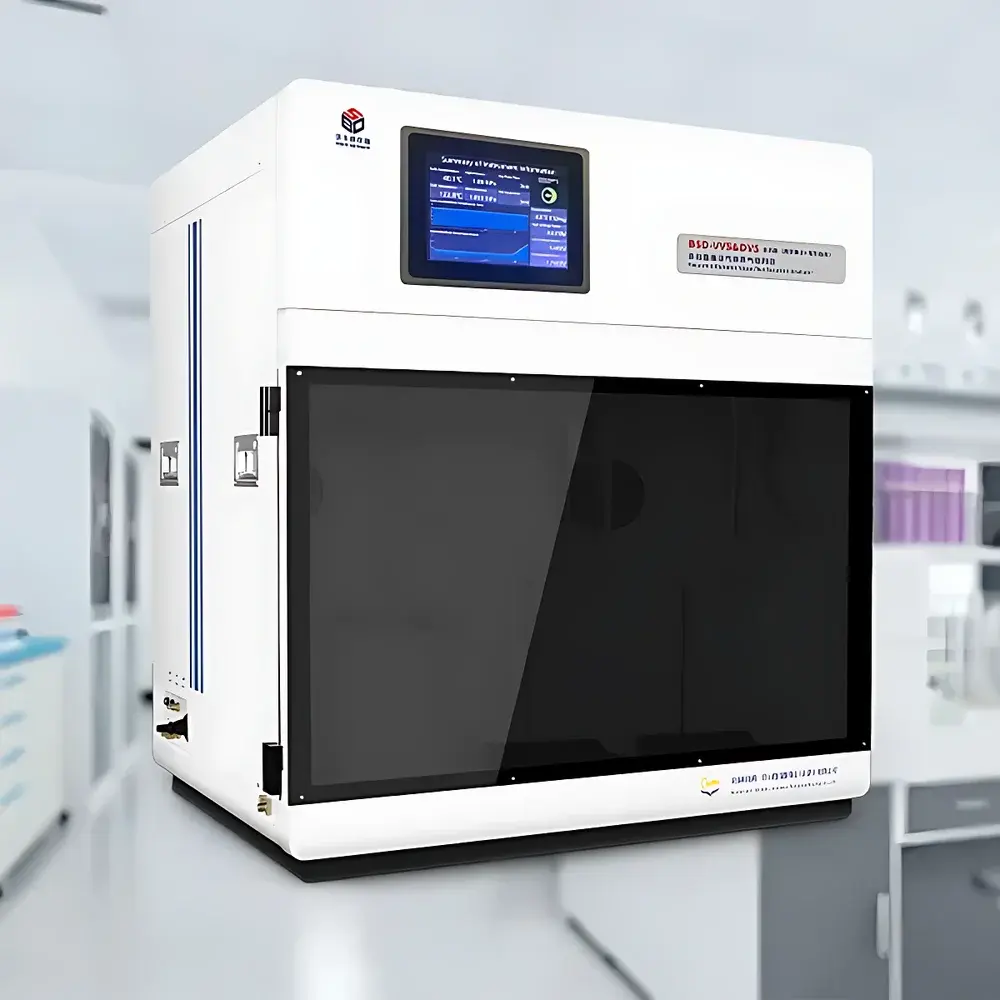
Beishide Instrument BSD-DVS Gravimetric Dynamic Vapor and Gas Sorption Analyzer
| Brand | Beishide Instrument |
|---|---|
| Origin | Beijing, China |
| Manufacturer Type | Direct Manufacturer |
| Region of Origin | Domestic (China) |
| Model | BSD-DVS |
| Instrument Type | Dynamic Vapor Sorption (DVS) Analyzer |
| Mass Resolution | 1 µg |
| Mass Range | 10–2000 mg |
| Temperature Range | −180 °C to 50 °C |
| Humidity Control Range | 0.1–98% RH (P/P₀) |
| Temperature Accuracy | ±0.1 °C (for thermal control zones) |
Overview
The Beishide Instrument BSD-DVS Gravimetric Dynamic Vapor and Gas Sorption Analyzer is a high-precision, multi-functional research platform engineered for quantitative characterization of vapor and gas interactions with solid materials under controlled thermodynamic conditions. Utilizing the gravimetric principle—where mass change of a sample is measured in real time as a function of precisely regulated vapor partial pressure (P/P₀), temperature, and gas composition—the BSD-DVS enables rigorous determination of sorption isotherms, kinetics, and thermal desorption behavior. Its dual operational modes—vacuum-based and dynamic (flow-through) configurations—support both ultra-high-vacuum surface science applications (e.g., TPD, TPR, TPO) and ambient-pressure industrial-relevant measurements (e.g., moisture uptake, organic solvent adsorption, CO₂ capture screening). Designed for reproducibility and traceability, the system complies with fundamental metrological requirements for gravimetric sorption analysis per ISO 15901-2, ASTM D6886, and IUPAC recommendations on physisorption and chemisorption characterization.
Key Features
- Gravimetric measurement architecture with factory-calibrated, imported microbalance (1 µg resolution; 10–2000 mg capacity), optionally upgradable to 0.1 µg/500 mg for ultra-low-mass samples.
- Dual-mode operation: vacuum-weighting (VVS/VGS) for high-sensitivity surface analysis and dynamic-flow (DVS/DGS) for kinetic and equilibrium studies under atmospheric or sub-atmospheric pressures.
- Multi-position configuration: 4- or 8-sample parallel analysis stations, each with independent thermal and vapor environment control—enabling statistical evaluation of batch heterogeneity and accelerated throughput without cross-contamination.
- Integrated dual-pump vacuum system: mechanical roughing pump + dedicated vapor-handling pump (or optional turbomolecular pump, base pressure <1×10⁻⁶ torr) for residual vapor suppression and low-background isotherm acquisition.
- Full-system thermostatic control: sample zone (−180 °C to 50 °C), vapor generation line (room temperature to 60 °C, ±0.1 °C stability), and degassing furnace (up to 400 °C, 32-segment programmable ramp).
- Advanced vapor generation: hybrid “static evaporation” and “carrier-gas mixing” methods ensure stable, repeatable P/P₀ control from 0.1% to 98%, with optional low-P/P₀ extension (<0.1%) via cryo-trapping or saturation column upgrades.
- Corrosive gas compatibility: configurable gas train with chemically resistant wetted materials (Hastelloy, PFA, quartz) for NH₃, SO₂, H₂S, and other reactive sorbates—validated per ASTM E2937 guidelines for corrosive media handling.
Sample Compatibility & Compliance
The BSD-DVS accommodates powders, granules, monoliths, thin films, fibers, and coated substrates across pharmaceuticals, MOFs, catalysts, battery electrode materials, food packaging polymers, and building materials. All thermal and vapor exposure protocols adhere to GLP-compliant data integrity standards: full audit trail logging, electronic signatures, and 21 CFR Part 11–ready software architecture (with optional validation package). Calibration traceability follows NIST-traceable mass and temperature standards. System performance verification includes certified reference materials (e.g., silica gel for water sorption, activated carbon for N₂/BET) and meets ISO/IEC 17025 criteria for accredited laboratories performing sorption-based QC/QA.
Software & Data Management
The proprietary Beishide SorptionSuite™ v5.x software provides fully automated method sequencing—including degassing, equilibration, stepwise P/P₀ ramping, isothermal holds, and programmed thermal desorption—with real-time mass derivative (dm/dt) visualization. Raw data are stored in HDF5 format with embedded metadata (instrument ID, operator, timestamp, calibration history). Integrated analysis modules compute BET surface area (single-point and multi-point), Langmuir monolayer capacity, BJH pore size distribution (mesopores), t-plot, DR, and HK micropore models—all compliant with ISO 9277 and ASTM D3663. Export options include CSV, Excel, and PDF reports with customizable templates aligned to internal SOPs or regulatory submission formats (e.g., FDA IND/NDA, EMA CTD).
Applications
- Pharmaceutical solid-state stability: hydrate formation kinetics, amorphous content mapping, excipient compatibility screening.
- Porous material development: MOF/COF water stability assessment, CO₂ working capacity under flue gas conditions, H₂ storage isotherms at cryogenic temperatures.
- Catalyst deactivation studies: sulfur poisoning (SO₂ adsorption), ammonia inhibition (NH₃ competitive binding), redox cycling (TPR/TPO).
- Electrode material characterization: electrolyte uptake in Li-ion battery separators, moisture-induced SEI degradation pathways.
- Packaging barrier performance: WVTR modeling via Fickian diffusion fitting, plasticizer migration kinetics under humidity gradients.
- Environmental sorbent evaluation: VOC capture efficiency, regeneration energy demand estimation, multi-component breakthrough prediction.
FAQ
What vapor species can be used with the BSD-DVS?
Water, ethanol, methanol, acetone, toluene, hexane, CO₂, N₂, O₂, and other non-corrosive vapors are standard. Corrosive gases (NH₃, SO₂, H₂S) require optional chemically resistant gas train components and are validated case-by-case.
Is buoyancy correction automated?
Yes—three modes are implemented: theoretical density-based calculation (default), blank-position background subtraction, and full background curve interpolation—all applied in real time during data acquisition.
Can the system perform simultaneous multi-analyte competitive adsorption?
Yes—via programmable gas/vapor blending using calibrated MFCs, enabling binary or ternary mixture studies with independent partial pressure control for each component.
How is data integrity ensured for regulated environments?
SorptionSuite™ supports role-based access control, electronic signatures, immutable audit logs, and 21 CFR Part 11 compliance packages—including IQ/OQ documentation and periodic performance verification protocols.
What maintenance intervals are recommended?
Microbalance recalibration annually; vapor generator cleaning every 200 runs; molecular pump oil replacement every 5,000 operating hours; full system performance verification semiannually using certified reference standards.



