
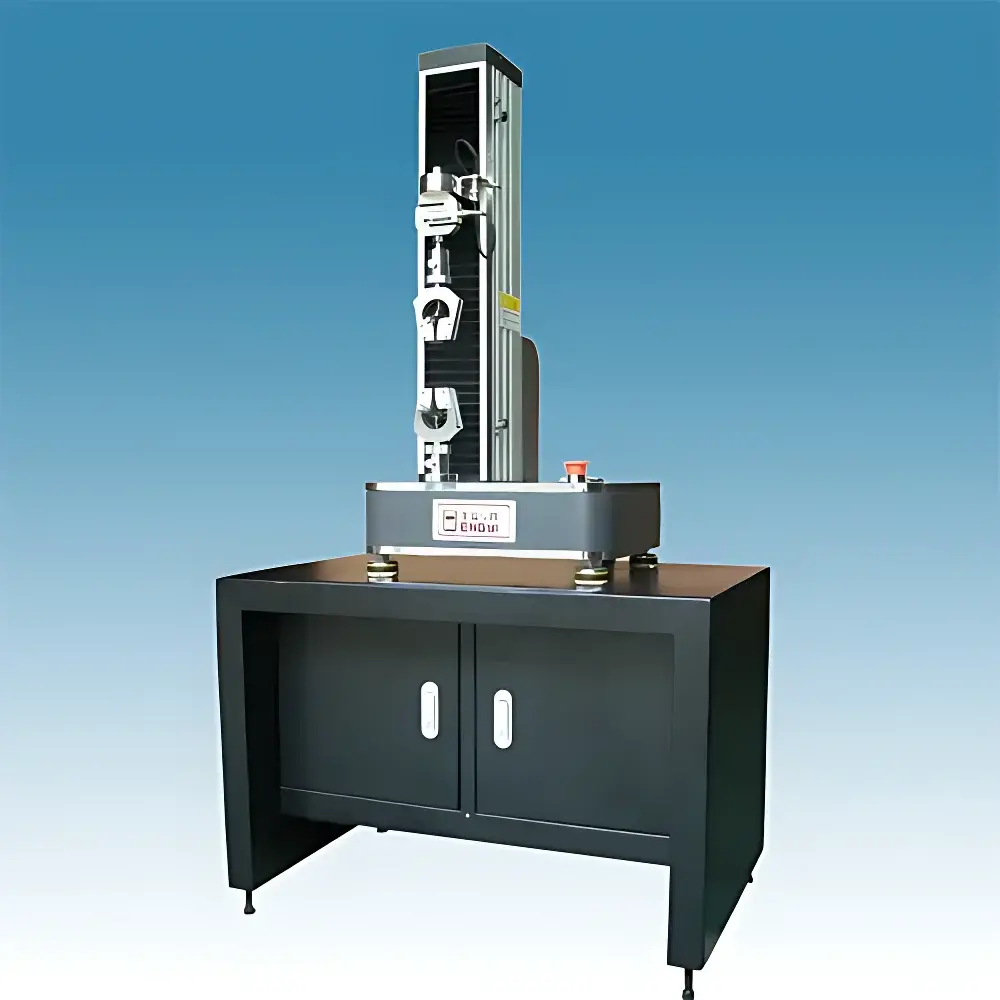
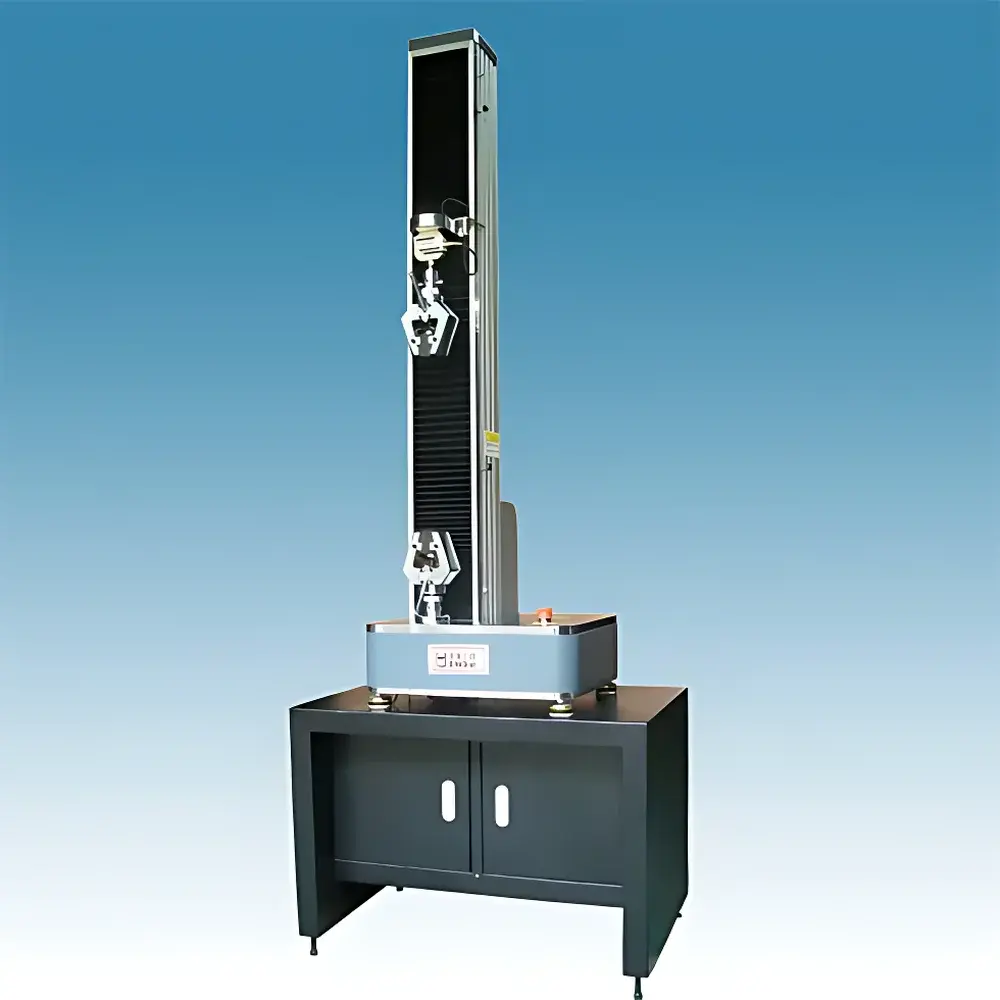
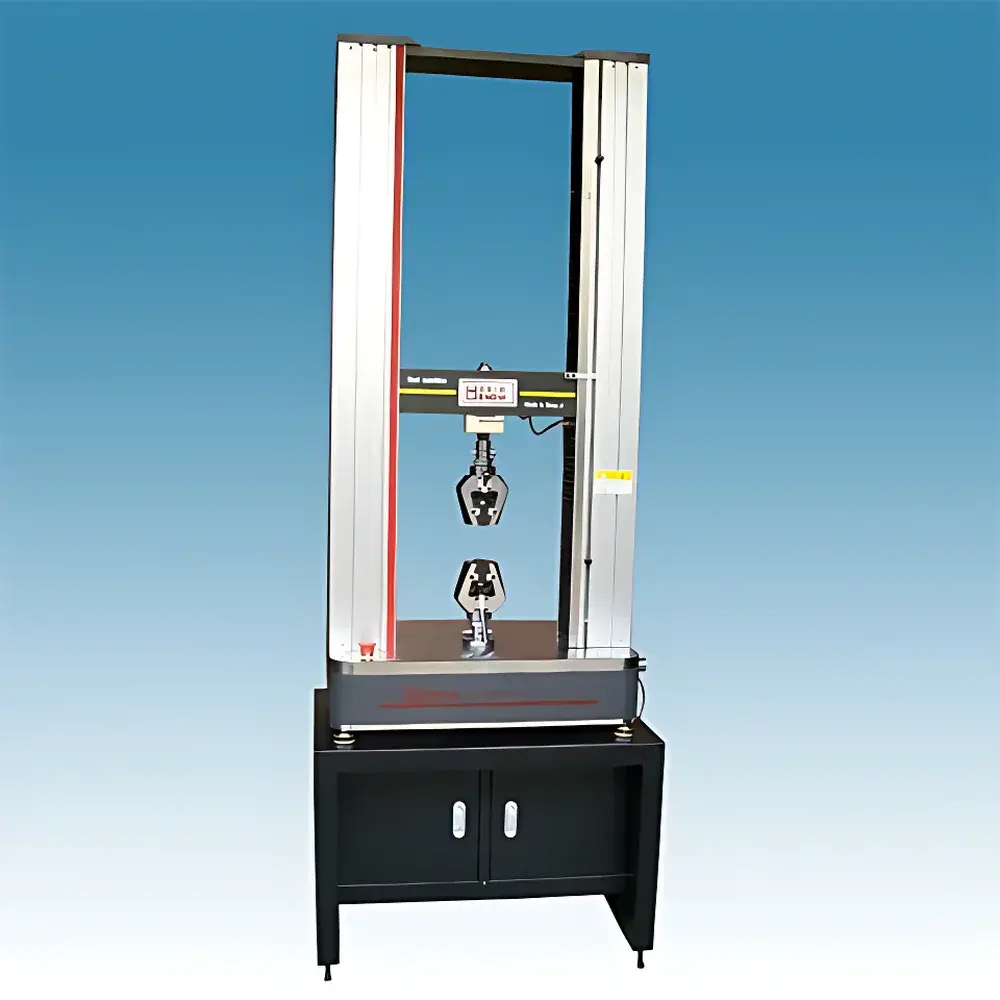
Hengyi HY-0580 Single-Column Universal Testing Machine for Lithium-Ion Battery Separator Tensile Testing
| Brand | Hengyi |
|---|---|
| Origin | Shanghai, China |
| Manufacturer Type | Direct Manufacturer |
| Instrument Type | Electromechanical Universal Testing Machine |
| Model | HY-0580 (Single-Arm Configuration) |
| Load Capacity Options | 1 N to 5000 N (interchangeable load cells) |
| Force Accuracy | ≤ ±0.5% of reading |
| Effective Test Width | 120 mm |
| Vertical Test Space | 800 mm |
| Speed Range | 0.001–500 mm/min (adjustable in real time) |
| Speed Accuracy | ±0.5% of set value |
| Displacement & Strain Measurement Accuracy | ±0.5% of reading |
| Force Resolution | ±500,000 counts (full-scale, no range switching) |
| Control Modes | Stress, strain, and displacement control with closed-loop feedback |
| Safety Features | Electronic travel limits, overload protection (110% FS), automatic return, programmable stop conditions (load/strain/time), self-diagnostic system |
| Power Supply | 220 V AC, 750 W |
| Dimensions (W×D×H) | 470 × 400 × 1510 mm |
| Weight | 120 kg |
| Compliance | GB/T 2611, GB/T 16491, GB/T 16852.1, GB/T 3923, GB/T 1040, ISO 527, ASTM D882, ASTM D638, JIS K7113, DIN 53455 |
Overview
The Hengyi HY-0580 is a precision-engineered single-column electromechanical universal testing machine specifically configured for high-reproducibility tensile evaluation of lithium-ion battery separators—thin, microporous polymer films (e.g., PE, PP, or ceramic-coated variants) requiring sub-newton force resolution and micron-level displacement control. It operates on a servo-controlled linear motion principle, utilizing a high-resolution load cell, optical encoder-based crosshead displacement sensing, and real-time closed-loop PID regulation to maintain precise stress, strain, or displacement ramping during quasi-static mechanical testing. Designed for laboratory and QC environments where regulatory traceability and method consistency are critical, the HY-0580 meets structural and metrological requirements defined in GB/T 16491 (equivalent to ISO 7500-1 Class 0.5), ensuring full compliance with international standards for force measurement uncertainty and system linearity. Its compact vertical architecture minimizes floor space while maintaining axial alignment integrity across test cycles—essential for evaluating anisotropic separator behavior under uniaxial loading.
Key Features
- Modular load cell architecture supporting interchangeable transducers from 1 N to 5000 N, enabling seamless transition between ultra-low-force separator peel tests and higher-load substrate characterization.
- True single-range force measurement system with ±500,000 internal counts resolution—no auto-ranging or hardware switching—guaranteeing consistent sensitivity across the entire capacity span.
- Programmable multi-stage test profiles: independent control of pre-load, ramp rate, dwell, break detection, and post-failure unloading—critical for capturing yield point, elongation at break, and puncture resistance per ASTM D882 Annex A4.
- Dual-speed motorized crosshead actuation (fast positioning + fine-test mode) with jog functionality and electronic end-stop protection to prevent overtravel damage during setup or failure events.
- Integrated safety interlocks including real-time overload cutoff (110% FS), automatic return-to-start after test completion, and configurable termination triggers (force threshold, strain limit, elapsed time).
- Self-diagnostic firmware that continuously monitors drive voltage, current draw, encoder signal integrity, and load cell bridge balance—logging anomalies and suspending operation if out-of-spec conditions are detected.
Sample Compatibility & Compliance
The HY-0580 accommodates standard separator specimens per ISO 14644-1 cleanroom handling protocols, using non-marring pneumatic or mechanical clamps with adjustable pressure to prevent edge slippage without inducing localized creep. Its 120 mm effective width and 800 mm vertical stroke support both ASTM D882 dog-bone strips (15 mm wide × 150 mm gauge length) and custom-width samples up to 100 mm. The system complies with GB/T 2611 (general testing machine requirements), GB/T 16852.1 (static uniaxial machine calibration), and harmonized equivalents including ISO 7500-1 (force verification), ISO 527-3 (plastics tensile testing), and JIS K7113 (film tensile methods). All measurement data—including raw sensor outputs, control parameters, and environmental metadata—can be timestamped and exported in CSV or XML formats compatible with GLP/GMP audit trails.
Software & Data Management
The HY-0580 operates with Hengyi’s proprietary PC-based control software, supporting Windows 10/11 and offering dual-mode operation: guided wizard interface for routine QC testing and advanced script editor for custom test sequences (e.g., cyclic loading for thermal shrinkage simulation). Software features include real-time graphing of stress–strain, load–displacement, and modulus vs. time curves; automated calculation of tensile strength, Young’s modulus, elongation at break, and secant modulus; and batch report generation with embedded digital signatures. Data files conform to ASTM E1447-compliant structure and may be archived in secure network folders with role-based access controls. Optional FDA 21 CFR Part 11 add-on provides electronic signature validation, audit trail logging, and user permission tiers for regulated pharmaceutical or battery cell manufacturing facilities.
Applications
- Quantitative tensile property assessment of polyolefin microporous separators (PE/PP monolayer or trilayer) per UL 2580 and GB/T 31485 requirements for EV battery safety certification.
- Peel strength evaluation of ceramic-coated separator interfaces using 90° or 180° fixtures to assess binder adhesion durability under thermal cycling.
- Mechanical screening of novel solid-state electrolyte membranes (e.g., sulfide or polymer-ceramic composites) under controlled humidity and temperature chambers (when integrated).
- Quality conformance testing for incoming separator reels in cathode/anode coating lines—validating lot-to-lot consistency in elongation and puncture resistance.
- Research-grade deformation analysis of separators subjected to simulated dendrite penetration via micro-indentation–tensile hybrid protocols.
FAQ
What load cell options are available for the HY-0580, and can they be changed in-house?
Yes—the HY-0580 supports hot-swappable load cells ranging from 1 N to 5000 N. Calibration coefficients are stored internally; replacement requires only mechanical mounting and software selection of the corresponding transducer ID.
Does the system meet ISO/IEC 17025 calibration traceability requirements?
All factory-calibrated load cells are traceable to CNAS-accredited national standards (GB/T 16852.1), and calibration certificates include uncertainty budgets per ISO/IEC 17025 Annex A. End users may perform in-house verification using certified reference weights.
Can the software generate reports compliant with automotive APQP documentation standards?
Yes—report templates include PPAP-relevant fields: material lot ID, operator name, equipment ID, environmental conditions (optional via external sensor input), and statistical summaries (mean, SD, Cp/Cpk) across test batches.
Is thermal chamber integration supported?
The HY-0580 frame includes standardized mounting flanges and cable routing ports for third-party environmental chambers (−40 °C to +150 °C); temperature feedback can be fed into the control loop for isothermal or ramped-temperature testing.
What maintenance intervals are recommended for long-term accuracy retention?
Biannual verification of force and displacement accuracy is advised. Lubrication of lead screws and inspection of clamp jaw surfaces should occur every 500 operational hours or per quarterly preventive maintenance schedule.



