
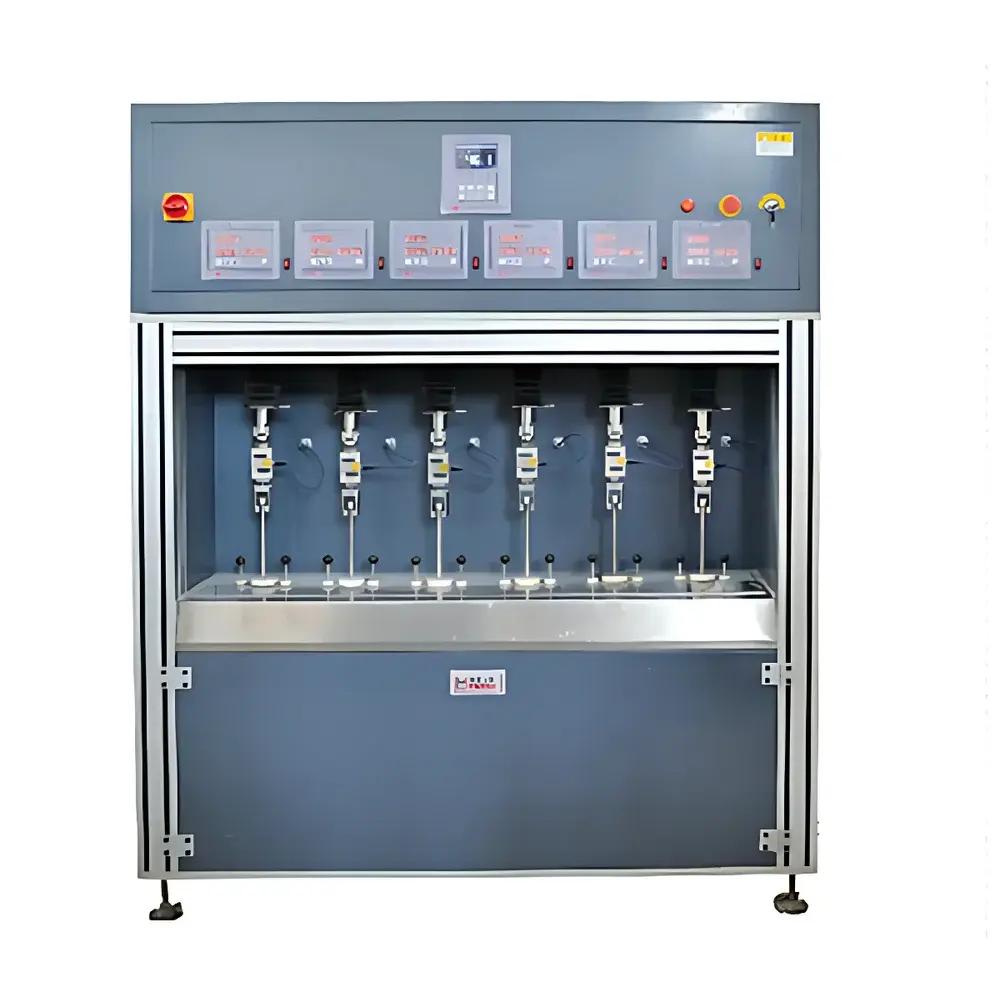
Hengyi HY(FNCT)0220 Full-Notch Creep Tensile Tester
| Brand | Hengyi |
|---|---|
| Origin | Shanghai, China |
| Manufacturer Type | Direct Manufacturer |
| Model | HY(FNCT)0220 |
| Test Stations | 6 or 12 independent stations |
| Force Range | 20–5000 N |
| Force Accuracy | ±0.5% FS |
| Creep Displacement Range | 0–200 mm |
| Temperature Control Accuracy | ±0.5 °C |
| Bath Medium | Constant-Temperature Water Bath |
| Compliance Standards | GB/T 32682–2016, GB/T 15820, GB/T 11546, ISO 16770, ISO 3501 |
| Control Interface | PC-based software with bilingual (English/Chinese) GUI |
| Power Supply | 380 V AC |
Overview
The Hengyi HY(FNCT)0220 Full-Notch Creep Tensile Tester is a precision-engineered instrument designed for standardized environmental stress cracking (ESC) evaluation of thermoplastic polymers—particularly polyethylene (PE) and PE-based pipe materials—under sustained tensile loading in controlled thermal or chemical environments. Based on the principle of constant-load uniaxial creep deformation, the system applies static tensile force to pre-notched specimens immersed in a thermostatically regulated water bath, monitoring time-to-failure as a function of applied stress, temperature, and environmental medium. This methodology directly implements the full-notch creep test (FNCT) protocol defined in GB/T 32682–2016 and its international equivalents—including ISO 16770 and ISO 3501—enabling quantitative assessment of long-term resistance to ESC in industrial-grade polyethylene resins, compounds, and extruded pipe products.
Key Features
- Six or twelve fully independent test stations, each equipped with electromechanical force application and real-time displacement sensing—eliminating cross-station mechanical coupling and ensuring statistical independence of replicate measurements.
- Modular elastic support architecture isolates mechanical load paths between stations, maintaining measurement integrity during multi-sample concurrent testing—a design feature validated for high reproducibility across inter-laboratory round-robin studies.
- Integrated self-diagnostic firmware continuously monitors actuator status, thermal stability, load cell drift, and bath temperature deviation, triggering automatic safety shutdown upon detection of out-of-specification conditions.
- PC-based control software provides dual-language (English/Chinese) interface with audit-ready data handling: timestamped raw acquisition (force, displacement, time), automated calculation of failure time at user-defined stress levels, and exportable plots of displacement vs. time, force vs. time, and stress vs. time-to-failure.
- Thermostatic water bath subsystem maintains temperature uniformity within ±0.5 °C across all immersion zones, supporting both standard ESC testing (e.g., 80 °C deionized water per GB/T 32682) and customized aggressive media protocols (e.g., surfactant solutions per ISO 3501).
Sample Compatibility & Compliance
The HY(FNCT)0220 accommodates standardized FNCT specimens per GB/T 32682–2016 (10 mm × 4 mm × 2 mm with 0.3 mm depth notch) and ISO 16770 (Type A geometry). It is routinely employed for quality assurance of PE 100 and PE 100-RC pipe resins, HDPE geomembranes, and blow-molded containers. All test procedures align with ISO/IEC 17025 requirements for method validation, and raw data files retain native timestamps and instrument metadata required for GLP-compliant reporting. The system supports traceability to national metrological standards via factory-calibrated load cells (certified to ISO 376 Class 0.5) and NIST-traceable temperature sensors.
Software & Data Management
The embedded Windows-compatible software logs all analog inputs at ≥10 Hz resolution, stores metadata (operator ID, sample ID, bath setpoint, calibration certificate numbers), and generates PDF reports compliant with internal QA workflows. Export formats include CSV (for statistical analysis in JMP or Minitab), XML (for LIMS integration), and PNG/SVG (publication-ready curve graphics). Audit trail functionality records every parameter change, user login/logout event, and calibration action—meeting documentation expectations under FDA 21 CFR Part 11 when deployed in regulated manufacturing environments.
Applications
- Comparative ESC resistance ranking of PE resin grades during polymer development and supplier qualification.
- Batch release testing of PE pipe compounds against ISO 4427 and ASTM D3350 specifications.
- Failure mechanism studies correlating molecular weight distribution (MWD), comonomer content, and antioxidant package efficacy with FNCT lifetime.
- Accelerated aging simulations for landfill liner geomembranes exposed to leachate analogues.
- Validation of processing parameters (e.g., extrusion temperature, cooling rate) on final product ESC performance.
FAQ
What standards does the HY(FNCT)0220 explicitly support?
GB/T 32682–2016, GB/T 15820, GB/T 11546, ISO 16770, ISO 3501, and ASTM D5397 (with minor fixture adaptation).
Can the system operate without PC connectivity?
No—the controller requires continuous USB/Ethernet communication with the host PC for real-time data acquisition, closed-loop force regulation, and environmental monitoring.
Is bath temperature uniformity verified across all stations?
Yes—each station includes an individual PT100 sensor; the software displays real-time deviation from setpoint for all 6 or 12 zones simultaneously.
How is force calibration maintained over extended operation?
Load cells are factory calibrated with traceable deadweight standards; users may perform zero-point verification and span checks using supplied reference weights prior to critical test campaigns.
Does the system support custom test profiles beyond standard FNCT?
Yes—users can define multi-step stress sequences, variable temperature ramps, and conditional termination logic (e.g., stop if displacement exceeds 5 mm before 1000 h).



