
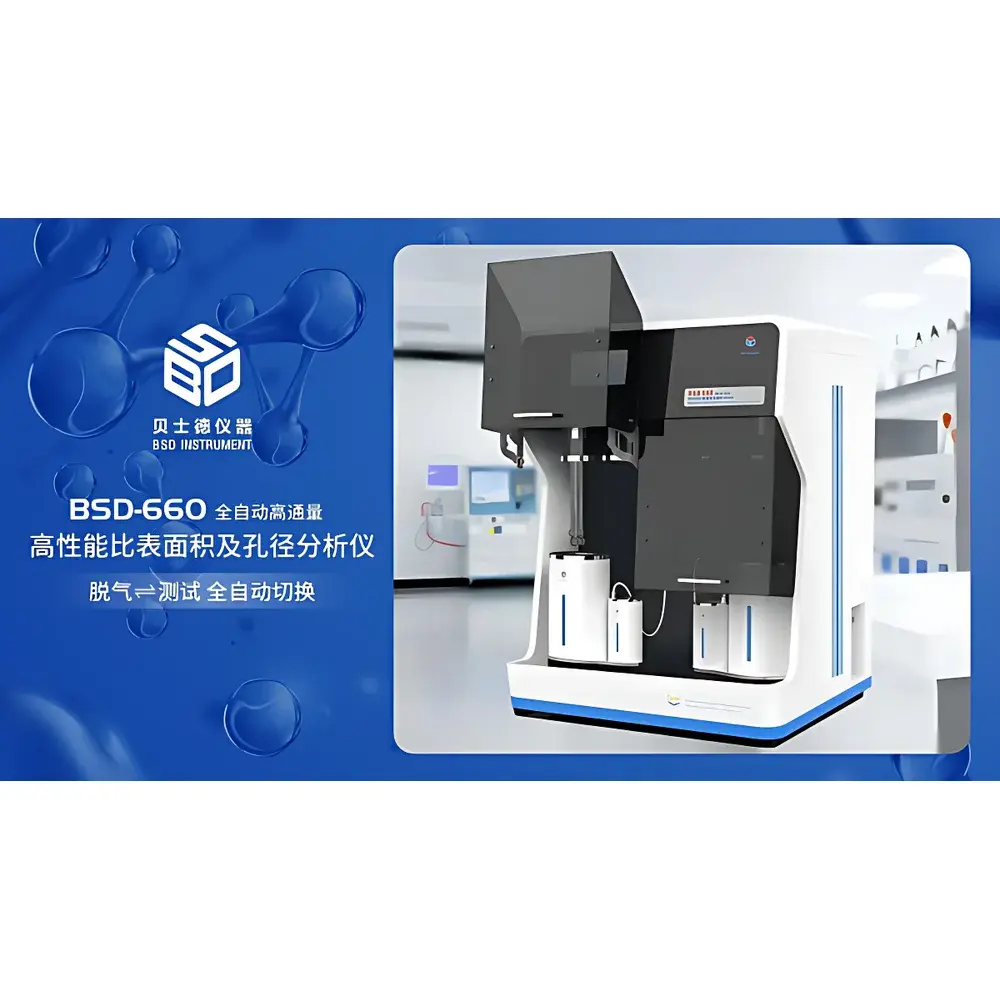
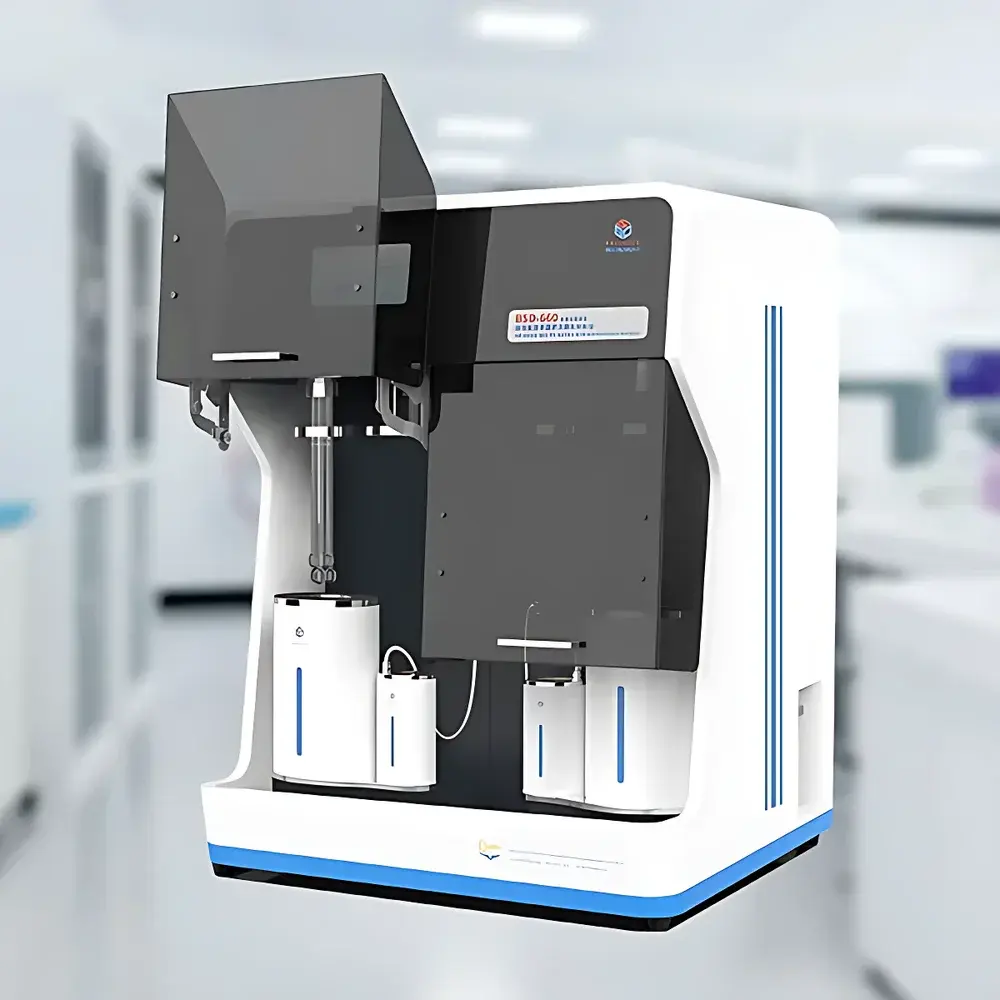
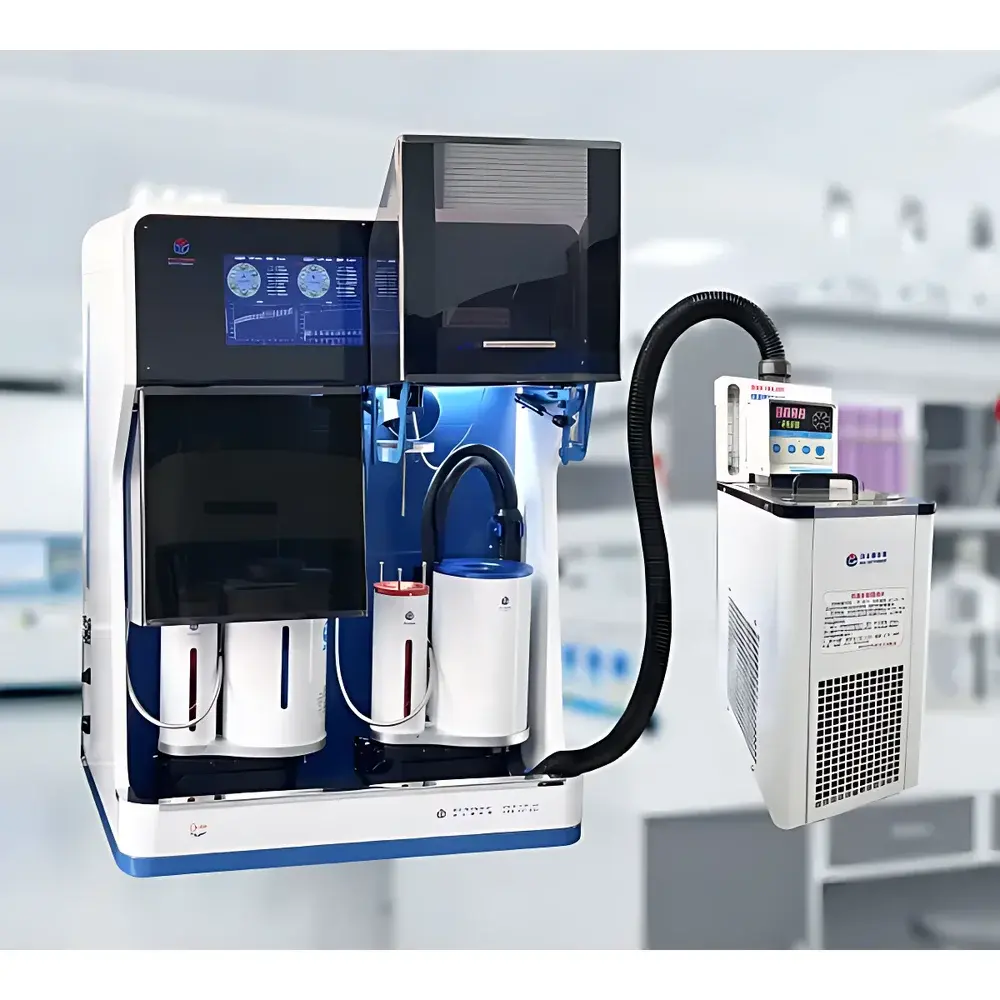
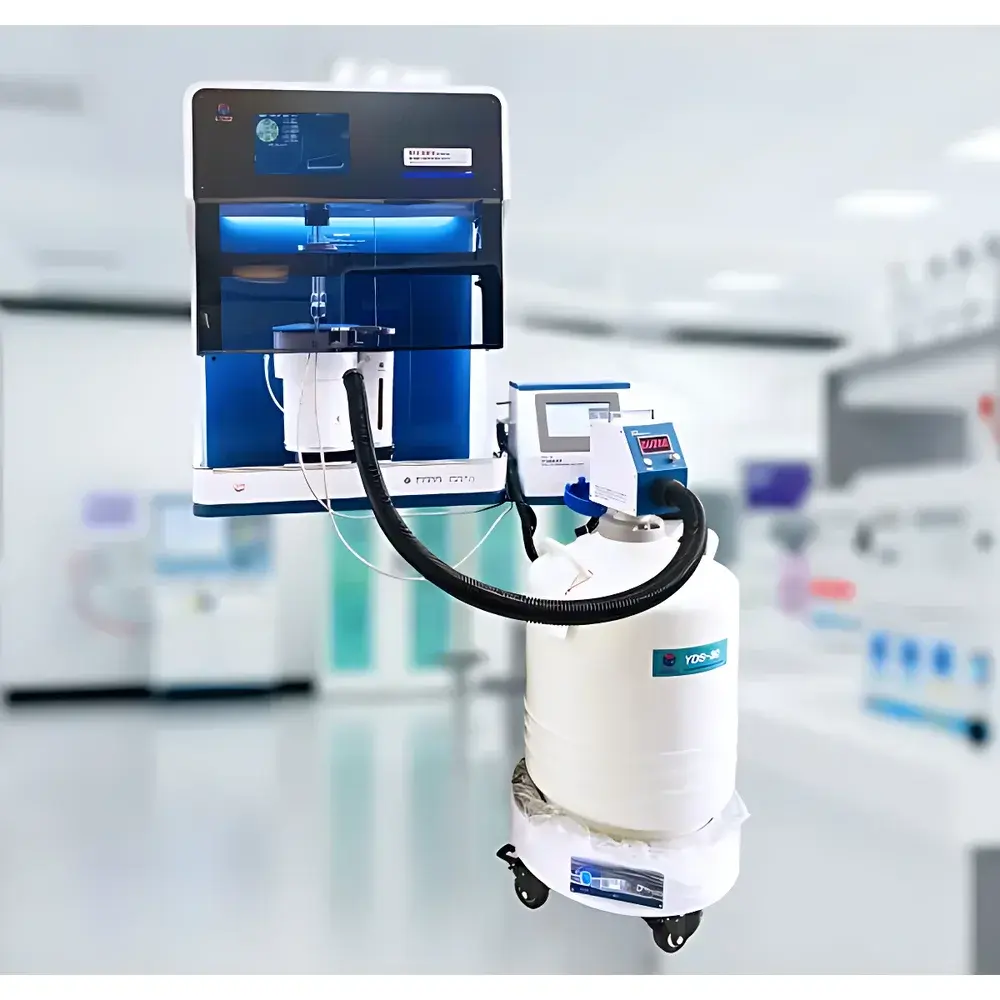
Beishide BSD-660A6S/B3M Static Volumetric Specific Surface Area and Pore Size Analyzer for Micropore, Mesopore, and Macropore Characterization
| Brand | Beishide Instrument |
|---|---|
| Origin | Beijing, China |
| Manufacturer Type | Manufacturer |
| Product Category | Domestic |
| Model | BSD-660A6S/B3M |
| Instrument Type | Specific Surface Area and Pore Size Analyzer |
| Measurement Principle | Static Volumetric Gas Adsorption (Manometric Method) |
| Number of Analysis Stations | 3 / 6 / 9 / 12 |
| Specific Surface Area Range | ≥0.01 m²/g |
| Pore Size Range | Micropores 0.35–2 nm, Mesopores 2–50 nm, Macropores >50 nm |
| Pressure Range | Up to 10 MPa |
| Repeatability | ≤±0.5% RSD (BET surface area on certified reference materials) |
| Vacuum Level | ≤1×10⁻⁹ Pa |
| Temperature Control Accuracy | ±0.1 °C (programmable from ambient to 400 °C) |
| Adsorption Gases | N₂, Ar, CO₂, O₂, CO, H₂, CH₄, C₂H₆, and corrosive gases (with optional configuration) |
| Vapor Adsorption | Optional with thermostatic bath (−10 to 80 °C) or liquid nitrogen temperature control (100 K to ambient) |
Overview
The Beishide BSD-660A6S/B3M is a high-precision, fully automated static volumetric gas adsorption analyzer engineered for comprehensive characterization of specific surface area, pore volume, and pore size distribution across microporous (50 nm) materials. It operates on the fundamental principles of physical adsorption—quantifying gas uptake at controlled relative pressures (P/P₀) under equilibrium conditions—enabling rigorous application of the Brunauer–Emmett–Teller (BET), Langmuir, t-plot, αs-plot, DFT, and NLDFT models. Unlike dynamic (flow-through) systems, its static manometric architecture ensures thermodynamic equilibrium measurement at each pressure step, delivering metrologically traceable data essential for R&D validation, quality control, and regulatory submissions. Designed for laboratories requiring both high throughput and metrological rigor, the instrument supports simultaneous multi-station analysis with full vacuum integrity, helium-free dead-volume calibration, and programmable thermal desorption—all compliant with ISO 9277:2010, GB/T 19587–2017, ISO 15901-1/2/3, and ASTM D3663.
Key Features
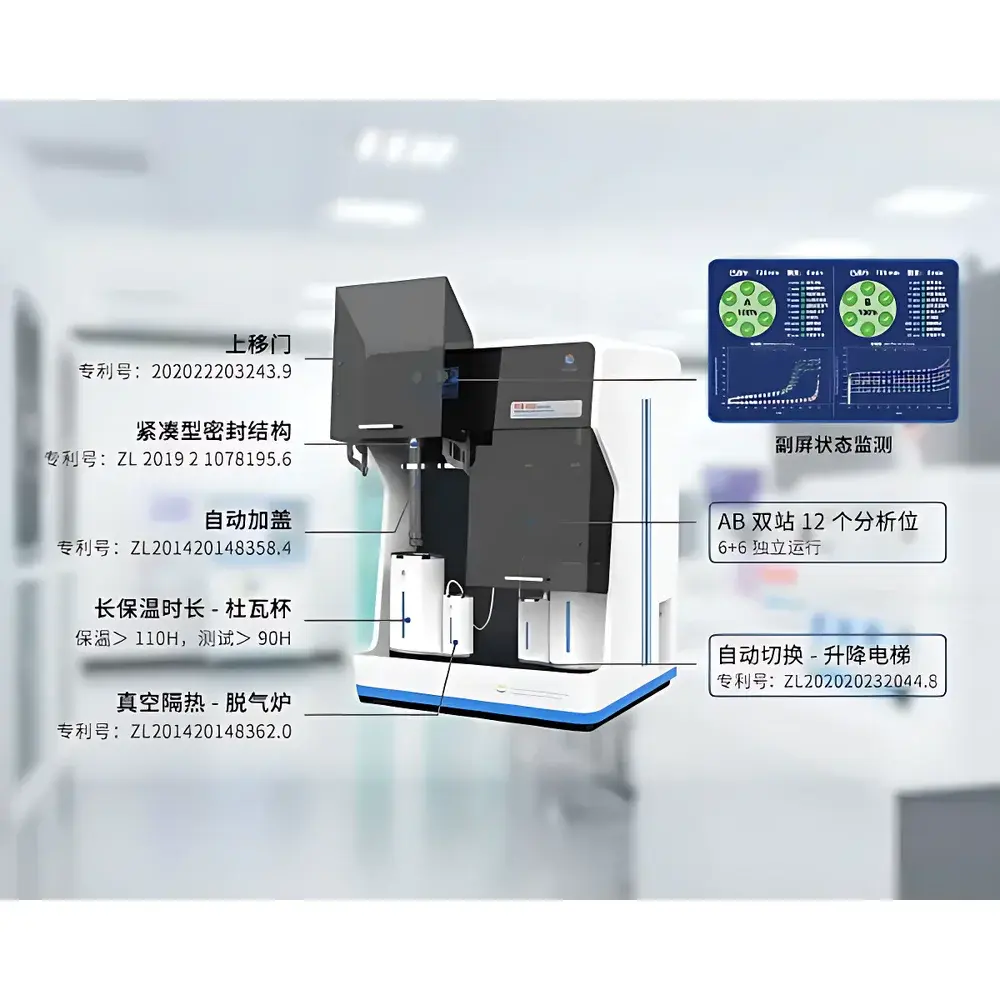
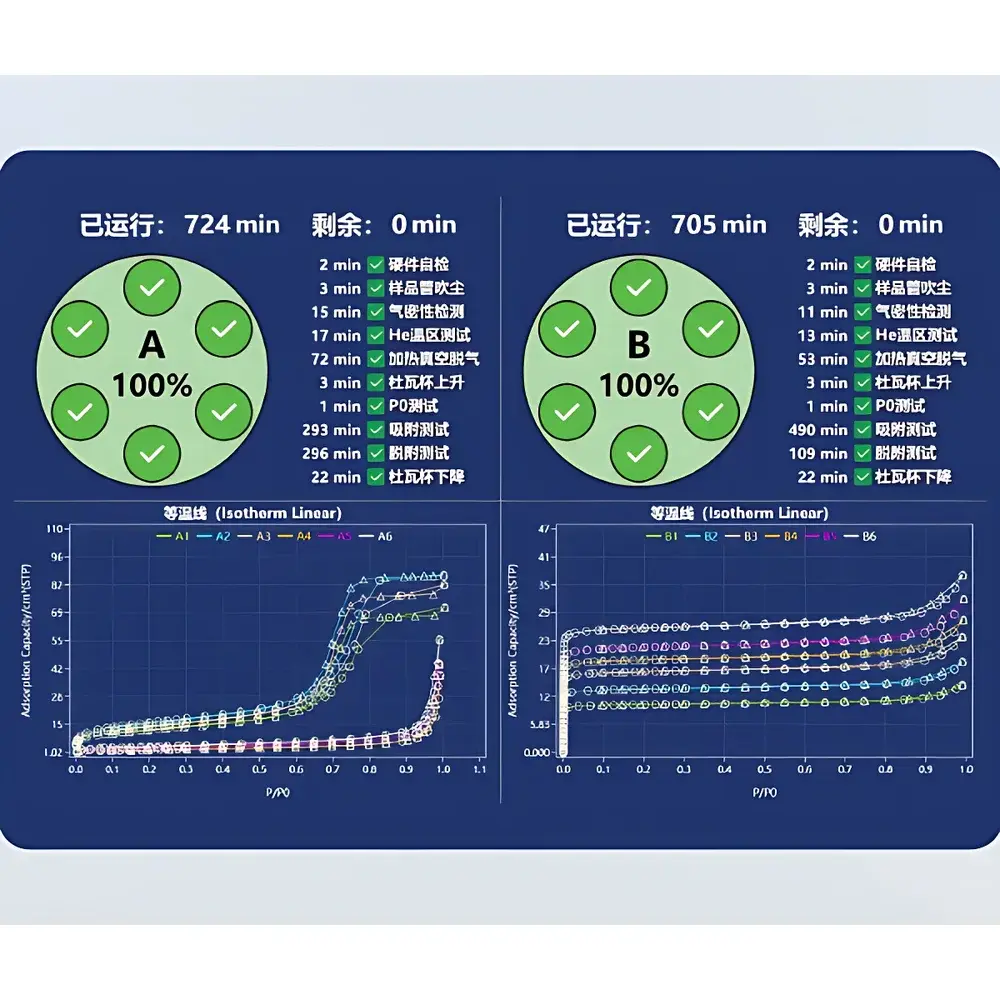
- Fully automated workflow: Integrated sample degassing → helium pycnometry → gas adsorption/desorption cycles without manual intervention; patented auto-switching between heating furnace and cryostat positions (ZL202020232044.8).
- Helium contamination elimination: Sequential helium dead-volume measurement followed by in-situ vacuum heating and adsorption testing—eliminating residual helium interference in micropore analysis.
- Pressure-controlled ramped degassing (“Pressurized Temperature Ramp”): Real-time pressure feedback modulates furnace elevation and heating rate to suppress sample fluidization and mass loss during thermal treatment (ZL202020230457.2).
- Thermal stability architecture: Entire gas manifold maintained at constant 40 °C (±0.01 °C); adsorption chamber temperature zone actively servo-regulated to ensure <0.10% 24-hour drift in equivalent dead volume (ZL201820401132.9).
- High-throughput scalability: Configurable 3-, 6-, 9-, or 12-station analysis modules; standard BET mode processes 12 samples in 60 minutes; ultra-fast mode completes same batch in 15 minutes (excluding degassing time).
- Multi-gas compatibility: Standard support for N₂, Ar, CO₂, O₂, CO; optional configurations for H₂, CH₄, C₂H₆, NH₃, SO₂, and other corrosive or condensable vapors with chemically resistant valves and seals.
- Open data architecture: Native API and standardized export formats (CSV, XML) enable seamless integration with LIMS, ELN, and enterprise QA/QC platforms; audit-trail enabled for GLP/GMP environments.
Sample Compatibility & Compliance
The BSD-660A6S/B3M accommodates diverse solid-state materials including battery cathode/anode powders (LiCoO₂, Si/C composites), MOFs/COFs/HOFs, activated carbons, zeolites, silica gels, metal oxides, pharmaceutical excipients, catalysts, and ceramic precursors. Its modular design permits rapid reconfiguration for non-corrosive gas, corrosive gas, or vapor-phase adsorption analysis per ISO 15901-3 and USP . All hardware and software meet electromagnetic compatibility (EMC) and electrical safety standards (IEC 61010-1). Data acquisition and reporting comply with FDA 21 CFR Part 11 requirements for electronic records and signatures when configured with user authentication, role-based access control, and immutable audit logs.
Software & Data Management
The proprietary BDS-660 software provides intuitive method scripting, real-time pressure/temperature monitoring, adaptive isotherm acquisition, and automated model selection (BET, Langmuir, DFT kernels). It includes built-in uncertainty propagation for surface area and pore volume calculations, ISO-compliant reporting templates, and customizable certificate generation. Raw isotherm data are stored in vendor-neutral HDF5 format with embedded metadata (gas type, temperature, calibration history). Batch processing supports statistical comparison across multiple runs, inter-laboratory reproducibility assessment, and trend analysis for aging or cycling studies. Export options include ASTM E2915-compliant summary files and machine-readable JSON for AI-driven material property prediction pipelines.
Applications
This analyzer serves critical functions across advanced materials development: optimizing pore architecture in battery electrode coatings for ion transport kinetics; quantifying accessible surface area in heterogeneous catalysts to correlate with turnover frequency; validating MOF stability under cyclic adsorption/desorption for carbon capture applications; certifying pharmaceutical powder flowability via surface energy mapping; and supporting QC release testing of activated carbon filters per EPA Method 502.1. Its micro-pore resolution enables accurate HK and DA modeling for sub-nanometer frameworks, while its extended meso-macro range supports Barrett–Joyner–Halenda (BJH) and density functional theory (DFT) analyses required for ASTM D4641 and ISO 15901-2 compliance.
FAQ
What gases can be used for micropore analysis?
N₂ at 77 K is standard; Ar at 87 K and CO₂ at 273 K are recommended for narrow micropores (<0.7 nm) due to faster diffusion kinetics and reduced quantum effects.
Does the system support low-temperature vapor adsorption?
Yes—optional thermostatic bath (−10 to 80 °C) and liquid nitrogen temperature control (100 K to ambient) enable precise vapor-phase isotherms for water, ethanol, or organic solvents.
How is degassing validated automatically?
Software monitors pressure decay rate and absolute residual pressure post-heating; termination criteria are configurable based on user-defined thresholds (e.g., <1×10⁻⁴ Pa/h drift over 30 min).
Can the instrument perform cyclic adsorption–desorption tests?
Yes—fully programmable multi-cycle protocols allow automated evaluation of adsorbent durability, hysteresis behavior, and regeneration efficiency over hundreds of cycles.
Is remote monitoring supported?
The system includes secure web-based dashboard access (HTTPS/TLS) for real-time status viewing, alarm notifications, and method queue management from any authorized network endpoint.



