
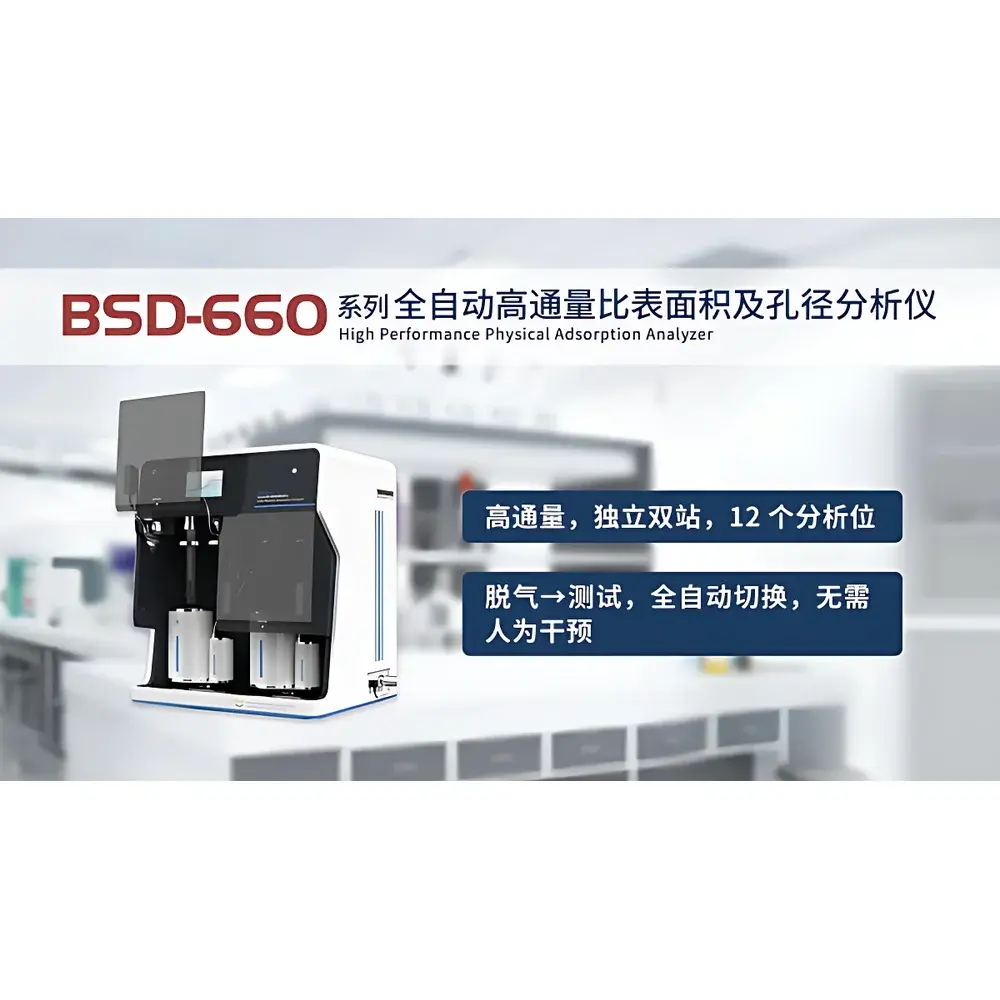
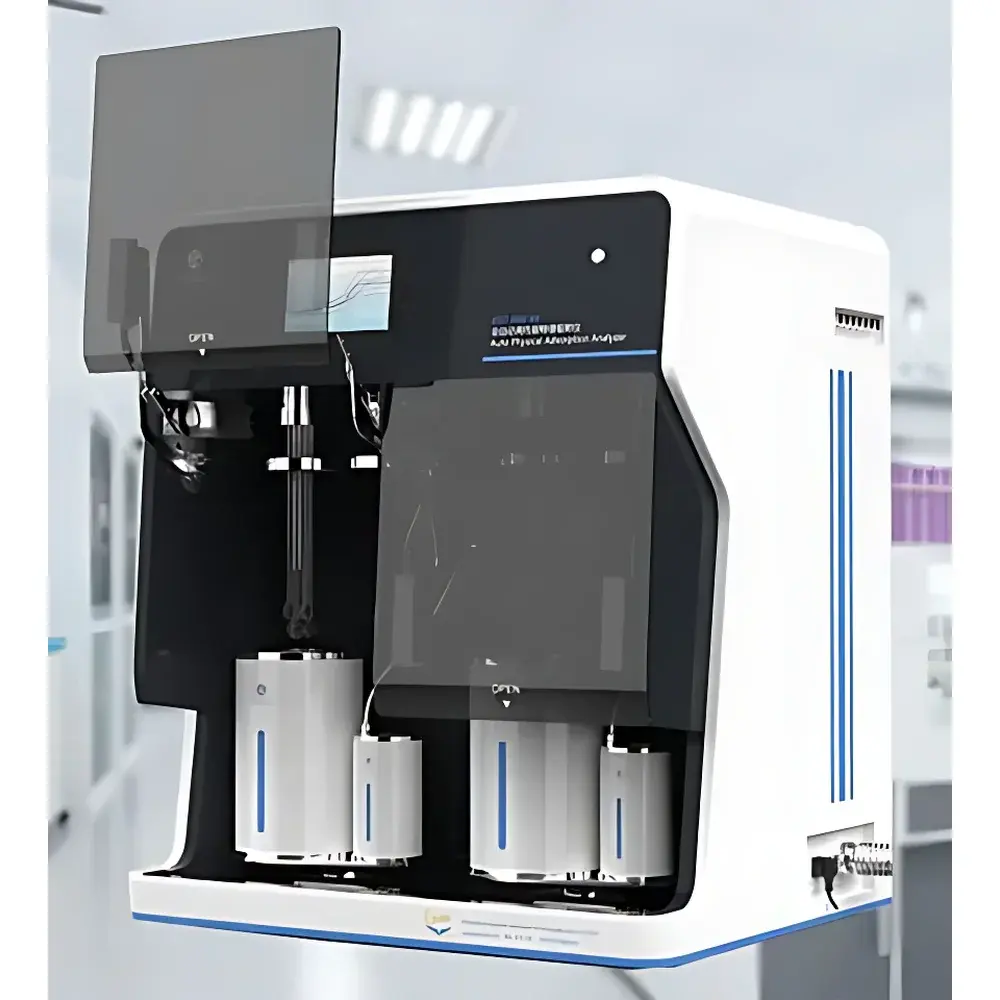
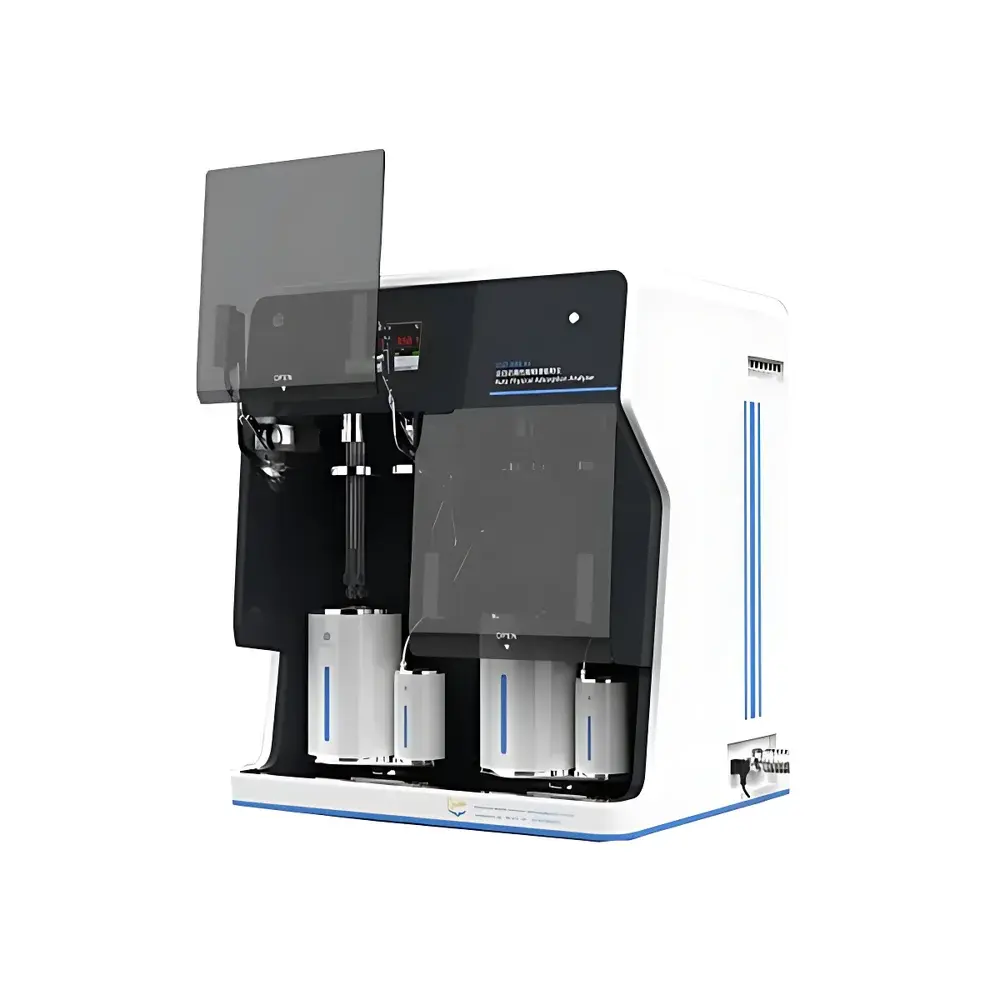
Beishide BSD-660 Series Fully Automated High-Throughput Specific Surface Area and Pore Size Analyzer
| Brand | Beishide Instrument |
|---|---|
| Origin | Beijing, China |
| Manufacturer Type | Manufacturer |
| Product Category | Domestic |
| Model | BSD-660 Series |
| Instrument Type | Specific Surface Area and Pore Size Analyzer |
| Measurement Principle | Static Volumetric Method |
| Number of Analysis Stations | 3 / 6 / 9 / 12 configurable |
| Surface Area Range | ≥0.0005 m²/g |
| Pore Diameter Range | 0.35–500 nm |
| Pressure Range | 10⁻² Pa (standard) |
| Test Theory | Static Volumetric Adsorption |
| Repeatability | ≤1% RSD |
Overview
The Beishide BSD-660 Series Fully Automated High-Throughput Specific Surface Area and Pore Size Analyzer is an engineered solution for quantitative characterization of porous and non-porous solid materials via nitrogen, argon, carbon dioxide, hydrogen, methane, and other adsorptive gases—including corrosive and vapor-phase species—under rigorously controlled static volumetric conditions. Based on the Brunauer–Emmett–Teller (BET) theory, t-plot, DFT/NLDFT, HK, DA, and BJH models, the system delivers traceable, reproducible measurements of specific surface area (SSA), micropore volume and size distribution (0.35–2 nm), mesopore structure (2–50 nm), and macropore morphology (50–500 nm). Designed for unattended operation across 24-hour cycles, it integrates vacuum integrity, thermal stability, and gas-phase purity management to meet the metrological demands of advanced materials R&D, QC/QA laboratories, and regulatory-compliant environments.
Key Features
- Fully automated workflow: Integrated sample degassing → thermal equilibration → gas dosing → adsorption isotherm acquisition → data reduction — all executed without manual intervention.
- Modular station configuration: Select from 3-, 6-, 9-, or 12-station setups to match throughput requirements; each station operates independently with dedicated pressure transducers and temperature sensors.
- Patented “pressure-controlled heating” (PCH) degassing: Prevents sample loss during high-temperature treatment by dynamically modulating furnace position and heating rate based on real-time chamber pressure feedback — critical for fragile micro/mesoporous powders.
- Helium-free dead-volume calibration: Sequential helium pycnometry at ambient temperature → high-vacuum degassing → adsorption analysis eliminates helium carryover into micropores, ensuring accuracy in sub-2 nm pore quantification per ISO 15901-3 and ASTM D6556.
- Temperature-stabilized architecture: Entire gas manifold maintained at 40.00 ± 0.01 °C; adsorption chamber equipped with servo-controlled isothermal zone stabilization (drift <0.10% over 24 h), surpassing conventional liquid-level or mechanical isothermal jacket approaches.
- Corrosive and vapor-compatible variants: BSD-660MG supports HCl, NH₃, SO₂, and other reactive gases; BSD-660MV enables controlled vapor-phase adsorption (e.g., H₂O, ethanol, toluene) with integrated chiller and saturation control.
- Electric turbo-liquid nitrogen pump: Contactless, variable-speed LN₂ delivery ensures contamination-free cryogen handling and precise bath-level maintenance across extended runs.
Sample Compatibility & Compliance
The BSD-660 accommodates diverse material classes including battery cathode/anode materials (LiCoO₂, Si/C composites), MOFs/COFs/HOFs, activated carbons, zeolites, silica gels, metal oxides, hydroxides, inorganic salts, polymer powders, and metallic nanoparticles. It complies with international standards including ISO 9277 (BET surface area), ISO 15901-1/2/3 (pore size distribution), GB/T 19587–2017, GB/T 21650.1–2008, ASTM D3663, and USP . Its audit-ready software supports 21 CFR Part 11 compliance through electronic signatures, role-based access control, and immutable audit trails for GLP/GMP-regulated labs.
Software & Data Management
The proprietary BDSorb™ software provides intuitive method setup, real-time isotherm visualization, model selection (BET, Langmuir, DFT/NLDFT kernel libraries), and automated report generation in PDF/CSV/XLSX formats. Raw data export includes absolute pressure, temperature, adsorbed quantity (mmol/g), and derived parameters (SSA, pore volume, PSD). An open API enables bidirectional integration with LIMS platforms (e.g., Thermo Fisher SampleManager, LabVantage) for centralized data governance and automated result archival.
Applications
- Quality control of catalyst supports and battery electrode materials for SSA consistency and pore accessibility.
- Stability assessment of MOFs under cyclic adsorption/desorption protocols (e.g., CO₂ capture cycling).
- Corrosion-resistant adsorbent development using acidic/basic gas isotherms (NH₃, SO₂).
- Vapor sorption kinetics and hysteresis analysis for pharmaceutical excipients and desiccant formulations.
- Validation of synthetic protocols for hierarchical porous carbons via multi-gas (N₂/Ar/CO₂) comparative analysis.
- Regulatory submission support for FDA IND filings requiring ICH Q5C-compliant surface property documentation.
FAQ
What adsorption theories are implemented in the BSD-660 software?
BET, Langmuir, t-plot, αs-plot, DFT/NLDFT (with slit/cylindrical/hexagonal kernel options), HK, DA, and BJH methods are embedded and selectable per measurement objective.
Can the instrument perform simultaneous degassing and analysis?
Yes — independent degassing furnaces and analysis stations allow concurrent processing: while one set of samples undergoes thermal treatment, another set is acquiring adsorption isotherms.
Is remote monitoring supported?
The system includes Ethernet connectivity and TLS-secured web interface for real-time status tracking, alarm notifications, and method initiation from off-site locations.
How is vacuum integrity verified during operation?
Built-in leak-rate diagnostics continuously monitor chamber pressure decay; automatic pass/fail reporting aligns with ISO 15901-1 Annex C verification procedures.
Does the system support custom gas mixtures?
When configured with optional mass flow controllers and gas blending modules, the BSD-660 can deliver precise binary or ternary gas mixtures (e.g., 10% CO₂ in He) for competitive adsorption studies.



