
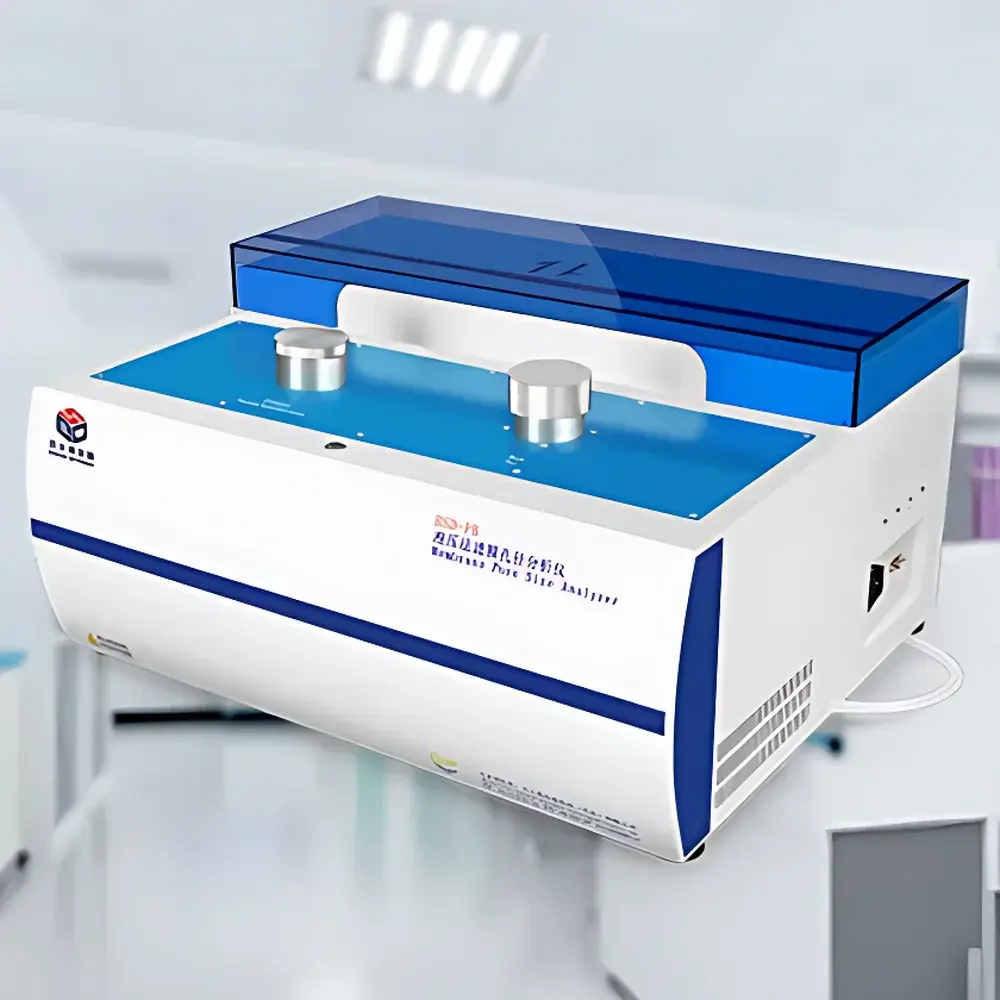
Beishide BSD-PBB Bubble Point & Gas-Flow Pore Size and Permeability Analyzer
| Brand | Beishide Instrument |
|---|---|
| Origin | Beijing, China |
| Manufacturer Type | Direct Manufacturer |
| Regional Category | Domestic (China) |
| Model | BSD-PBB |
| Pricing | Upon Request |
Overview
The Beishide BSD-PBB Bubble Point & Gas-Flow Pore Size and Permeability Analyzer is a precision-engineered instrument designed for the quantitative characterization of through-pore structure in porous membranes and filtration media. It operates on the fundamental principles of capillary flow porometry—specifically, the bubble point method and gas-permeation flow analysis—enabling determination of maximum pore size (bubble point), minimum pore size (critical wetting pressure), mean flow pore size, pore size distribution (PSD), and gas permeability under controlled differential pressure. The instrument is calibrated and validated for compliance with ASTM F316-22 (Standard Test Methods for Pore Size Characteristics of Membrane Filters by Bubble Point and Forward Flow), ISO 4003:1977 (Determination of Bubble Point and Pore Size Distribution of Porous Sintered Metals), and relevant sections of USP (Membrane Pore Size Determination). Its dual-sensor architecture and fully automated fluidic control ensure high reproducibility across repeated measurements, making it suitable for R&D validation, QC release testing, and process development in regulated environments.
Key Features
- Validated pore size measurement range: 0.02–500 µm, covering ultrafiltration to microfiltration and coarse sintered media
- Dual high-accuracy pressure sensors with auto-ranging capability—low-range (0–100 kPa) and high-range (0–1000 kPa)—switched dynamically based on real-time pressure response
- Dual mass flow sensors with complementary full-scale ranges (0–10 mL/min and 0–1000 mL/min), enabling precise low-flow detection during initial breakthrough and high-flow quantification at full dry-membrane permeability
- Integrated vacuum-assisted wetting station with programmable dwell time and pressure ramping, reducing sample equilibration time by ≥50% versus manual immersion
- Modular sample holder system accommodating discs (13–90 mm diameter), flat sheets, fibers, nonwovens, and irregular geometries; custom fixtures available for specialty substrates (e.g., battery separators, ceramic monoliths)
- Chemically resistant stainless-steel fluid path with metal-to-metal sealing—rated for ≤1.2 MPa operating pressure and compatible with water, isopropanol, perfluoroalkanes, and other standard wetting liquids per ASTM F316
- Fully automated test sequence: wetting → purge → pressure ramp → dry curve acquisition → PSD calculation → report generation
- Real-time voice-guided operation interface with multilingual prompt support (English default); all actions logged with timestamp resolution to ±1 second
- Embedded audit trail compliant with ALCOA+ principles: user ID, method version, parameter set, raw pressure/flow timestamps, and calibration history are immutably recorded
Sample Compatibility & Compliance
The BSD-PBB analyzer supports a broad class of rigid and semi-flexible porous materials including polymeric microfiltration/ultrafiltration membranes (PVDF, PTFE, nylon, polysulfone), sintered metals (stainless steel, bronze), ceramic filters (alumina, zirconia), battery separator films (PP/PE trilayer), geotextiles, and catalytic monoliths. Sample thickness up to 5 mm is accommodated without modification. All wetting liquid selections adhere to ISO 15787:2015 guidelines for surface tension consistency and vapor pressure stability. Instrument firmware includes preloaded methods aligned with FDA-recommended practices for membrane integrity verification in biopharmaceutical processing (e.g., pre-use post-sterilization integrity tests per 21 CFR Part 211.111). Data export formats include CSV, PDF, and XML, supporting integration into LIMS and electronic lab notebook (ELN) platforms compliant with 21 CFR Part 11 requirements.
Software & Data Management
The proprietary Beishide PoreCalc™ software provides ISO/IEC 17025-aligned data reduction algorithms, including derivative-based inflection point detection for bubble point identification and integral normalization for cumulative pore volume distribution. Raw pressure–flow curves are stored in HDF5 format with embedded metadata (sensor serial numbers, calibration dates, environmental conditions). Users may define multi-step test protocols—including hold steps for equilibrium confirmation—and apply post-acquisition smoothing filters (Savitzky-Golay, 3rd order, 5-point window) without altering original datasets. Audit logs are digitally signed and exportable as tamper-evident PDF-A archives. Remote monitoring via secure HTTPS API enables integration with MES and SCADA systems in GMP manufacturing settings.
Applications
- Quality control of sterile-grade filter cartridges used in pharmaceutical final fill operations
- Development and specification of lithium-ion battery separator pore architecture for dendrite suppression
- Validation of fouling resistance in forward osmosis membranes via pore narrowing quantification
- Comparative assessment of thermal sintering effects on pore interconnectivity in metal injection molded (MIM) components
- Regulatory submission support for medical device membrane biocompatibility dossiers (ISO 10993-12)
- Research into biofouling mechanisms using time-resolved pore occlusion mapping
FAQ
What wetting liquids are supported, and how is surface tension accounted for in calculations?
The system supports isopropanol (23.0 mN/m), water (72.8 mN/m), and FC-72 (15.5 mN/m) with preloaded surface tension values traceable to NIST SRM 849. Users may input custom values with uncertainty propagation enabled in final PSD reporting.
Can the BSD-PBB perform both bubble point and dry-wet flow tests in a single run?
Yes—the instrument executes sequential wet curve acquisition followed immediately by dry curve measurement under identical temperature and flow-path conditions, eliminating operator-induced variability between states.
Is the system compliant with 21 CFR Part 11 for electronic records and signatures?
Full Part 11 compliance is achieved via role-based access control, electronic signature workflows, and cryptographic hash logging; optional IQ/OQ/PQ documentation packages are available upon request.
How is instrument accuracy verified between calibrations?
A built-in reference capillary array (certified pore sizes: 0.22, 0.45, 1.0, 5.0 µm) enables daily performance qualification without external standards.
Does the software support statistical process control (SPC) charting for batch release?
Yes—X-bar/R charts, Cpk/Ppk indices, and out-of-trend (OOT) alerts are configurable per test parameter (e.g., bubble point pressure, mean flow pore size) with automated email notifications.
Related Products



