
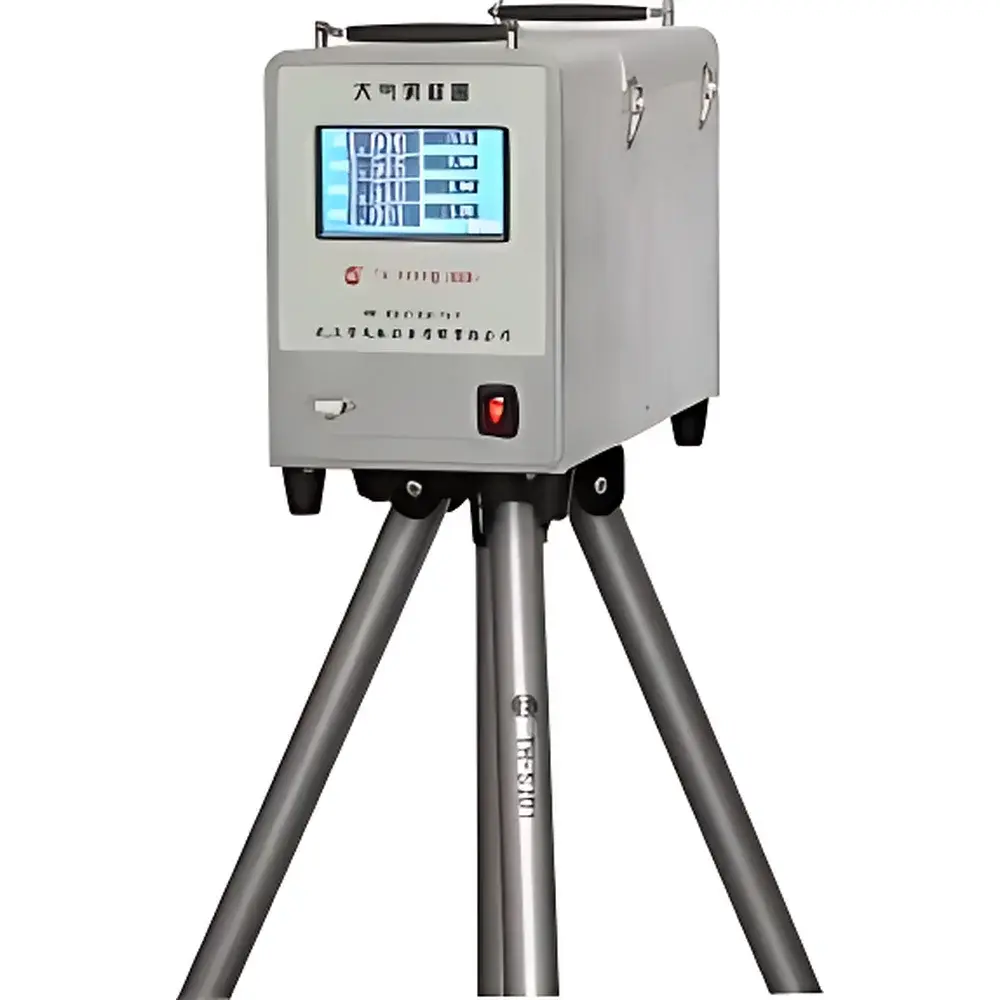
Tianhong TH-110H Dual-Channel Intelligent Ambient Air Sampler
| Brand | Tianhong |
|---|---|
| Origin | Hubei, China |
| Model | TH-110H |
| Instrument Type | Dual-Channel Constant-Flow Ambient Air Sampler |
| Compliance | HJ/T 375–2007, JJG 956–2013, Q/WTH 24–2016 |
| Display | 4.3-inch high-brightness color touch screen |
| Power Supply | AC/DC dual-mode with built-in rechargeable battery (≥20 h operation on battery) |
| Data Storage | ≥500 sampling records per channel |
| Environmental Parameter Measurement | Real-time ambient temperature, atmospheric pressure, pre-flowmeter pressure, and flow rate |
| Flow Control | Microprocessor-based digital flow regulation with automatic compensation |
| Optional Features | Thermal control for sampling bottles (activation <20 °C), GPS positioning, remote status/data upload via cellular network, thermal printer interface, external DC input |
Overview
The Tianhong TH-110H Dual-Channel Intelligent Ambient Air Sampler is an engineered solution for regulatory-grade environmental air monitoring in accordance with Chinese national standards HJ/T 375–2007 (“Technical Requirements and Test Methods for Ambient Air Samplers”) and JJG 956–2013 (“Verification Regulation for Atmospheric Samplers”). Designed for continuous, unattended field deployment, the TH-110H implements constant-flow sampling through closed-loop digital feedback control—leveraging a microprocessor-driven system that continuously monitors and adjusts pump output to maintain user-defined volumetric flow rates under variable ambient resistance and temperature conditions. Its dual-channel architecture enables simultaneous, independent sampling from two distinct locations or media (e.g., PM2.5 filter + gaseous adsorbent tube), supporting comparative analysis and multi-pollutant workflows. The instrument operates across standard ambient conditions (−20 °C to 50 °C; 10–100 kPa atmospheric pressure), with integrated sensors for real-time correction of sampled volume to reference conditions (25 °C, 101.325 kPa), ensuring metrological traceability required by environmental laboratories and regulatory reporting frameworks.
Key Features
- Dual independent sampling channels with fully decoupled flow control, each configurable with discrete flow setpoints (range: 0.1–1.0 L/min typical, calibrated per Q/WTH 24–2016)
- High-precision digital mass flow measurement using imported thermal anemometric sensors, enabling ±2% full-scale accuracy under dynamic load conditions
- Brushless DC diaphragm pump assembly with low acoustic emission (<55 dB(A)) and extended service life under continuous duty cycles
- 4.3-inch capacitive touch display with graphical UI for intuitive parameter configuration, real-time trend visualization, and diagnostic feedback
- Onboard environmental sensing: integrated Pt100 temperature sensor, piezoresistive barometer (±0.5 kPa), and differential pressure transducer for pre-filter vacuum monitoring
- Intelligent thermal management: automatic heating of sampling bottle holders when ambient temperature falls below 20 °C, maintaining sorbent integrity for volatile organic compound (VOC) collection
- Battery-backed non-volatile memory preserving all operational parameters—including flow setpoints, start/stop times, temperature, pressure, and accumulated volumes—even after power interruption
- AC/DC dual power architecture with internal Li-ion battery supporting ≥20 hours of uninterrupted sampling at 0.5 L/min per channel
Sample Compatibility & Compliance
The TH-110H supports standard 47-mm and 90-mm filter cassettes (for particulate matter), stainless steel or glass sorbent tubes (e.g., Tenax TA, Carbopack B/C), and impingers for gaseous analytes including SO2, NOx, ozone, and formaldehyde. All wetted materials comply with US EPA Method TO-17 and ISO 16000-6 requirements for inertness and extractables. Calibration procedures follow traceable protocols aligned with JJG 956–2013 verification methodology, including multi-point flow calibration using primary-standard dry calibrators (e.g., Brooks 5876TR). Data integrity conforms to GLP principles: timestamped records include operator ID (optional), instrument serial number, calibration history, and environmental metadata—facilitating audit readiness for provincial EPB inspections and third-party QA/QC reviews.
Software & Data Management
Field data are stored in structured binary format with CRC-32 checksums, exportable via USB 2.0 to CSV or XML for integration into LIMS platforms. Firmware supports over-the-air updates via SD card or serial interface. Optional cloud connectivity (via LTE Cat-M1 or NB-IoT modules) enables automated transmission of instrument status, GPS coordinates (±5 m CEP), real-time flow deviation alerts, and historical sampling logs to centralized environmental data servers. All uploaded data are encrypted using TLS 1.2; local storage includes write-protected audit trails compliant with basic 21 CFR Part 11 expectations (user authentication, electronic signatures optional via external RADIUS server).
Applications
- Fixed-site ambient air quality monitoring networks (PM10, PM2.5, TSP, heavy metals, PAHs)
- Mobile source emission characterization near roadways and ports
- Indoor air quality assessment in schools, hospitals, and office buildings per GB/T 18883–2022
- Source apportionment studies requiring synchronized multi-location sampling
- Method validation and inter-laboratory comparison exercises under CNAS accreditation scopes
- Emergency response deployments for hazardous gas release assessment (with appropriate sorbents and PPE integration)
FAQ
Does the TH-110H support flow calibration in the field?
Yes—through its touchscreen interface, users can execute zero/span and multi-point flow calibrations using an external primary standard calibrator. All calibration coefficients are digitally signed and time-stamped.
What is the maximum allowable backpressure for stable operation?
The instrument maintains flow stability up to 25 kPa differential pressure across the sampling train at 0.5 L/min, verified per HJ/T 375–2007 Annex B.
Can sampling parameters be modified during an active run?
Yes—flow rate, remaining duration, and target volume may be adjusted in real time without interrupting acquisition; the system recalculates and applies compensation dynamically.
Is GPS positioning mandatory for data upload?
No—GPS is optional hardware. When installed, it provides geotagged metadata; otherwise, location must be manually assigned or inferred from network cell ID.
How is data security handled during remote transmission?
All cellular transmissions use TLS 1.2 encryption with device-authenticated handshakes; no credentials or raw sensor values are exposed in plaintext headers or payloads.
Related Products







