
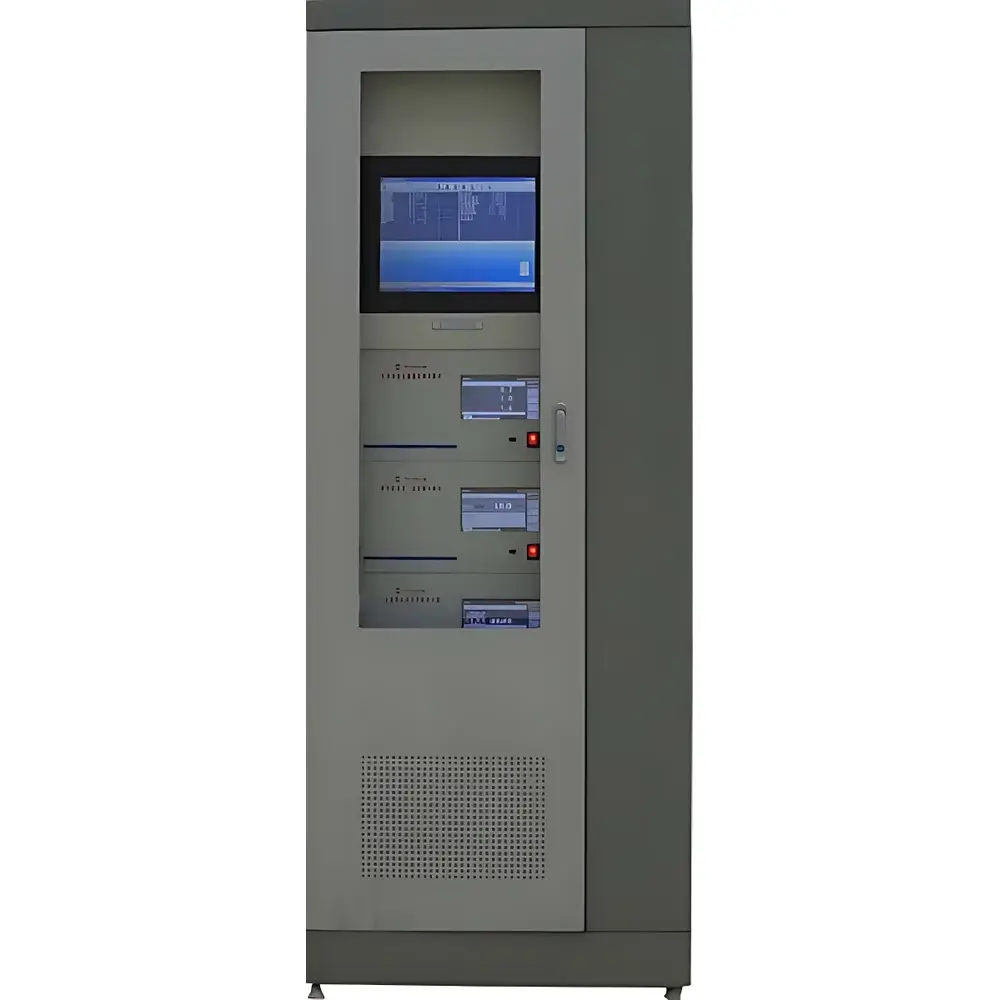
Tianhong TH-860 Continuous Emission Monitoring System (CEMS) for Ultra-Low Flue Gas Emissions
| Brand | Tianhong |
|---|---|
| Origin | Hubei, China |
| Model | TH-860 |
| Instrument Type | Continuous Emission Monitoring System (CEMS) |
| Measurement Error | ±5% FS |
| Repeatability | ≤2% RSD |
| Response Time | ≤200 s |
| Drift Stability | ≤5% / h |
| Measured Parameters | SO₂, NOₓ |
| Detection Limit | 0.5 ppb (SO₂ and NOₓ) |
| Dilution Ratio Range | 50:1 to 250:1 |
| O₂ Measurement Method | Electrochemical or Zirconia Sensor |
Overview
The Tianhong TH-860 Continuous Emission Monitoring System (CEMS) is an engineered solution for regulatory-grade, real-time quantification of ultra-low concentration gaseous pollutants—specifically sulfur oxides (SOx) and nitrogen oxides (NOx)—in industrial flue gas streams. Designed in accordance with international CEMS performance specifications (e.g., EPA Method 6C, EN 15267-3, and HJ 75–2017), the system employs a certified dilution sampling architecture coupled with optical detection principles: ultraviolet fluorescence (UVF) for SO2 and chemiluminescence (CLD) for NO/NO2. Unlike extractive hot-wet systems, the TH-860 utilizes a critical-orifice-based dilution probe mounted adjacent to the stack, where dry zero air drives a venturi jet pump to aspirate flue gas at a precisely controlled sonic flow rate. This ensures stoichiometric dilution—typically between 50:1 and 250:1—yielding sample gas with a dew point consistently below ambient temperature. As a result, condensation is eliminated across the entire transport path, enabling unheated or low-temperature heated sample lines and eliminating the need for complex condensate management hardware.
Key Features
- Dilution probe with integrated sonic critical orifice and venturi jet pump—no electrical components required at the probe head, ensuring high reliability and low maintenance frequency.
- Full-path dynamic auto-calibration initiated at the probe inlet, compliant with ISO 14956 and EN 14181 QAL3 requirements for traceable accuracy verification.
- UVF SO2 analyzer and CLD NOx analyzer both achieve sub-part-per-trillion sensitivity, with verified lower detection limits of 0.5 ppb under field-representative conditions.
- Integrated O2 measurement via electrochemical cell or zirconia sensor, supporting stoichiometric correction and excess air coefficient (λ) calculation per EN 14792 and GB/T 16157.
- 7-inch capacitive touchscreen interface with multilingual support (English firmware available), enabling unit switching among ppb, ppm, µg/m³, and mg/m³—fully traceable to NIST SRMs.
- Onboard temperature and pressure compensation algorithms aligned with ISO 10780 and EPA 40 CFR Part 60 Appendix B, ensuring volumetric concentration reporting at standard conditions (e.g., 273.15 K, 101.325 kPa, 3% O2 dry).
- Adaptive signal processing engine optimizes response time and signal-to-noise ratio without manual tuning—critical for transient combustion events in coal-fired, waste-to-energy, and cement kiln applications.
Sample Compatibility & Compliance
The TH-860 accommodates flue gas matrices from diverse thermal processes—including coal, biomass, natural gas, and municipal solid waste combustion—with particulate loadings up to 50 g/Nm³ (pre-filtered). Its dilution architecture inherently mitigates interference from water vapor, acidic condensates, and alkali salts that commonly degrade optical windows and reaction chambers in direct-extraction systems. All analytical modules comply with electromagnetic compatibility (EMC) standards IEC 61326-1 and safety standard IEC 61010-1. The system supports audit-ready data integrity per FDA 21 CFR Part 11 (with optional electronic signature module) and GLP/GMP-aligned data logging—retaining one year of 5-minute averaged records with full metadata (calibration timestamps, span/gas verification logs, fault codes). It meets Chinese national standard HJ 75–2017 for CEMS technical requirements and is suitable for equivalency assessment against EU Directive 2010/75/EU (IED) and U.S. EPA PS-11 certification protocols.
Software & Data Management
Embedded firmware provides dual-mode operation: standalone local control or network-integrated SCADA interfacing via Modbus TCP/IP, OPC UA, or 4–20 mA analog outputs. All measurement data—including raw detector signals, compensated concentrations, dilution ratio status, O2 content, and diagnostic flags—are timestamped with microsecond precision using internal RTC synchronized to NTP servers. Historical datasets are stored in encrypted SQLite format with cyclic overwrite protection and export capability to CSV or XML. Remote diagnostics include live parameter streaming (lamp intensity, photomultiplier voltage, reaction chamber temperature), predictive maintenance alerts (filter saturation, pump efficiency decay), and over-the-air firmware updates. Audit trails record every user action—including calibration initiations, range changes, and alarm acknowledgments—with immutable hash-verified logs.
Applications
The TH-860 is deployed in continuous compliance monitoring for power generation (coal, CFB, and gas turbines), waste incineration facilities, glass and ceramic kilns, iron and steel sintering plants, and chemical process heaters operating under stringent ultra-low emission thresholds (e.g., ≤35 mg/m³ SO2, ≤50 mg/m³ NOx at 6% O2). Its robustness in high-dust, high-moisture, and variable-temperature environments makes it particularly suited for retrofit installations where space, power, and infrastructure constraints limit adoption of traditional hot-wet CEMS. The system also serves as a reference-grade validation platform during periodic relative accuracy test audits (RATA) and supports mass balance calculations for carbon accounting frameworks.
FAQ
What dilution ratios are supported, and how is the ratio selected?
The TH-860 operates within a validated dilution range of 50:1 to 250:1. Selection is based on expected pollutant concentration, required detection limit, and stack temperature—determined during site-specific engineering assessment per EN 15267-3 Annex D.
Does the system meet international calibration traceability requirements?
Yes. All gas calibrations use NIST-traceable certified reference materials (CRMs), and the full-path dynamic calibration method satisfies EN 14181 QAL3 and EPA PS-11 verification criteria.
Can the TH-860 integrate with existing plant DCS or EMS platforms?
It supports native Modbus TCP/IP, OPC UA, and analog 4–20 mA outputs with configurable scaling and alarm thresholds—fully compatible with Siemens Desigo, Honeywell Experion, and ABB 800xA environments.
How is moisture interference managed without refrigerated drying?
By maintaining sample gas dew point below ambient via precise dilution, condensation is thermodynamically prevented—eliminating reliance on permeation dryers or chiller units that introduce lag and maintenance overhead.
Is remote firmware update capability included by default?
Yes. Secure OTA updates are enabled via TLS-encrypted HTTPS channel; version history and rollback functionality are embedded in the bootloader.







