
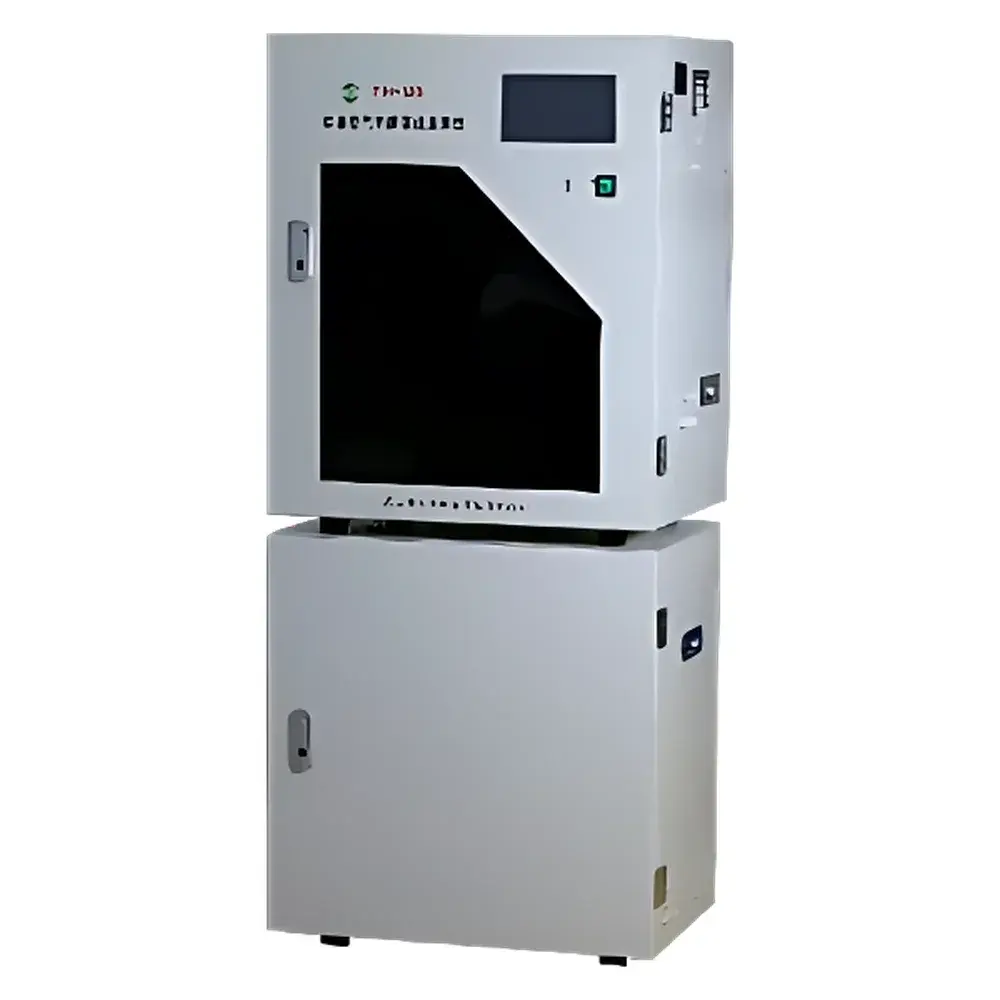
Tianhong TH-309 Formaldehyde Online Ambient Air Monitor
| Brand | Tianhong |
|---|---|
| Origin | Hubei, China |
| Model | TH-309 Formaldehyde Online Ambient Air Monitor |
| Detection Principle | Acetylacetone Colorimetric Method (UV-Vis at 413 nm) |
| Measurement Range | 0–5 mg/m³ (configurable) |
| Detection Limit | ≤0.01 mg/m³ |
| Sampling Flow Rate | 0.5–2.0 L/min |
| Operating Temperature | 0–40 °C |
| Relative Humidity | ≤90% RH (non-condensing) |
| Power Supply | AC 220 V ±10%, 50 Hz |
| Data Storage | ≥6 months (internal flash memory, power-loss resistant) |
| Compliance | GB/T 15516–1995 |
Overview
The Tianhong TH-309 Formaldehyde Online Ambient Air Monitor is a fully automated, laboratory-grade continuous emission monitoring system engineered for real-time quantification of formaldehyde (HCHO) in ambient air. It operates on the internationally validated acetylacetone colorimetric method—standardized in GB/T 15516–1995 and aligned with EPA TO-11A principles for carbonyl compound analysis. Ambient air is drawn through a heated sampling line into a permeation-controlled absorption module, where gaseous formaldehyde is quantitatively dissolved in ultrapure water. The resulting aqueous extract is mixed with acetylacetone reagent under precisely controlled pH (6.0 ± 0.1, maintained by acetate buffer) and subjected to thermal derivatization in a thermostatically regulated boiling bath (100 °C ± 0.5 °C). This reaction yields a stable yellow chromophore (3,5-diacetyl-1,4-dihydrolutidine), whose absorbance is measured photometrically at 413 nm using a high-stability, low-noise silicon photodiode detector. The instrument’s optical path is temperature-compensated and sealed against ambient light interference, ensuring long-term baseline stability and measurement reproducibility (<2% RSD over 72 h).
Key Features
- Imported high-sensitivity photodetector with integrated temperature stabilization and auto-zero referencing for drift-free absorbance measurement
- Precision syringe pump combined with a 12-port electrically actuated multi-position valve—enabling accurate, pulseless reagent delivery (±0.5% volumetric accuracy per injection)
- Three operational modes: continuous online monitoring, scheduled discrete sampling, and manual-triggered point measurement—fully configurable via embedded control logic
- Multi-level cleaning protocol: automated daily rinse cycles (using deionized water), user-initiated deep wash, and programmable position-specific flushing to prevent cross-contamination
- Integrated calibration suite: automatic zero-air generation (via catalytic scrubber), multi-point standard addition (0.1–4.0 mg/m³ formaldehyde gas standards), and periodic span verification with traceable NIST-traceable reference materials
- Onboard self-diagnostic engine: real-time monitoring of flow rate, pressure drop, reagent level, temperature deviation, optical path integrity, and valve actuation status—with configurable alarm thresholds and event logging
- Integrated Peltier-based refrigeration unit (4–8 °C) for onboard reagent storage, extending shelf life of acetylacetone solution to ≥90 days without degradation
- Low-consumption architecture: ≤1.2 mL reagent per analysis cycle; ≤8 mL total waste volume per 24-hour operation; service intervals extended to ≥3 months under typical ambient conditions
- Industrial-grade 7-inch capacitive touchscreen interface with multilingual support (English default), intuitive icon-driven navigation, and password-protected configuration access
Sample Compatibility & Compliance
The TH-309 is optimized for unattended, long-term deployment in diverse ambient environments—including urban background sites, residential neighborhoods, scenic zones, industrial perimeters, and regulatory air quality monitoring stations. Its sampling system incorporates particulate filtration (PM₂.₅ cut-off), moisture management (Nafion® dryer optional), and ozone scrubbing (MnO₂-coated cartridge) to minimize interferences from co-occurring VOCs, NO₂, SO₂, and aerosols. The methodology conforms to GB/T 15516–1995 and demonstrates method equivalence to ISO 16000-3:2023 (Indoor air — Part 3: Determination of formaldehyde — Active sampling followed by spectrophotometric analysis). All data acquisition and storage comply with GLP requirements, including electronic audit trails, user authentication, and immutable timestamping. Optional firmware upgrade supports 21 CFR Part 11-compliant electronic signatures and role-based access control.
Software & Data Management
The TH-309 runs on a Linux-based embedded OS with dual-mode communication: RS-485 Modbus RTU for integration into SCADA networks and Ethernet TCP/IP for remote web-based supervision. Local data are stored in non-volatile flash memory (≥2 GB) with cyclic overwrite protection and automatic power-fail recovery—retaining >1 million records (timestamp, HCHO concentration, QC flags, diagnostic codes). The included Tianhong AirData Manager v3.2 software enables remote configuration, real-time trend visualization, automated report generation (PDF/CSV), and compliance-ready audit logs. Historical datasets can be exported with full metadata (e.g., calibration history, maintenance events, environmental conditions) for third-party validation or regulatory submission.
Applications
- Continuous regulatory monitoring at national and provincial ambient air quality stations (AAQS)
- Source attribution studies near formaldehyde-emitting facilities (e.g., plywood mills, resin plants, disinfection units)
- Indoor-outdoor exposure assessment in schools, hospitals, and public buildings
- Long-term trend analysis for epidemiological research on respiratory health endpoints
- Verification of abatement system performance in industrial fenceline monitoring programs
- Supporting ISO 14001 environmental management system documentation and reporting
FAQ
What is the detection limit and linear dynamic range of the TH-309?
The instrument achieves a method detection limit (MDL) of ≤0.01 mg/m³ (10 ppb) with a linear response up to 5 mg/m³ (5000 ppb); extended ranges are available via dilution module.
Does the TH-309 require external zero-air or calibration gas sources?
No—it generates zero air internally via catalytic oxidation and supports liquid standard introduction; certified gas cylinders are optional for independent verification.
How frequently must consumables be replaced?
Reagents (acetylacetone + buffer) require replacement every 90 days; filters and tubing are rated for ≥6 months; no optical components require field replacement within 5 years.
Is remote firmware update supported?
Yes—secure OTA updates are delivered via HTTPS with SHA-256 signature verification and rollback capability.
Can the TH-309 be integrated into existing air quality networks such as China’s CNEMC platform?
Yes—it supports Modbus TCP, HTTP REST API, and custom XML schema mapping for seamless ingestion into national and municipal AQMS platforms.
Related Products







