
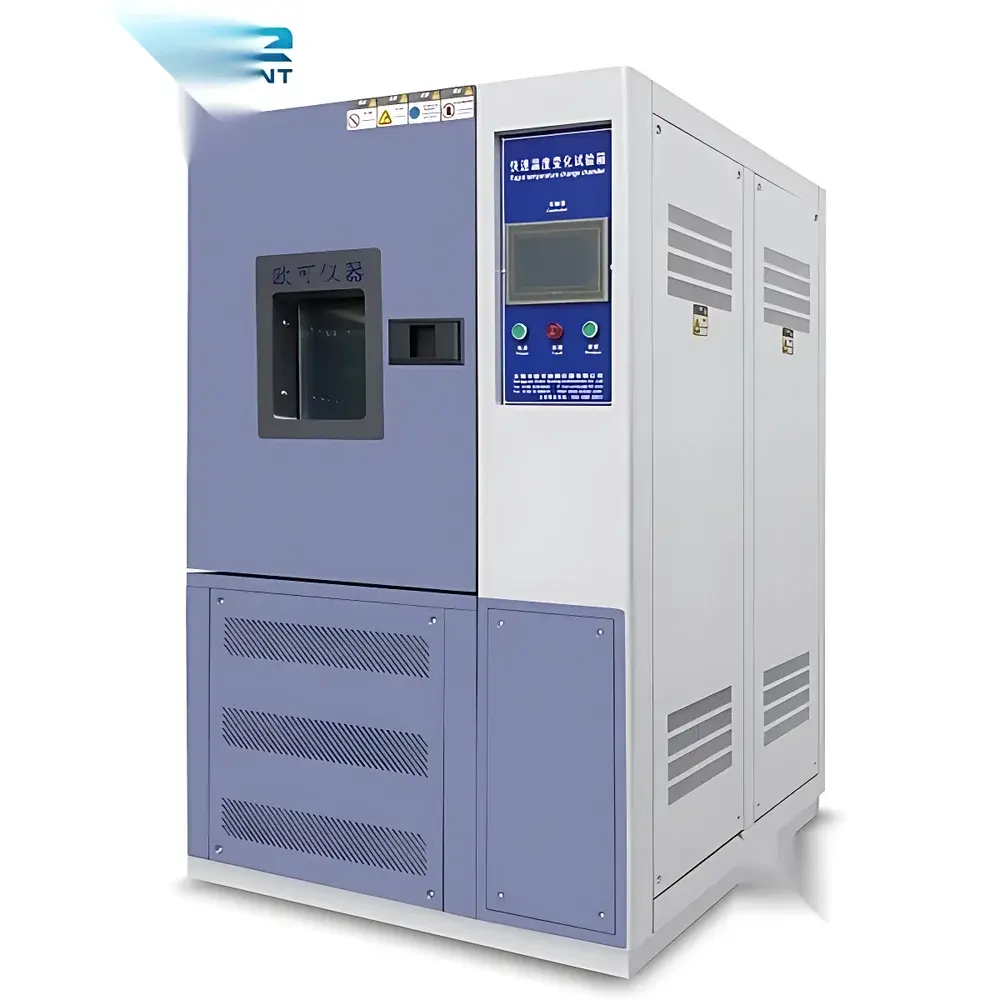
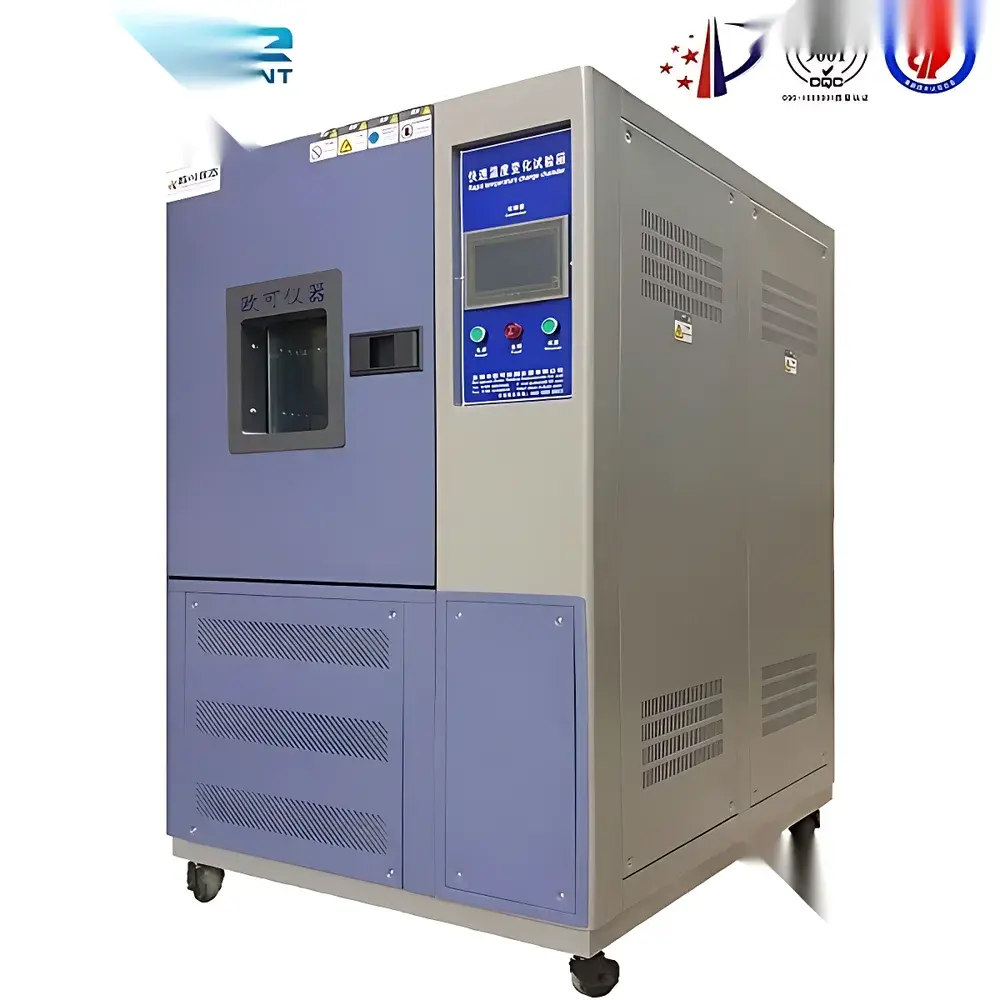
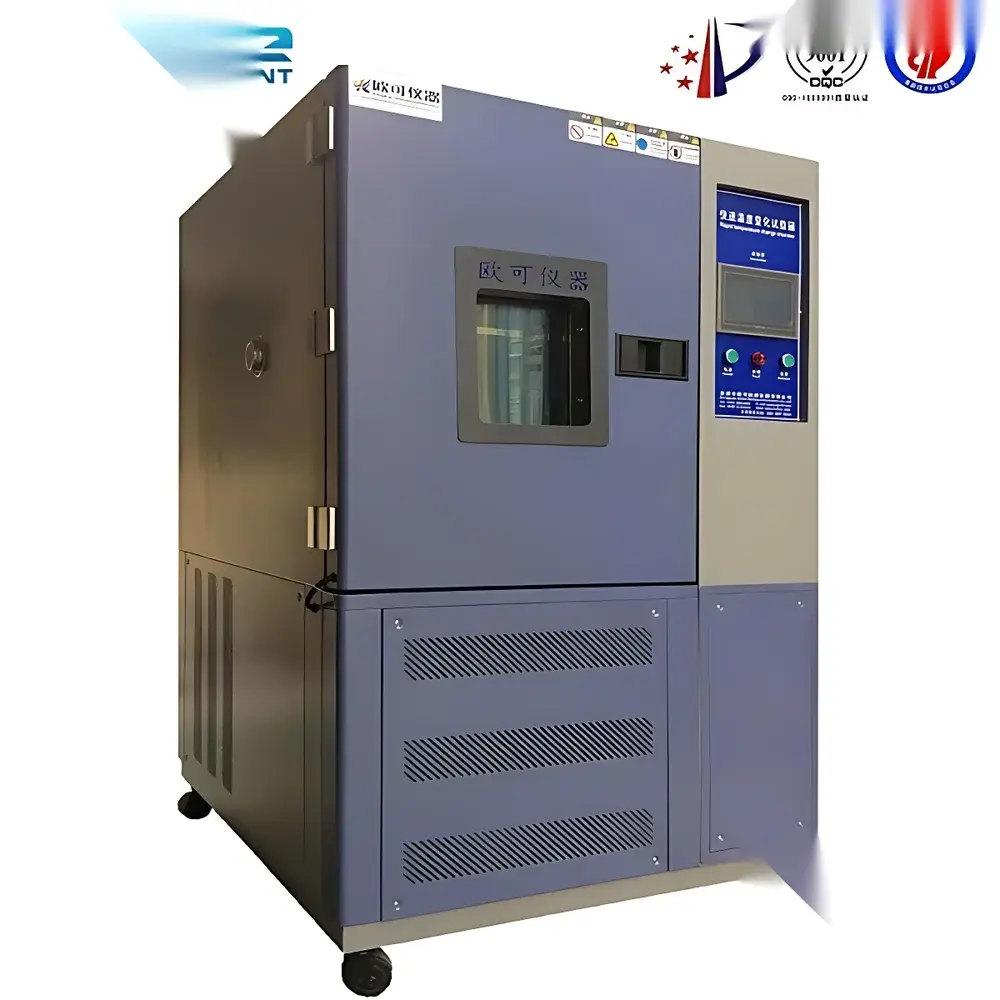
KS-TH-408 High-Speed Thermal Shock Test Chamber (Three-Zone, Air-Actuated)
| Key | Internal Chamber Dimensions: 40 × 35 × 30 cm |
|---|---|
| High-Temperature Zone Range | RT to +100 °C |
| Low-Temperature Zone Range | −40 °C to −10 °C |
| Thermal Shock Range | +100 °C / −40 °C |
| Ramp Rate (Heating) | ~15 min from RT to +100 °C |
| Ramp Rate (Cooling) | ~60 min from RT to −40 °C |
| Dwell Time per Cycle | 0.1–999.9 h |
| Cycle Count Programmable | 1–9999 |
| Recovery Time after Shock | ≤5 min |
| Max. Sample Mass | 1.5 kg |
| Construction | Exterior & Interior – SUS304 brushed stainless steel (interior mirror finish) |
| Refrigeration System | Dual-stage cascade refrigeration, water-cooled, hermetic or semi-hermetic compressors (EU/US origin) |
| Controller | Full-color LED touchscreen HMI with PID auto-tuning |
| Safety Protections | Overcurrent fuses, compressor overheat/overpressure/overcurrent protection, dry-heater alarm, chamber overtemperature alarm |
| Standard Accessories | One φ50 mm test port, two sample racks |
| Refrigerants | R404A / R23 (zero ODP, low GWP HFC blends) |
Overview
The KS-TH-408 High-Speed Thermal Shock Test Chamber is a three-zone, air-actuated thermal cycling system engineered for rigorous reliability validation of electronic components, automotive modules, aerospace assemblies, and advanced packaging materials under accelerated temperature extremes. Unlike single- or dual-chamber designs, this system physically isolates high-temperature (RT to +100 °C), low-temperature (−40 °C to −10 °C), and test zones—enabling true static-sample thermal shock testing via rapid pneumatic air-path switching. This architecture eliminates mechanical movement of test specimens, minimizing vibration-induced artifacts and ensuring repeatable stress application in accordance with IEC 60068-2-14, MIL-STD-810H Method 503.5, and JESD22-A104D. The dual-stage cascade refrigeration system—water-cooled and built with EU/US-sourced hermetic compressors—delivers stable sub-zero performance while maintaining energy efficiency and acoustic noise below 72 dB(A) at 1 m distance. All refrigerants (R404A/R23) comply with current global environmental directives, exhibiting zero ozone depletion potential (ODP) and reduced global warming potential (GWP) relative to legacy CFC/HCFC alternatives.
Key Features
- Three-zone physical separation (high-temp zone, low-temp zone, test zone) ensures zero cross-contamination and precise thermal boundary control during shock transitions.
- Air-actuated thermal transfer mechanism eliminates mechanical shuttle motion—critical for evaluating solder joint integrity, die attach reliability, and MEMS device functionality without inertial interference.
- Full-color LED touchscreen HMI with embedded PID auto-tuning delivers ±0.3 °C temperature uniformity (per IEC 60068-3-5) and real-time ramp-rate monitoring across all operational modes.
- Dual-stage cascade refrigeration achieves ≤60-minute cooling from RT to −40 °C and ≤15-minute heating from RT to +100 °C—validated per ASTM E1545 calibration protocols.
- Programmable dwell time (0.1–999.9 hours) and cycle count (1–9999) support both qualification-level stress profiling and HALT/HASS protocol execution.
- Comprehensive safety architecture includes independent overtemperature cutoffs for each zone, compressor discharge pressure monitoring, refrigerant leak detection logic, and dry-heater interlock circuits—all logged with timestamped event history.
- Structural integrity certified to IP54 ingress protection; interior surfaces finished in electropolished SUS304 stainless steel for corrosion resistance and ease of cleaning in cleanroom-adjacent environments.
Sample Compatibility & Compliance
The KS-TH-408 accommodates static samples up to 1.5 kg and 40 × 35 × 30 cm in volume, making it suitable for PCBAs, power modules, sensors, battery cells, and encapsulated optical devices. Its design conforms to key international standards governing environmental stress screening, including IEC 60068-2-14 (change of temperature), ISO 16750-4 (road vehicles—electrical loads), and AEC-Q200 stress test requirements for passive components. The controller supports audit-ready data logging compliant with FDA 21 CFR Part 11 when paired with optional secure network interface modules—enabling electronic signatures, user access tiers, and immutable operation logs required for GLP/GMP-regulated development labs. Calibration traceability is maintained through NIST-traceable Pt100 sensors (Class A tolerance) mounted at geometric center and corner locations per IEC 60068-3-5 verification procedures.
Software & Data Management
The integrated HMI firmware supports local data storage (≥16 GB internal flash) for full-cycle temperature profiles, alarm events, and system diagnostics—with export capability to CSV or PDF via USB 2.0. Optional Ethernet or RS485 interfaces enable integration into centralized lab management systems (LIMS) or MES platforms using Modbus TCP or ASCII protocol stacks. Remote monitoring is achievable via secure TLS-encrypted web interface (HTTPS), supporting role-based access control (RBAC) and real-time dashboard visualization of chamber status, active profile progress, and predictive maintenance alerts (e.g., condenser fouling index, refrigerant subcooling delta). All logged data retains ISO/IEC 17025-compliant metadata: operator ID, timestamp (UTC-synced), environmental conditions, and sensor calibration expiry dates.
Applications
- Qualification testing of automotive ECUs per ISO 16750-4 and LV-124 specifications.
- Reliability screening of semiconductor packages (QFN, BGA, CSP) prior to burn-in and final test.
- Material compatibility assessment for conformal coatings, potting compounds, and thermal interface materials (TIMs).
- Failure mode analysis of lithium-ion battery cells under rapid thermal transients.
- Validation of hermetic seal integrity in medical implant housings and MEMS pressure sensors.
- Accelerated aging studies for adhesives, elastomers, and composite laminates used in aerospace structures.
FAQ
What is the difference between air-actuated and mechanical shuttle-type thermal shock chambers?
Unlike shuttle-based systems that move samples between hot/cold zones—introducing mechanical shock and positional uncertainty—the KS-TH-408 maintains samples statically in the test zone and transfers conditioned air via high-speed dampers. This preserves test fidelity for vibration-sensitive devices and enables tighter temperature uniformity control (±0.3 °C vs. typical ±1.0 °C in shuttle systems).
Can the KS-TH-408 operate as a standalone high-temperature or low-temperature chamber?
Yes. Independent zone control allows deactivation of either thermal reservoir—enabling continuous operation as a precision high-temp oven (RT–+100 °C) or ultra-low-temp chamber (−40 °C to −10 °C) without compromising stability or calibration integrity.
Is R404A/R23 refrigerant compatible with long-term service life and regulatory compliance?
R404A (zeotropic blend) and R23 (trifluoromethane) are approved under EU F-Gas Regulation (No. 517/2014) and EPA SNAP program for new equipment until 2030. Their zero ODP and documented field reliability (>15-year compressor service life in similar cascade systems) make them technically and legally appropriate for this class of test chamber.
How is temperature uniformity verified and maintained across the test volume?
Uniformity is validated quarterly using nine calibrated Pt100 sensors (traceable to NIST SRM 1750) positioned per IEC 60068-3-5 Annex B. The controller dynamically adjusts zone airflow distribution and heater/refrigeration duty cycles based on spatial deviation feedback—ensuring sustained compliance with ±0.3 °C uniformity specification.



