
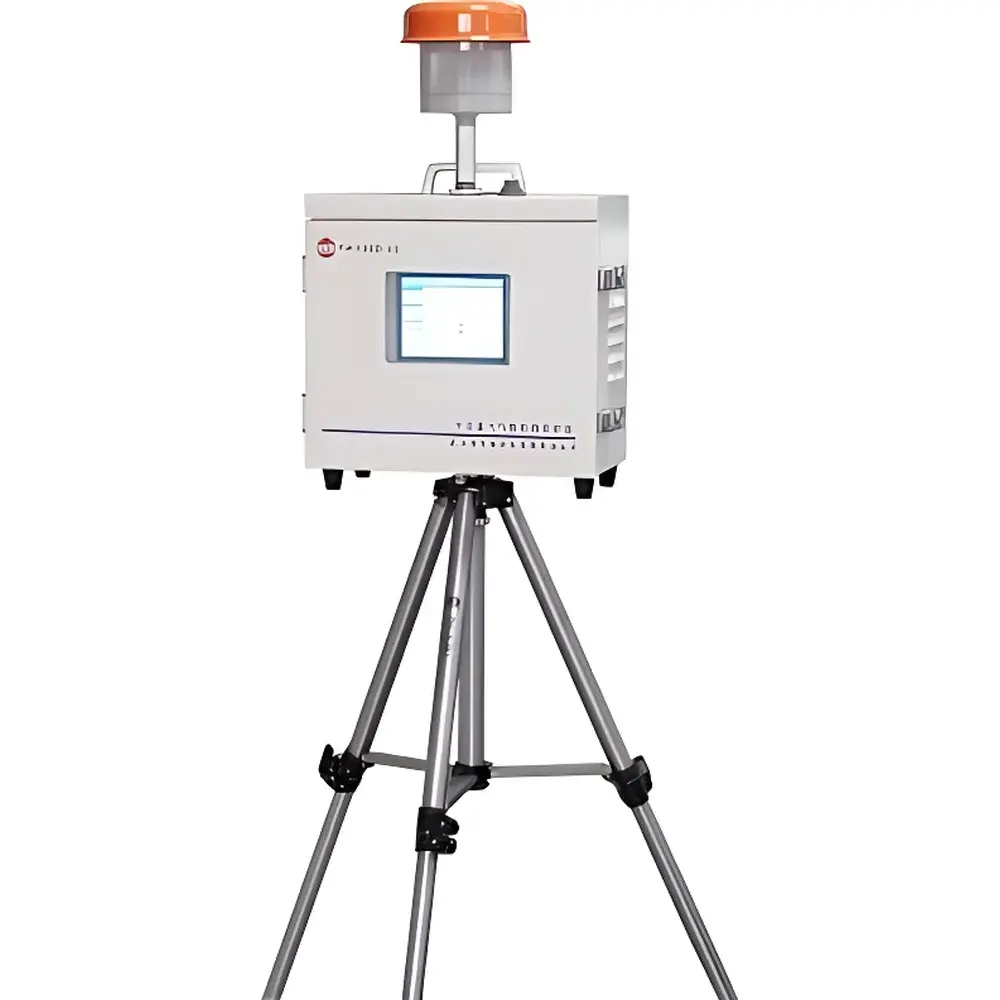
Tianhong TH-150DII Medium-Flow Ambient Particulate Matter Sampler
| Brand | Tianhong |
|---|---|
| Origin | Hubei, China |
| Model | TH-150DII |
| Sampling Flow Range | 60–130 L/min (extendable to 180 L/min) |
| Flow Accuracy | ±2.5% of reading |
| Flow Control Resolution | 0.1 L/min |
| Flow Stability | <0.5% over time |
| Pump Service Life | >10,000 hours |
| Minimum Sustained Flow at 20 kPa Backpressure | >100 L/min |
| Data Retention | Non-volatile memory with power-loss recovery |
| Environmental Compliance | HJ 664-2013, HJ 194-2017, HJ/T 374-2007, HJ/T 375-2007, Q/WTH 04-2017 |
Overview
The Tianhong TH-150DII Medium-Flow Ambient Particulate Matter Sampler is a field-deployable, microprocessor-controlled instrument engineered for high-reliability, unattended collection of total suspended particulates (TSP), PM10, and PM2.5 in ambient air monitoring networks. It operates on the principle of isokinetic or constant-rate volumetric sampling—drawing ambient air through standardized size-selective inlets (e.g., TSP, PM10, or PM2.5 cyclones or impactors) and depositing particulate mass onto pre-weighed filters for subsequent gravimetric analysis per ISO 7708, EN 12341, and US EPA Method IO-1A. Designed to meet Chinese national environmental monitoring standards—including HJ 194-2017 (Manual Monitoring Technical Specifications for Ambient Air Quality) and HJ/T 375-2007 (Technical Requirements for Ambient Air Samplers)—the TH-150DII supports both regulatory compliance and research-grade data acquisition across fixed-site, mobile, and temporary monitoring deployments.
Key Features
- High-capacity, imported high-efficiency vortex pump delivering sustained flow rates up to 180 L/min under 20 kPa backpressure, enabling stable operation even with loaded filters or restrictive inlet configurations
- Microcontroller-based closed-loop flow control system with automatic real-time adjustment; flow setpoint resolution of 0.1 L/min and long-term stability better than ±0.5% of set value
- Integrated environmental sensor suite measuring and logging ambient temperature, barometric pressure, system load (vacuum), and actual volumetric flow—enabling automatic calculation and storage of both ambient and standard-condition (273.15 K, 101.325 kPa) cumulative sampled volumes
- Robust non-volatile memory architecture preserving all operational parameters, timestamps, and sensor readings during power interruption; seamless resumption of scheduled sampling upon power restoration
- Flexible scheduling logic supporting weekly repeating cycles with up to five user-defined daily sampling intervals, plus configurable “interval sampling” (on/off cycling) and “make-up sampling” (optional post-interruption duration compensation)
- IP54-rated enclosure with rain-resistant housing and corrosion-resistant internal components, certified for continuous 24/7 outdoor deployment without shelter
- Optional accessories include stainless-steel or anodized aluminum TSP/PM10/PM2.5 size-selective inlets, thermal printer module for on-site data verification, and RS-232/USB communication interfaces for remote configuration and data export
Sample Compatibility & Compliance
The TH-150DII is compatible with standard 8×10 inch (20.3 × 25.4 cm) glass fiber or quartz fiber filters used in gravimetric analysis per ISO 12103-1 (A2 test dust reference) and US EPA Method 201A. Its flow control architecture ensures adherence to HJ/T 374-2007 requirements for TSP sampler performance, including dynamic response to variable filter loading and resistance. The instrument’s calibration traceability aligns with national metrological verification procedures outlined in JJG 943-2011 (Verification Regulation for Ambient Air Samplers). All firmware and data handling protocols support audit-ready recordkeeping suitable for GLP-compliant laboratories and third-party QA/QC audits.
Software & Data Management
Data are stored internally in timestamped binary records with CRC-16 error checking. The embedded file system supports export via USB flash drive in CSV format, retaining full metadata: date/time, ambient T/P, flow rate history, cumulative volumes (ambient and STP), alarm events (e.g., low-flow, high-load), and battery status. Optional PC software provides visualization tools for flow trend analysis, calendar-based schedule validation, and automated report generation aligned with HJ 664-2013 station documentation templates. No proprietary drivers or cloud dependency is required; raw data files are human-readable and interoperable with common statistical and GIS platforms.
Applications
- Regulatory ambient air quality monitoring networks (urban, rural, roadside, background stations)
- Source apportionment studies requiring co-located TSP, PM10, and PM2.5 filter sets
- Long-term trend analysis per national air quality assessment frameworks
- Validation of low-cost sensor networks through collocated reference-grade sampling
- Field campaigns for epidemiological exposure assessment and atmospheric chemistry modeling
- Environmental impact assessments (EIA) and industrial compliance verification under GB 3095-2012 (Ambient Air Quality Standards)
FAQ
What particle fractions can the TH-150DII collect?
It supports TSP, PM10, and PM2.5 sampling when paired with certified size-selective inlets meeting HJ/T 374-2007 dimensional and aerodynamic performance criteria.
Does the instrument comply with international standards such as ISO or EN?
While designed primarily for Chinese regulatory alignment (HJ series), its flow accuracy, stability, and data integrity characteristics meet functional equivalency with ISO 12103-1 and EN 12341 for manual reference samplers.
Can the TH-150DII operate continuously for extended periods without maintenance?
Yes—the pump’s rated service life exceeds 10,000 hours, and the system includes self-diagnostic alerts for flow deviation or excessive vacuum, enabling predictive maintenance planning.
Is calibration traceable to national standards?
Calibration is performed using primary-standard dry gas meters traceable to the China National Institute of Metrology (NIM), with certificate documentation provided per JJG 943-2011.
How is data integrity ensured during power failure?
All critical parameters—including time, flow setpoint, accumulated volume, and sensor readings—are written to non-volatile memory before shutdown; no data loss occurs, and sampling resumes from the exact point of interruption.
Related Products







