
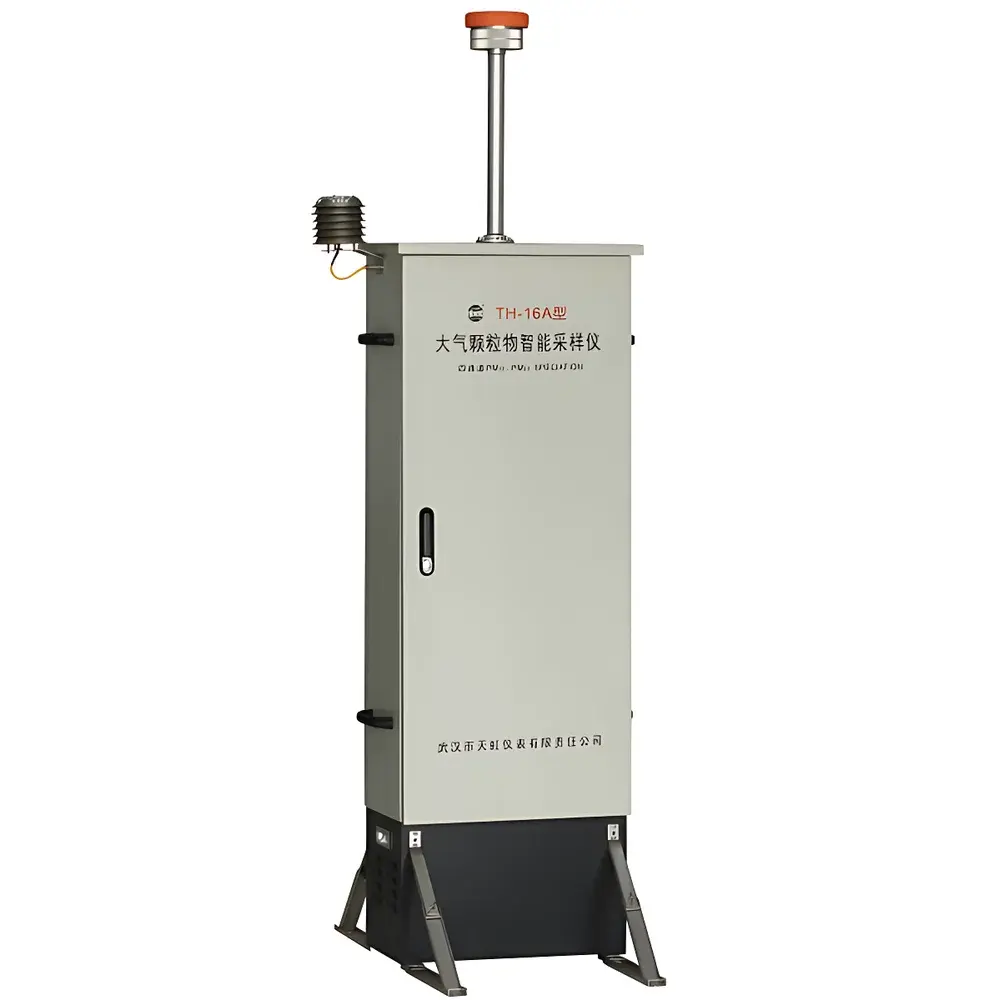
Tianhong TH-16A Intelligent Atmospheric Particulate Sampler
| Brand | Tianhong |
|---|---|
| Origin | Hubei, China |
| Model | TH-16A |
| Instrument Type | 24-Hour Constant-Temperature Constant-Flow Gas Sampler |
| Configuration | Multi-Channel (4-Channel) Particulate Sampler |
| Flow Range | 0–20 L/min (Nominal Operating Flow: 16.7 L/min ± 0.25 L/min) |
| Flow Stability | ±5% |
| Flowmeter Accuracy | ±2.5% |
| Maximum Vacuum Pressure | 26 kPa |
| Pump Service Life at Max Flow & Backpressure | ≥5000 h |
| Continuous Operation Duration at Max Flow & Backpressure | 2–8 h |
| Power Rating | 0.22 kW |
| Operating Voltage | AC 220 V ±10%, 50 Hz |
| Ambient Pressure Range | 70–110 kPa (±0.1 kPa) |
| Compliance | HJ/T 374–2007, HJ 618–2011, Q/WTH18–2012 |
Overview
The Tianhong TH-16A Intelligent Atmospheric Particulate Sampler is a four-channel, constant-temperature and constant-flow ambient air sampling system engineered for high-fidelity gravimetric and chemical speciation analysis of airborne particulate matter. It operates on the principle of isokinetic inertial separation, integrating standardized cyclonic and impactor-based particle size cutpoints to simultaneously collect co-located samples across multiple aerodynamic diameter fractions—including Total Suspended Particulates (TSP), PM10, PM5, PM2.5, and PM1. Designed for regulatory-grade environmental monitoring, the TH-16A satisfies the technical requirements specified in HJ/T 374–2007 (Specifications and Test Methods for Total Suspended Particulates Samplers) and HJ 618–2011 (Determination of PM10 and PM2.5 in Ambient Air by Gravimetric Method). Its multi-path architecture enables synchronized sampling without cross-channel flow interference, ensuring metrological traceability and inter-channel comparability essential for source apportionment, receptor modeling, and long-term trend analysis.
Key Features
- Four independent, digitally regulated sampling channels—each maintaining constant flow at 16.7 L/min ± 0.25 L/min via closed-loop feedback control, with flow stability ≤ ±5% under variable filter loading and ambient backpressure conditions.
- Modular, semi-automatic filter cassette exchange mechanism with positive-seal gasketing, minimizing operator exposure and preventing sample loss or contamination during media changeover.
- Integrated environmental sensor suite recording real-time atmospheric pressure (70–110 kPa, ±0.1 kPa), temperature, relative humidity, wind speed, and wind direction—synchronized with particulate mass data acquisition.
- High-efficiency imported diaphragm pump delivering 26 kPa maximum vacuum pressure; equipped with exhaust filtration to eliminate secondary emissions and built-in power-loss recovery for uninterrupted 24-hour unattended operation.
- Embedded industrial computer running a deterministic real-time OS, supporting audit-trail-capable logging of all operational parameters, calibration events, and fault diagnostics.
- Front-panel touchscreen interface with full Chinese localization; data export via SD card (FAT32 formatted) in CSV and binary formats compatible with EPA Compendium Method IO-3.2 and ISO/IEC 17025-compliant QA/QC workflows.
Sample Compatibility & Compliance
The TH-16A accommodates standard 47-mm and 90-mm quartz fiber, Teflon®, and cellulose ester filters per EPA TO-13A, EN 12341, and ISO 7708 protocols. Each channel supports interchangeable PM-selective inlets—such as WINS impactors for PM2.5 or VSCC cyclones for PM10—enabling method-specific configuration per HJ 618–2011 and US EPA Reference Method PS-1. All firmware and data handling routines adhere to GLP principles, with time-stamped, non-erasable event logs meeting minimum requirements for FDA 21 CFR Part 11–aligned systems validation. The instrument’s mechanical design conforms to IP54 ingress protection and IEC 61000-4 electromagnetic immunity standards.
Software & Data Management
Data acquisition and system control are managed through an embedded Linux-based application with dual-mode operation: autonomous scheduled sampling and manual trigger mode. Raw sensor outputs (flow, pressure, temperature, pump status) are logged at 1-second intervals and aggregated into 1-, 5-, and 60-minute summary records. Calibration coefficients—including flowmeter K-factors and pressure transducer offsets—are stored in write-protected EEPROM with versioned firmware signing. Exported datasets include metadata headers compliant with FAIR (Findable, Accessible, Interoperable, Reusable) principles and support direct ingestion into common environmental data platforms such as AQS, AirNow, and R-based air quality analysis pipelines (e.g., openair, rAQ).
Applications
- Long-term ambient air quality monitoring networks requiring concurrent PM mass and speciated chemical analysis (e.g., water-soluble ions, elemental carbon, organic carbon, metals).
- Source characterization studies where co-located, size-resolved sampling improves resolution of combustion vs. crustal vs. secondary aerosol contributions.
- Method validation and inter-laboratory comparison exercises under CNAS or ILAC-MRA frameworks.
- Field deployment in mobile laboratories or fixed-site stations operating under ISO 50001 energy management or ISO 14001 environmental management systems.
- Support for health-related epidemiological cohort studies requiring precise temporal alignment between exposure metrics and clinical endpoints.
FAQ
Does the TH-16A support remote monitoring or network connectivity?
No Ethernet or cellular telemetry module is integrated by default; however, the SD card output and RS-232 serial interface allow integration with third-party SCADA or edge-computing gateways.
Can the instrument be calibrated in-house using NIST-traceable standards?
Yes—the built-in electronic flow controller accepts manual calibration input via certified primary standards (e.g., bubble meters, critical orifices); calibration history is retained with user ID and timestamp.
Is the TH-16A suitable for indoor or occupational sampling applications?
It is designed exclusively for ambient outdoor monitoring per HJ/T 374–2007; it does not meet OSHA or NIOSH criteria for personal or workplace sampling due to its fixed-flow architecture and lack of battery operation.
What maintenance intervals are recommended for sustained accuracy?
Pump diaphragms and inlet seals should be inspected every 500 operating hours; flow sensors require annual verification against reference calibrators; full system performance validation is advised biannually per Q/WTH18–2012 Clause 7.3.
Are firmware updates provided post-purchase, and how are they deployed?
Tianhong releases validated firmware patches annually; updates are delivered as signed .bin files via secure FTP and installed via SD card—no internet connection required on the device.
Related Products







