
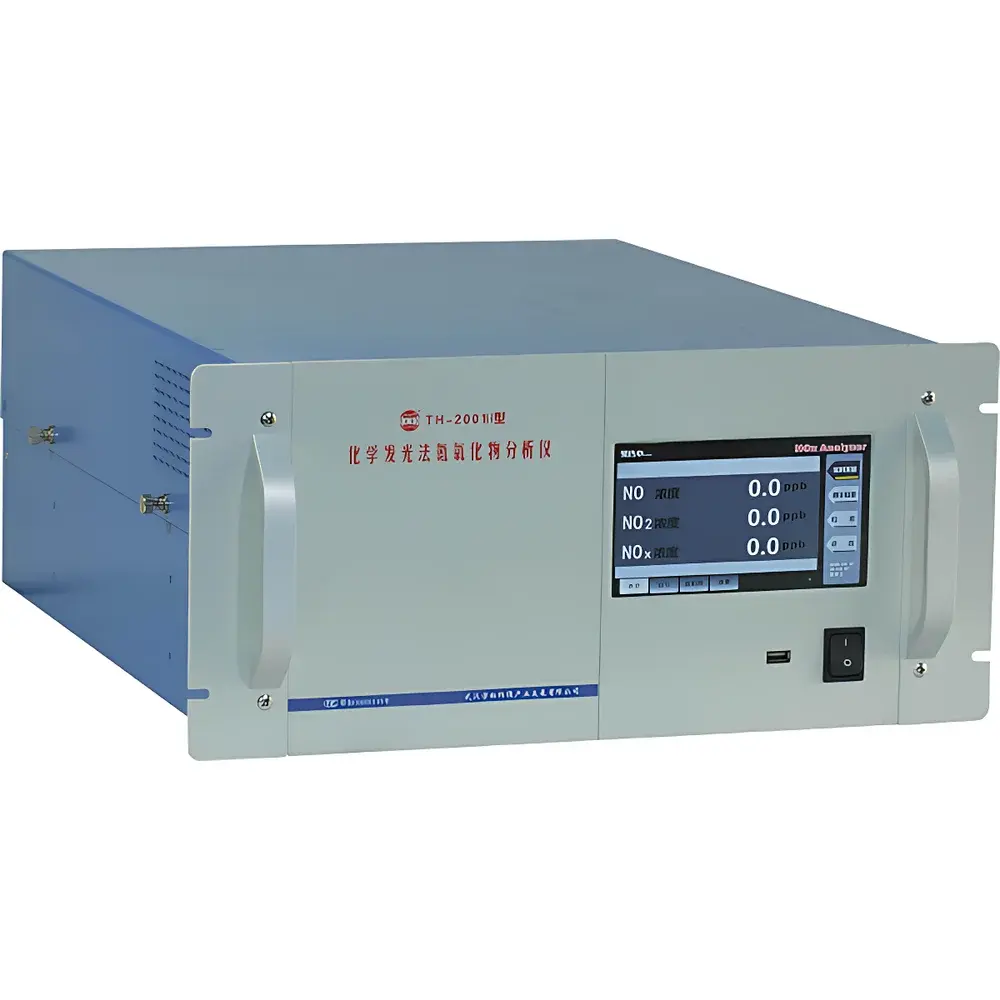
Tianhong TH-2001H Chemiluminescence Nitrogen Oxides (NOₓ) Analyzer
| Brand | Tianhong |
|---|---|
| Model | TH-2001H |
| Detection Principle | Chemiluminescence (CLD) |
| Measurands | NO, NO₂, NOₓ (total) |
| Display | 7-inch full-touch color LCD |
| Concentration Units | ppb, ppm, µg/m³, mg/m³ |
| Data Logging | 1-year storage at 5-minute intervals |
| Sampling System | Dual-path, time-division single-channel |
| Auto-ranging | Yes |
| Temperature & Pressure Compensation | Integrated |
| Remote Diagnostics & Calibration Support | Yes |
| Alarm Functions | Multi-parameter configurable |
Overview
The Tianhong TH-2001H Chemiluminescence Nitrogen Oxides (NOₓ) Analyzer is a laboratory- and field-deployable trace gas analyzer engineered for continuous, high-sensitivity quantification of nitric oxide (NO), nitrogen dioxide (NO₂), and total reactive nitrogen oxides (NOₓ) in ambient air, stack emissions, and indoor environmental monitoring applications. It operates on the well-established chemiluminescence detection (CLD) principle: NO in the sampled gas stream reacts stoichiometrically with ozone (O₃) in a reaction chamber to form electronically excited nitrogen dioxide (NO₂*), which relaxes to its ground state by emitting photons centered at ~600–3000 nm. This emitted light intensity is directly proportional to the NO concentration and is detected by a low-noise photomultiplier tube (PMT). To quantify NO₂, a parallel gas stream passes through a heated molybdenum (Mo) or stainless-steel catalytic converter (typically operated at 325–400 °C), where NO₂ is quantitatively reduced to NO prior to CLD detection. The difference between total NOₓ and NO yields the NO₂ concentration. This dual-path, time-division sampling architecture ensures high specificity, minimal cross-interference, and compliance with reference methods defined in EPA Method 7E, ISO 7935:1990, and EN 14792:2017.
Key Features
- 7-inch full-color capacitive touchscreen interface with intuitive Chinese-language menu navigation — optimized for operator efficiency in regulatory and industrial QA/QC environments.
- Real-time unit switching among ppb, ppm, µg/m³, and mg/m³ — automatically recalculated using user-configurable molecular weight (30.01 g/mol for NO; 46.01 g/mol for NO₂) and standard temperature/pressure (STP) conditions.
- Integrated temperature and barometric pressure compensation — applies real-time corrections per ISO 10780 and ASTM D6522 to ensure volumetric concentration accuracy across variable site conditions.
- Adaptive signal optimization algorithm — dynamically adjusts PMT gain, integration time, and background subtraction to maximize signal-to-noise ratio (SNR) and minimize response time without manual intervention.
- Dual-path, time-division sampling system — eliminates mechanical valves and associated dead volume; improves long-term stability and reduces maintenance frequency compared to traditional dual-chamber designs.
- Remote diagnostics and calibration capability — supports secure SSH or TLS-based access for firmware updates, parameter verification, zero/span validation, and fault log retrieval — aligned with IEC 62443-3-3 cybersecurity guidelines for industrial instrumentation.
- Configurable multi-level alarm system — triggers visual/audio alerts and optional relay outputs based on concentration thresholds, flow deviation, converter temperature drift, or PMT voltage anomalies.
Sample Compatibility & Compliance
The TH-2001H is validated for use with ambient air, flue gas (with optional particulate and moisture conditioning), and clean-room ventilation streams. Sample inlet accepts 6–8 mm OD PTFE or stainless-steel tubing; recommended sample flow rate: 0.8–1.2 L/min. Internal ozone generator uses UV photolysis of dry oxygen (O₂) with 95% at 350 °C) for NO₂-to-NO reduction. Instrument design conforms to electromagnetic compatibility (EMC) requirements per EN 61326-1 and safety standards per EN 61010-1. Data integrity features — including audit-trail-enabled event logging, immutable timestamping, and password-protected configuration — support GLP/GMP-aligned operations and readiness for FDA 21 CFR Part 11-compliant environments when deployed with validated networked data management systems.
Software & Data Management
Onboard firmware stores up to one year of 5-minute averaged data (≥105,000 records) with full metadata: date/time stamp, NO/NO₂/NOₓ concentrations, O₃ generator status, converter temperature, sample flow rate, ambient T/P, and diagnostic flags. Data export is supported via USB mass storage (CSV format) or RS-232/RS-485 serial protocols. Optional Ethernet/Wi-Fi module enables integration into SCADA, EMS, or cloud-based environmental dashboards using Modbus TCP or HTTP RESTful API. All stored records include cryptographic checksums to prevent tampering. Firmware supports remote over-the-air (OTA) updates with version rollback capability and signed package verification.
Applications
- Ambient air quality monitoring networks (AQN) — meeting national standards for NO₂ reporting (e.g., China’s HJ 654-2013, EU Directive 2008/50/EC).
- Continuous emissions monitoring systems (CEMS) for coal-fired power plants, cement kilns, and waste incinerators — interfacing with certified data acquisition and handling systems (DAHS).
- Mobile laboratory platforms and roadside monitoring stations — leveraging low-power operation (<120 W) and vibration-resistant construction.
- Research laboratories conducting atmospheric chemistry studies, catalyst evaluation, or vehicle exhaust characterization — benefiting from sub-ppb detection limits and linear dynamic range spanning 0–5000 ppb.
- Indoor air quality (IAQ) assessment in tunnels, parking garages, and industrial facilities — with optional integrated zero-air scrubber for baseline stability.
FAQ
What is the minimum detectable concentration (MDL) for NO under typical operating conditions?
The instrument achieves an MDL of ≤0.3 ppb (3σ, 60-second averaging) when configured with standard optical path length and optimized ozone generation.
Does the TH-2001H require external calibration gases for routine operation?
Yes — periodic zero/span verification using certified NO-in-N₂ and NO₂-in-N₂ standards is required per QA/QC protocols (e.g., EPA 40 CFR Part 60, Appendix F). Onboard zero-air generation eliminates need for bottled zero gas.
Can the analyzer operate unattended for extended periods?
Yes — designed for 7×24 operation with automatic self-diagnostics, thermal stabilization, and battery-backed real-time clock. Recommended preventive maintenance interval: every 6 months.
Is the catalytic converter replaceable in the field?
Yes — the Mo-based converter cartridge is user-replaceable without tools; typical service life exceeds 12 months under continuous operation at 350 °C.
How is data security ensured during remote access?
All remote sessions enforce TLS 1.2+ encryption, role-based authentication (admin/operator/guest), and session timeout. Configuration changes generate immutable audit entries with user ID and timestamp.
Related Products







