
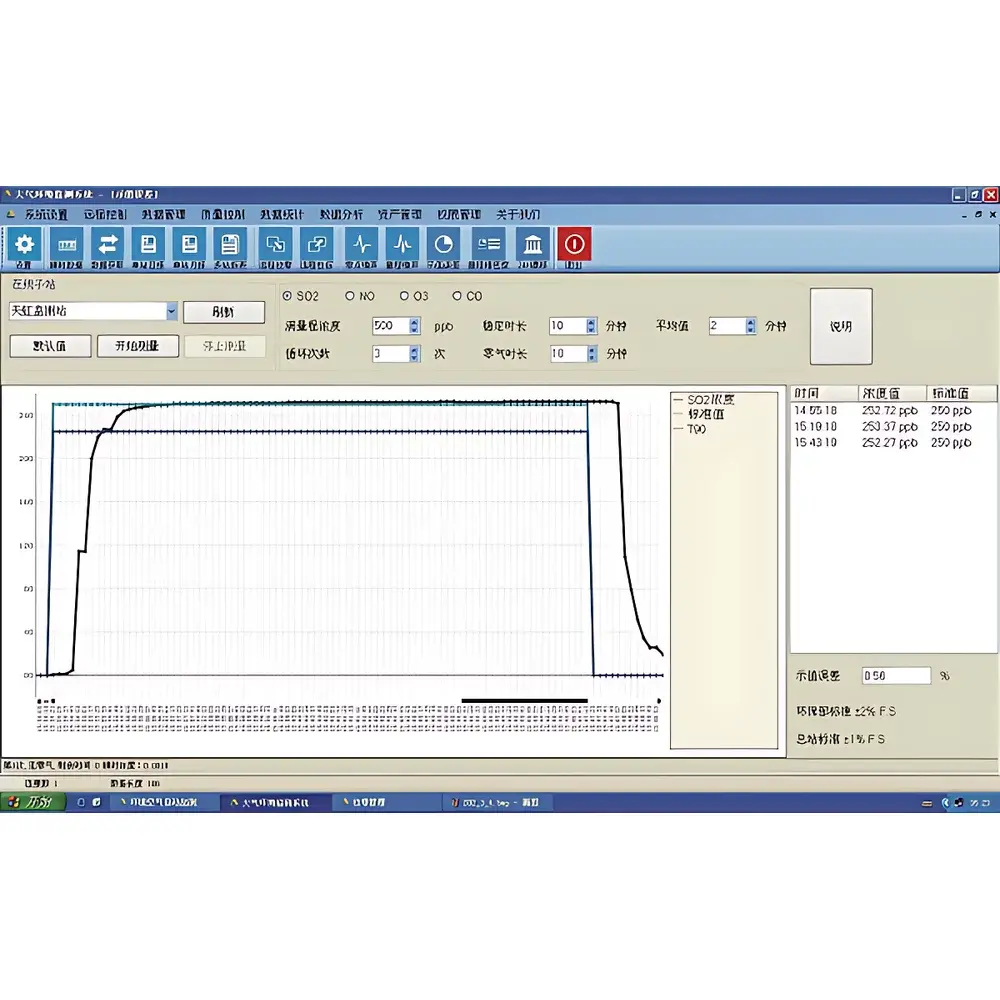
Tianhong TH-2000(R) Automatic Ambient Air Quality Monitoring System
| Brand | Tianhong |
|---|---|
| Origin | Hubei, China |
| Model | TH-2000(R) |
| Measured Pollutants | PM₁, PM₂.₅, PM₁₀, TSP, SO₂, NO₂, NO, NOₓ, O₃, CO, H₂S, NH₃ |
| Communication Options | Wired (Ethernet), GPRS, 3G |
| Data Output Formats | TXT, CSV, Excel (.xlsx), DBF |
| Regulatory Compliance Support | GB 3095–2012, HJ 653–2013, HJ 654–2013, ISO 9001, ISO/IEC 17025 (for accredited lab integration) |
| Software Architecture | Multi-tier client-server with centralized database (PostgreSQL/SQL Server), role-based access control, audit trail logging per GLP/GMP-aligned data integrity practices |
Overview
The Tianhong TH-2000(R) Automatic Ambient Air Quality Monitoring System is a modular, networked environmental monitoring platform engineered for continuous, real-time measurement and centralized management of gaseous and particulate pollutants in ambient air. Built upon a distributed architecture comprising one central station and multiple remote sub-stations, the system employs standardized analytical modules—including beta attenuation (PM₁/PM₂.₅/PM₁₀/TSP), electrochemical sensors (SO₂, NO₂, CO, H₂S, NH₃), UV photometry (O₃), and chemiluminescence (NO/NOₓ)—to deliver traceable, metrologically sound data compliant with Chinese national standards (GB 3095–2012, HJ 653–2013, HJ 654–2013) and internationally recognized quality assurance frameworks. Its design prioritizes long-term operational stability, interoperability with third-party analyzers, and full data lineage—from raw second-level sensor outputs to validated hourly/daily aggregates—enabling regulatory reporting, trend analysis, and public health exposure assessment.
Key Features
- Distributed topology supporting up to 128 sub-stations per central server, scalable via redundant communication gateways
- Multi-protocol data acquisition engine compatible with Modbus RTU/TCP, RS-232/485, and analog 4–20 mA inputs for heterogeneous instrument integration
- Automated QA/QC routines including remote zero/span calibration, 24-hour drift verification, noise assessment, and precision validation per HJ 654–2013 methodology
- Real-time status monitoring with dynamic graphical visualization of time-series pollutant concentrations, instrument health metrics, and communication latency
- Configurable data retention policy: raw minute-level data stored locally at sub-stations for ≥30 days; synchronized hourly/daily aggregates retained centrally for ≥5 years
- Role-based user interface with hierarchical permissions (administrator, operator, reviewer, auditor) aligned with ISO/IEC 17025 documentation requirements
- Embedded audit trail functionality recording all data modifications, calibration events, and user actions with timestamp, IP address, and operator ID
Sample Compatibility & Compliance
The TH-2000(R) system is designed for unattended, continuous operation in outdoor urban, industrial, and background monitoring environments. Sub-station enclosures meet IP55 ingress protection rating and operate reliably across –20 °C to +50 °C ambient conditions. All gas analyzers are factory-calibrated against NIST-traceable reference standards and undergo periodic verification using certified calibration gases (ISO 6141, ISO 6145). Particulate monitors comply with EN 12341 and ISO 20983 for gravimetric equivalence. The system supports compliance workflows required under China’s “Environmental Monitoring Management Measures” and facilitates alignment with international frameworks including EU Directive 2008/50/EC and US EPA 40 CFR Part 58—particularly when integrated with meteorological sensors (wind speed/direction, temperature, humidity, pressure) and supplementary modules such as heavy metal speciation or VOC monitoring.
Software & Data Management
The TH-2000(R) software suite operates on a Microsoft Windows Server–based central platform with PostgreSQL or Microsoft SQL Server backend. It implements structured data handling per IEC 62443 cybersecurity guidelines and includes built-in mechanisms for electronic signature, data integrity validation (CRC32 checksums), and automated backup to NAS or cloud storage (AWS S3-compatible). Reporting modules generate standardized outputs including hourly/daily concentration summaries, API/AQI indices per GB 3095–2012 Annex A, statistical summaries (year-on-year, month-on-month, data capture rate, validity ratio), and customizable dashboards exportable in Excel (.xlsx), CSV, TXT, and legacy DBF formats. All reports include embedded metadata (instrument ID, calibration date, QA/QC flag status) to satisfy GLP/GMP audit readiness requirements.
Applications
- Municipal and provincial environmental protection bureaus conducting routine ambient air quality assessment and public reporting
- Industrial park environmental monitoring centers performing compliance verification against emission limits and fence-line monitoring
- Research institutions studying spatiotemporal pollutant dispersion, source apportionment, and health impact modeling
- Urban planning agencies integrating air quality data with GIS platforms for exposure mapping and policy evaluation
- Emergency response units deploying mobile sub-stations during pollution episodes or hazardous material incidents
FAQ
Does the TH-2000(R) support FDA 21 CFR Part 11 compliance?
Yes—when deployed with optional electronic signature modules and configured audit trail settings, the system meets core Part 11 requirements for record retention, authenticity, and tamper-evident logging.
Can third-party analyzers from Thermo Fisher, Horiba, or Teledyne be integrated into the TH-2000(R) network?
Yes—the system’s open communication protocol layer supports Modbus, OPC UA, and ASCII serial interfaces, enabling seamless integration with major OEM analyzers without proprietary lock-in.
What is the minimum data resolution supported for historical retrieval?
Raw data can be retrieved at 1-minute intervals from sub-station memory; aggregated values (hourly averages, max/min, standard deviations) are computed and archived centrally.
Is remote firmware update capability available?
Yes—secure over-the-air (OTA) updates are supported via authenticated HTTPS channels with version rollback and integrity verification.
How does the system handle data gaps caused by communication interruption?
Sub-stations autonomously store raw data during outages and perform automatic resynchronization upon reconnection, preserving temporal continuity and eliminating manual intervention.







